Delta Ratio is the acid-base step that looks beyond the obvious diagnosis. It asks whether the bicarbonate fall is proportional to the anion gap rise, or whether a second metabolic process is hidden underneath.
This article follows Metabolic Acidosis Explained, Anion Gap Explained and Winter's Formula Explained.
Learning Objectives
- Define Delta Ratio and Delta Gap
- Explain why the anion gap rise should match the bicarbonate fall
- Calculate Delta Ratio correctly
- Interpret low, normal and high Delta Ratio values
- Recognise mixed metabolic disorders
- Avoid common examination pitfalls
What Is Delta Ratio?
Delta Ratio is a tool used to detect mixed metabolic disorders in patients with high anion gap metabolic acidosis. It compares the rise in anion gap with the fall in bicarbonate.
Delta Ratio evaluates whether the increase in anion gap matches the decrease in bicarbonate.
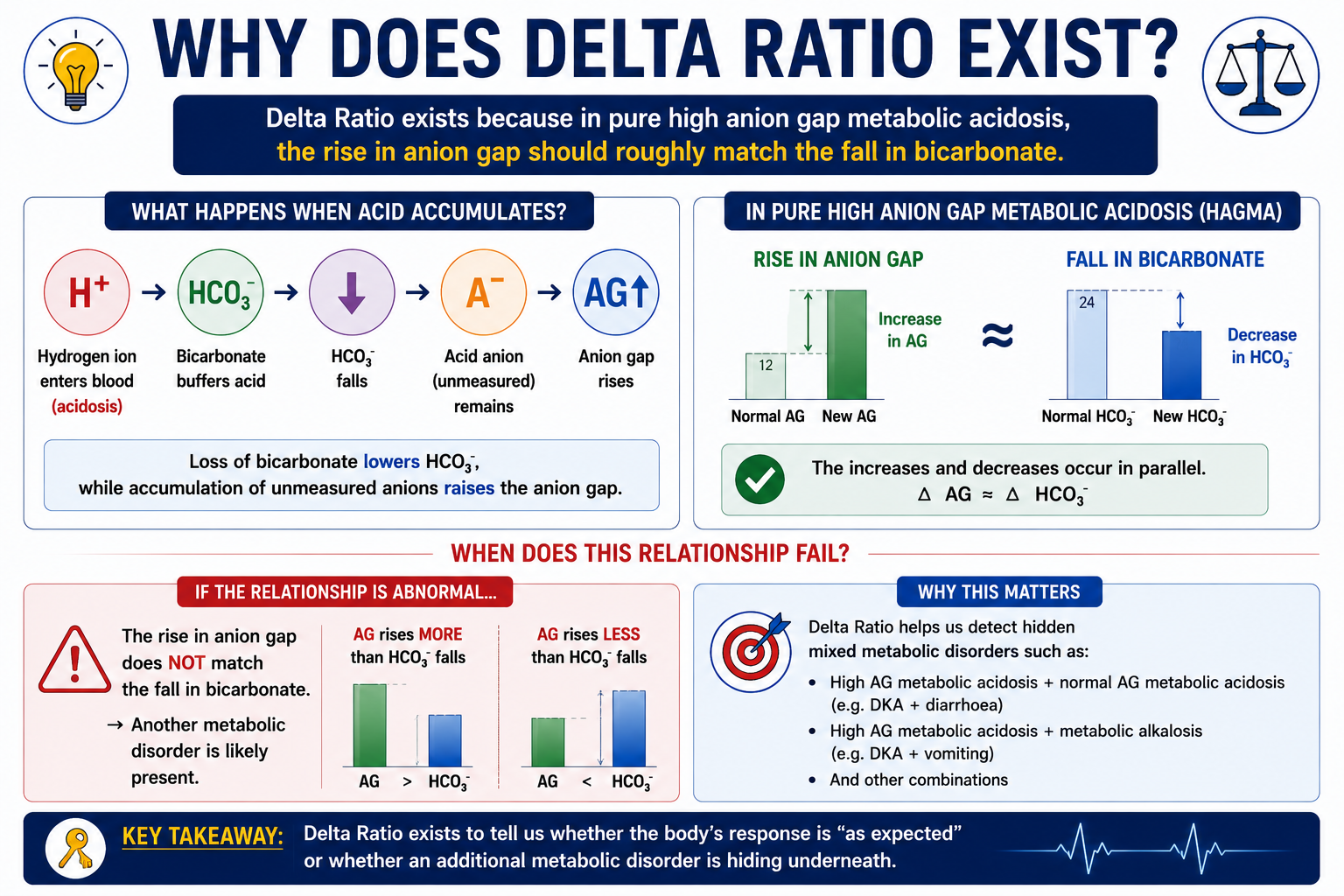
In pure high anion gap metabolic acidosis, the anion gap rises because unmeasured acid anions accumulate. At the same time, bicarbonate falls because it buffers the hydrogen ions from those acids.
If the relationship is abnormal, a second metabolic disorder may be present.

Why Does Delta Ratio Exist?
Understanding the concept is more important than memorising the formula. When an acid accumulates in blood, the hydrogen ion is buffered by bicarbonate. The remaining acid anion stays in the blood and raises the anion gap.
In Pure HAGMA
In pure high anion gap metabolic acidosis, the increase in anion gap should roughly match the decrease in bicarbonate. For example, if the anion gap rises by 12, bicarbonate should fall by about 12.
If the anion gap rise and bicarbonate fall do not match, look for another metabolic disorder.
The Delta Ratio Formula
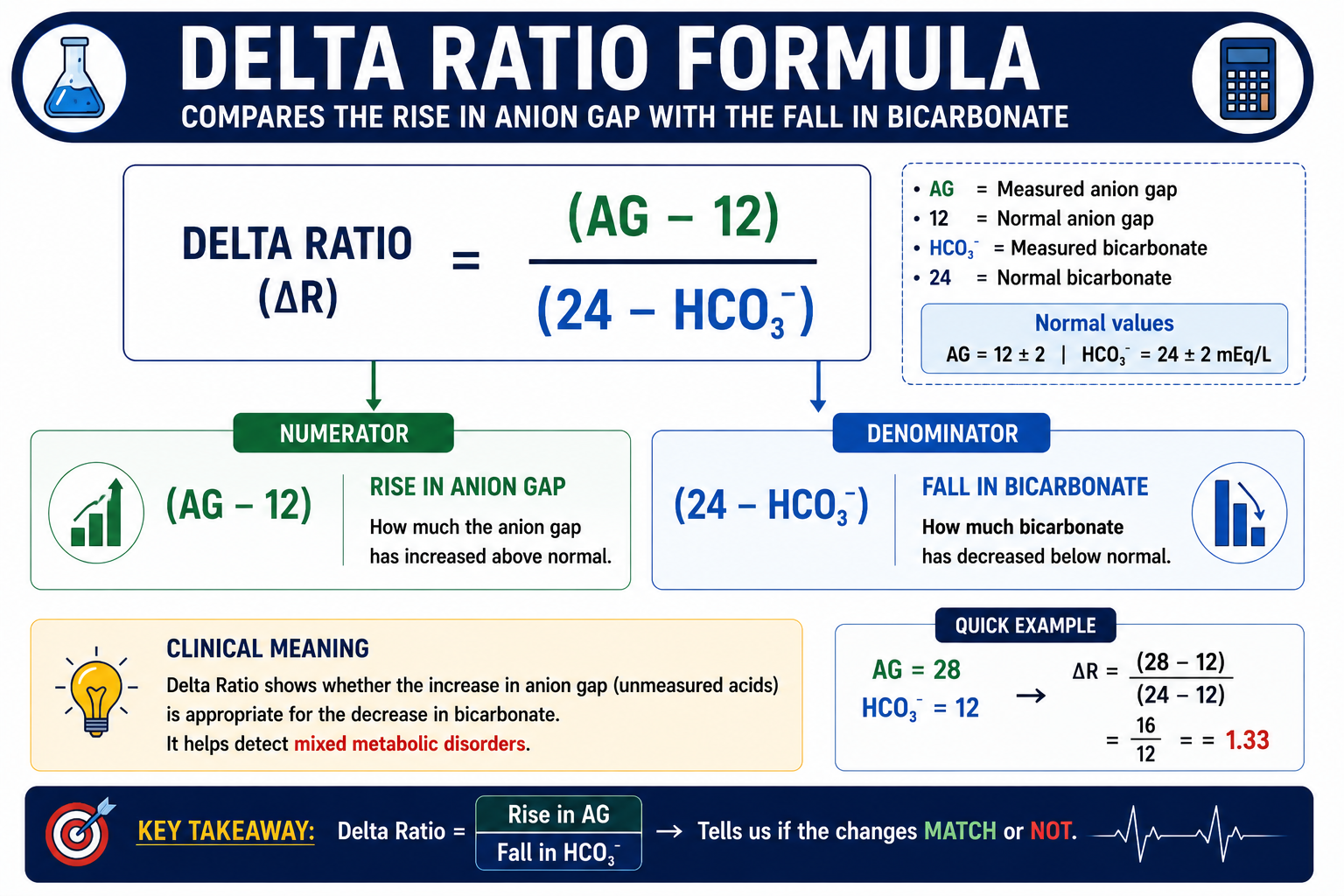
The commonly used Delta Ratio formula is:
Formula Breakdown
| Component | Meaning |
|---|---|
| AG | Measured anion gap, preferably corrected for albumin when albumin is low |
| 12 | Commonly used normal anion gap reference value |
| HCO3- | Measured bicarbonate concentration |
| 24 | Commonly used normal bicarbonate reference value |
Delta Ratio should only be used when the anion gap is elevated. If the anion gap is normal, Delta Ratio is not useful and may lead to incorrect interpretation.
Always correct the anion gap for albumin before calculating Delta Ratio. Low albumin can hide a high anion gap metabolic acidosis and produce misleading Delta Ratio values.
The numerator represents the rise in anion gap. The denominator represents the fall in bicarbonate.
When Should Delta Ratio Be Used?
Delta Ratio is not a general acid-base formula. It is mainly used after high anion gap metabolic acidosis has been identified. Its purpose is to determine whether another metabolic disorder is also present.
| Situation | Use Delta Ratio? | Reason |
|---|---|---|
| High anion gap metabolic acidosis | Yes | This is the main setting where Delta Ratio helps detect mixed metabolic disorders. |
| Normal anion gap metabolic acidosis | No | The anion gap has not risen, so there is no meaningful Delta AG to compare with bicarbonate fall. |
| Metabolic alkalosis | No | Delta Ratio is not designed for primary metabolic alkalosis. |
| Respiratory acidosis | No | Respiratory disorders require respiratory compensation rules, not Delta Ratio. |
| Respiratory alkalosis | No | Delta Ratio does not assess primary PaCO2 disorders. |
First confirm metabolic acidosis. Then calculate and correct the anion gap. If the corrected anion gap is elevated, Delta Ratio may be useful.
Understanding the Delta Gap Concept
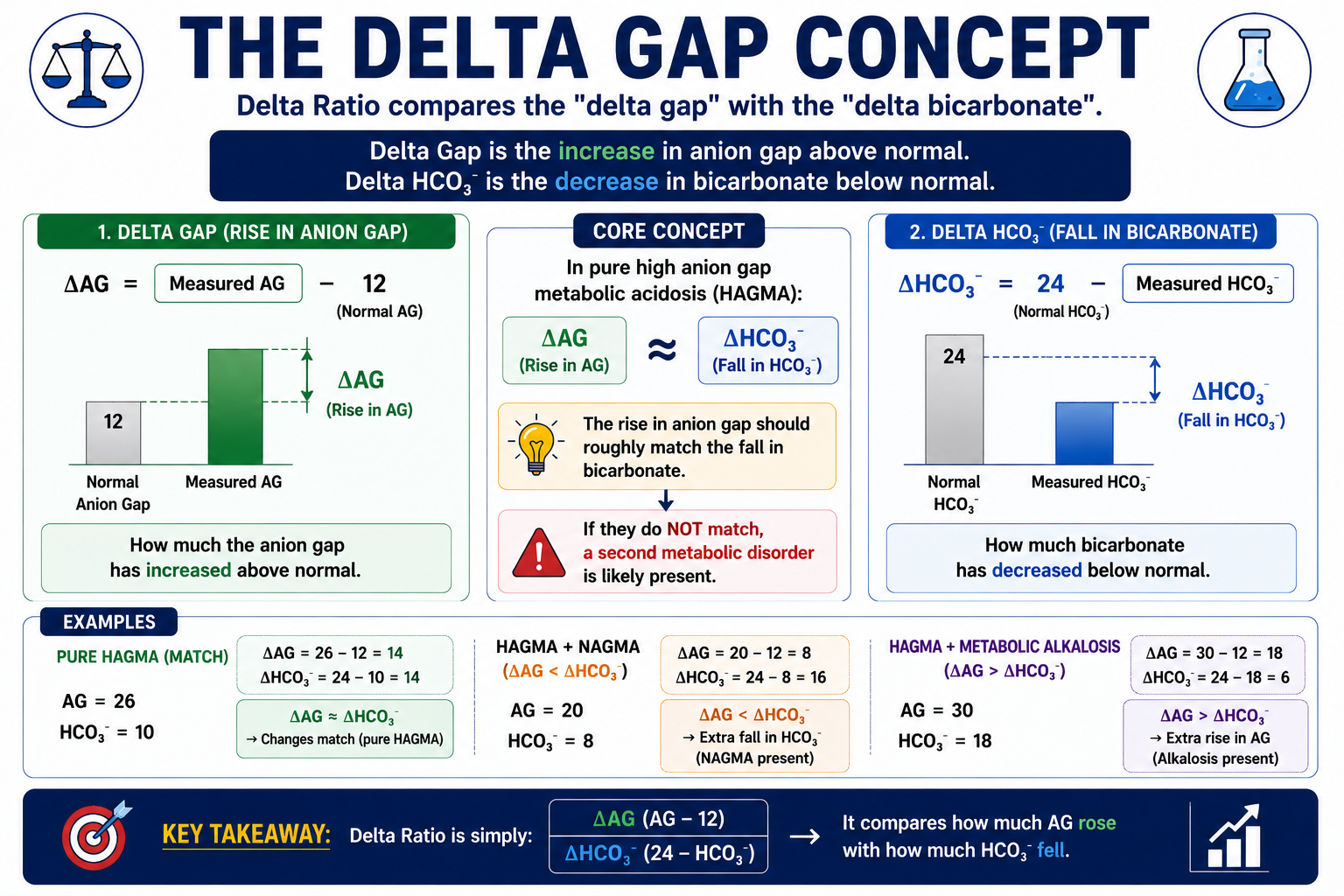
Before calculating Delta Ratio, students should understand Delta Gap. Delta Gap simply means measured anion gap minus normal anion gap.
For example, if measured AG is 28 and normal AG is 12, the Delta Gap is 16. Similarly, if measured bicarbonate is 8 and normal bicarbonate is 24, the bicarbonate fall is 16.
How To Calculate Delta Ratio
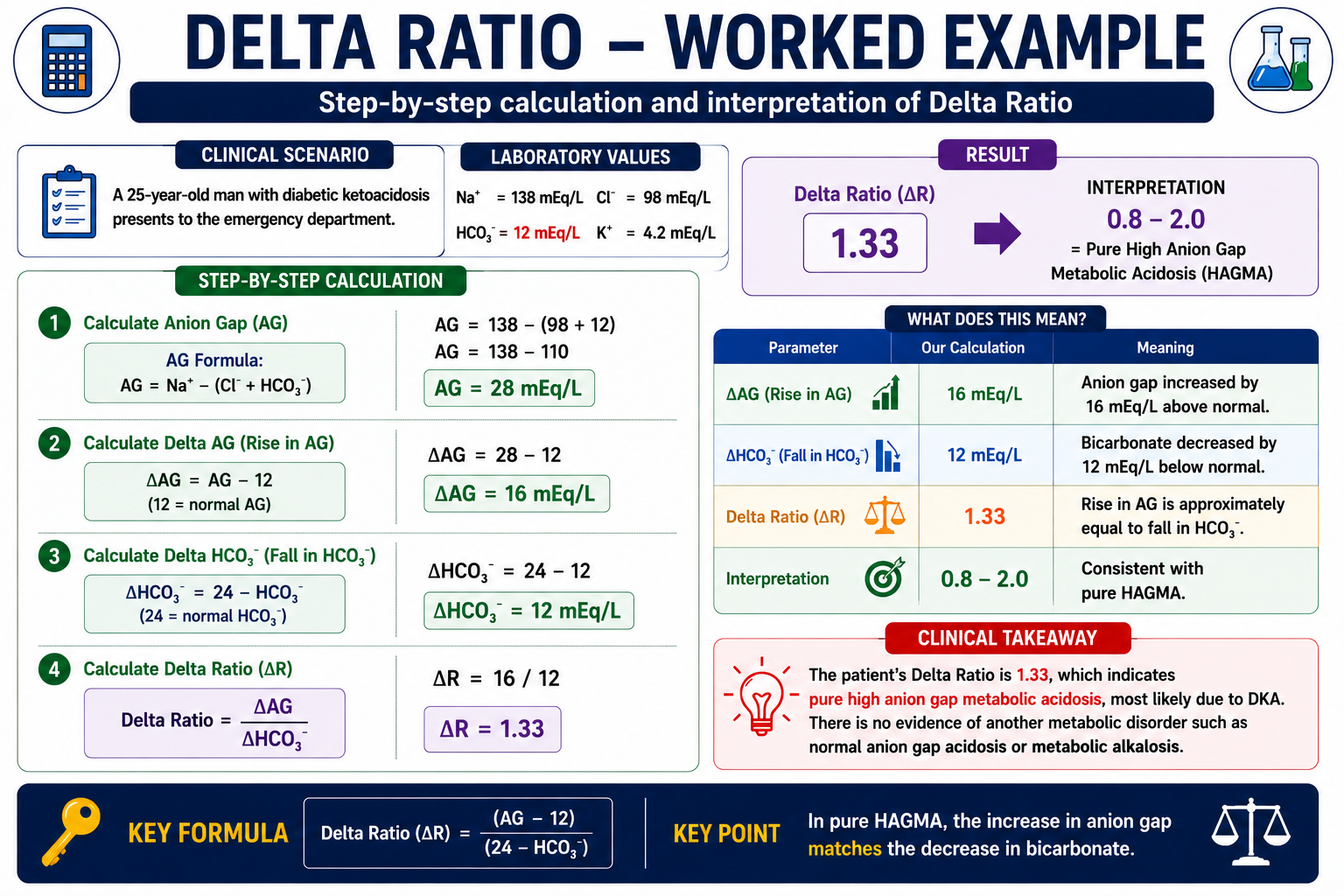
- Calculate the anion gap. Use Na+ - (Cl- + HCO3-).
- Correct the anion gap for albumin if albumin is low.
- Calculate AG - 12. This is the anion gap rise.
- Calculate 24 - HCO3-. This is the bicarbonate fall.
- Divide. Delta Ratio = Delta AG / Delta HCO3-.
Worked Calculation
| Variable | Value |
|---|---|
| AG | 24 |
| HCO3- | 12 |
| Numerator | 24 - 12 = 12 |
| Denominator | 24 - 12 = 12 |
| Delta Ratio | 12 / 12 = 1.0 |
| Interpretation | Pure high anion gap metabolic acidosis |
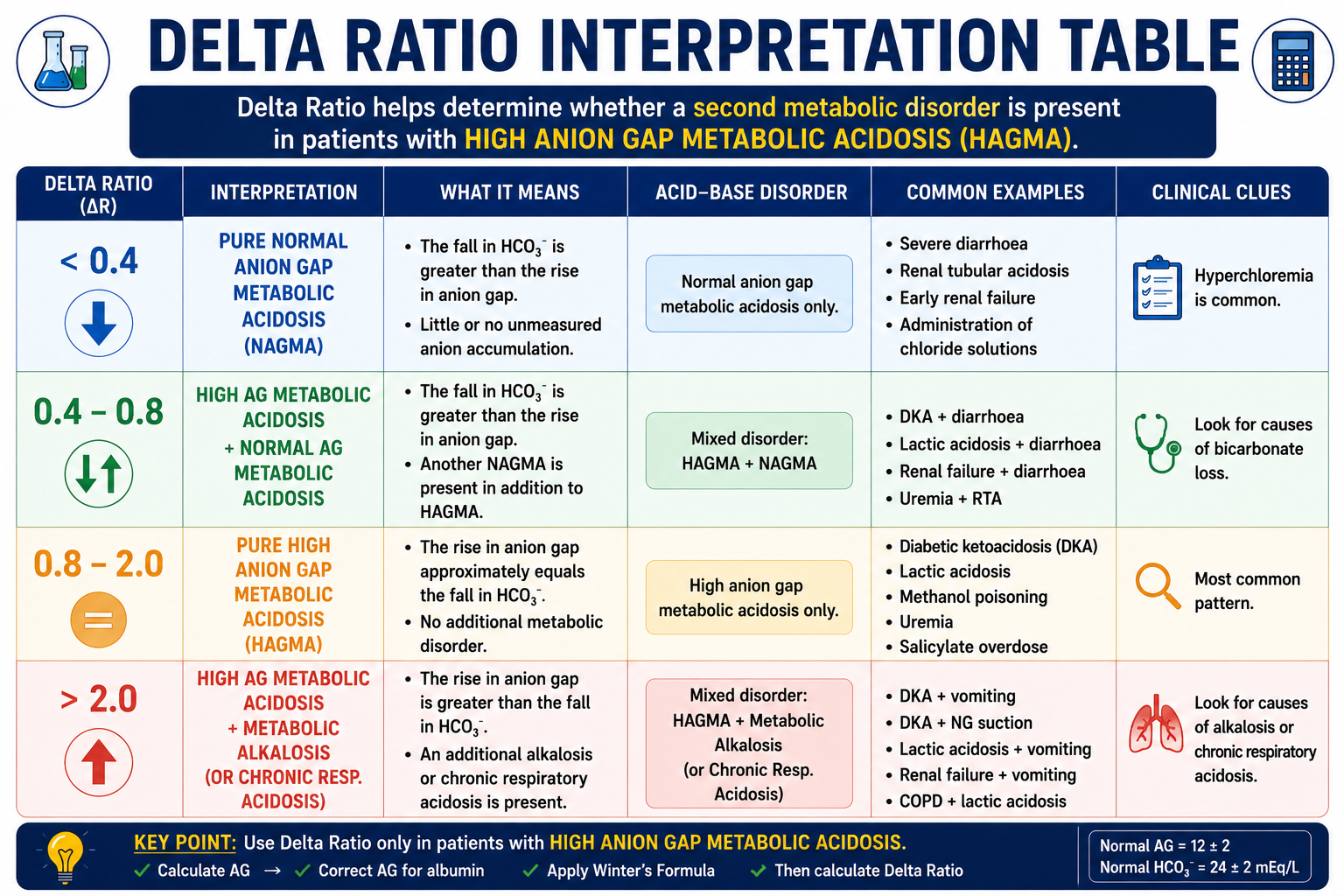
Delta Ratio Interpretation
This is the most important section. Delta Ratio is useful because different ranges suggest different acid-base patterns.
| Delta Ratio | Interpretation | Examples |
|---|---|---|
| < 0.4 | Pure normal anion gap metabolic acidosis | Severe diarrhoea, renal tubular acidosis |
| 0.4-0.8 | High AG metabolic acidosis + normal AG metabolic acidosis | DKA + diarrhoea, renal failure + diarrhoea |
| 0.8-2.0 | Pure high AG metabolic acidosis | DKA, lactic acidosis, methanol poisoning |
| > 2 | High AG metabolic acidosis + metabolic alkalosis | DKA + vomiting, DKA + nasogastric suction |
A Delta Ratio above 2 may also be seen when high anion gap metabolic acidosis occurs in a patient with chronic respiratory acidosis and renal bicarbonate retention.
Worked Clinical Examples
Example 1: Pure DKA
AG = 24 and HCO3- = 12. Delta Ratio = (24 - 12) / (24 - 12) = 12 / 12 = 1.0.
Pure high anion gap metabolic acidosis.
Example 2: DKA + Diarrhoea
AG = 20 and HCO3- = 8. Delta Ratio = (20 - 12) / (24 - 8) = 8 / 16 = 0.5.
High anion gap metabolic acidosis with additional normal anion gap metabolic acidosis.
Example 3: DKA + Vomiting
AG = 30 and HCO3- = 18. Delta Ratio = (30 - 12) / (24 - 18) = 18 / 6 = 3.
High anion gap metabolic acidosis with additional metabolic alkalosis.
Mixed Metabolic Disorders
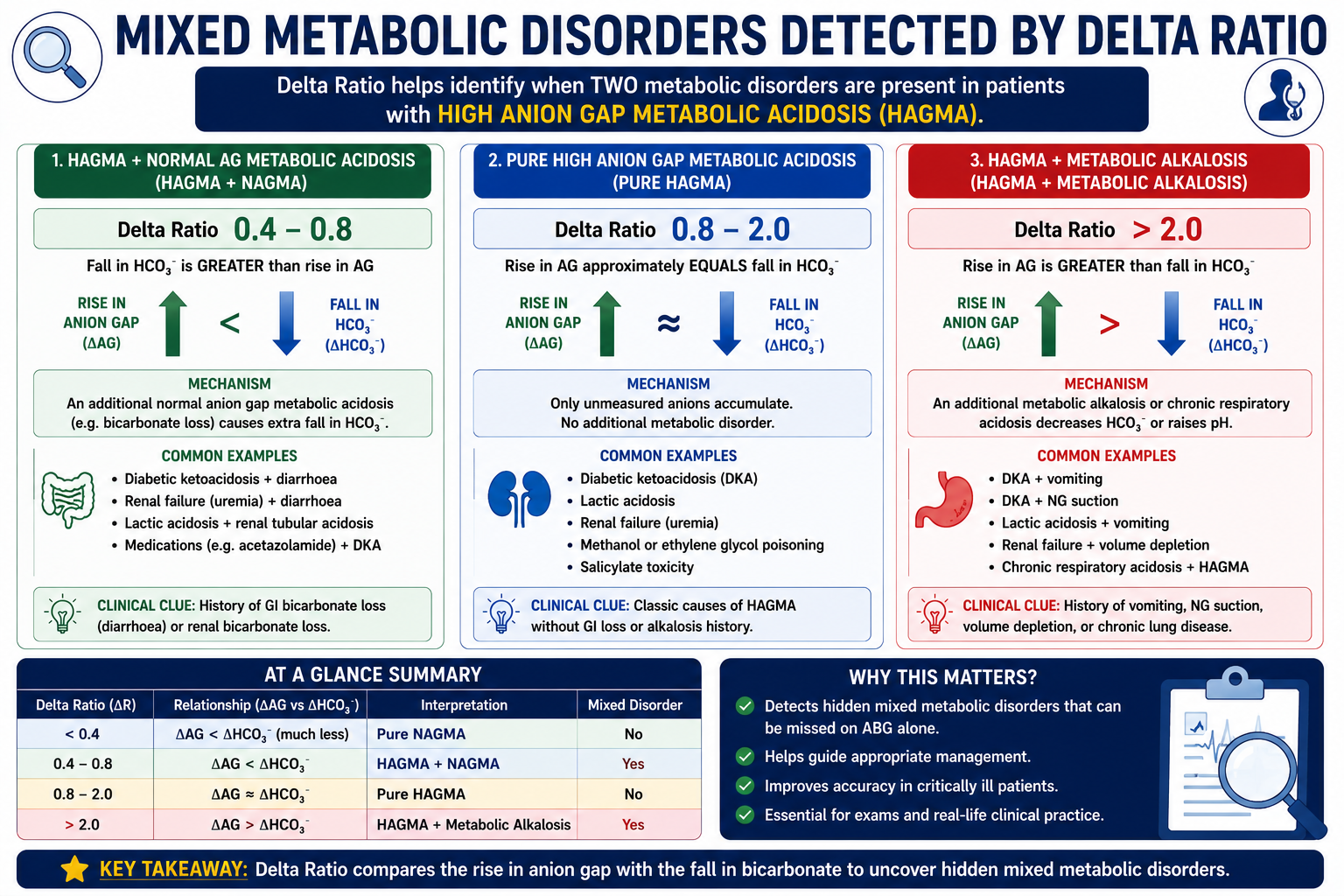
Delta Ratio becomes most valuable when two metabolic disorders coexist. These combinations are common in real patients because illness rarely follows textbook boundaries.
Real patients often have more than one acid-base disorder. A patient with diabetic ketoacidosis may also have diarrhoea, vomiting, renal failure or respiratory disease. Delta Ratio helps uncover these hidden processes.
| Clinical pattern | Acid-base combination | Expected Delta Ratio pattern |
|---|---|---|
| DKA + diarrhoea | HAGMA + NAGMA | Low, often 0.4-0.8 |
| DKA + vomiting | HAGMA + metabolic alkalosis | High, often > 2 |
| Renal failure + diarrhoea | HAGMA + NAGMA | Low |
| Lactic acidosis + vomiting | HAGMA + metabolic alkalosis | High |
Common Pitfalls
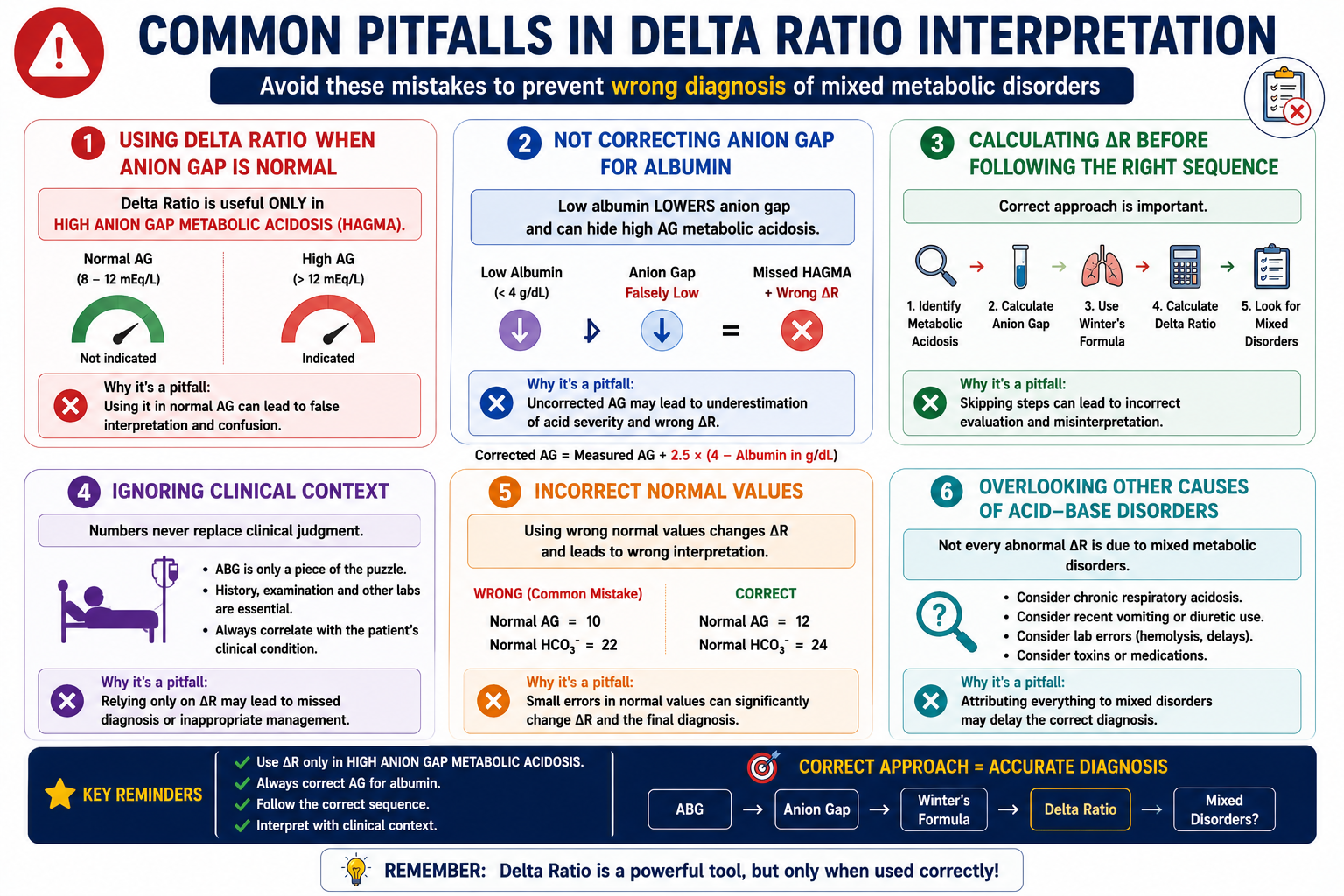
- Using Delta Ratio when the anion gap is normal: Delta Ratio is mainly useful when the anion gap is elevated.
- Ignoring albumin: low albumin lowers the observed anion gap. Correct the AG first when albumin is low.
- Using Delta Ratio before calculating AG: the correct order is metabolic acidosis, anion gap, Winter's Formula, then Delta Ratio.
- Ignoring clinical context: numbers guide interpretation, but they do not replace clinical judgement.
Interpretation Algorithm
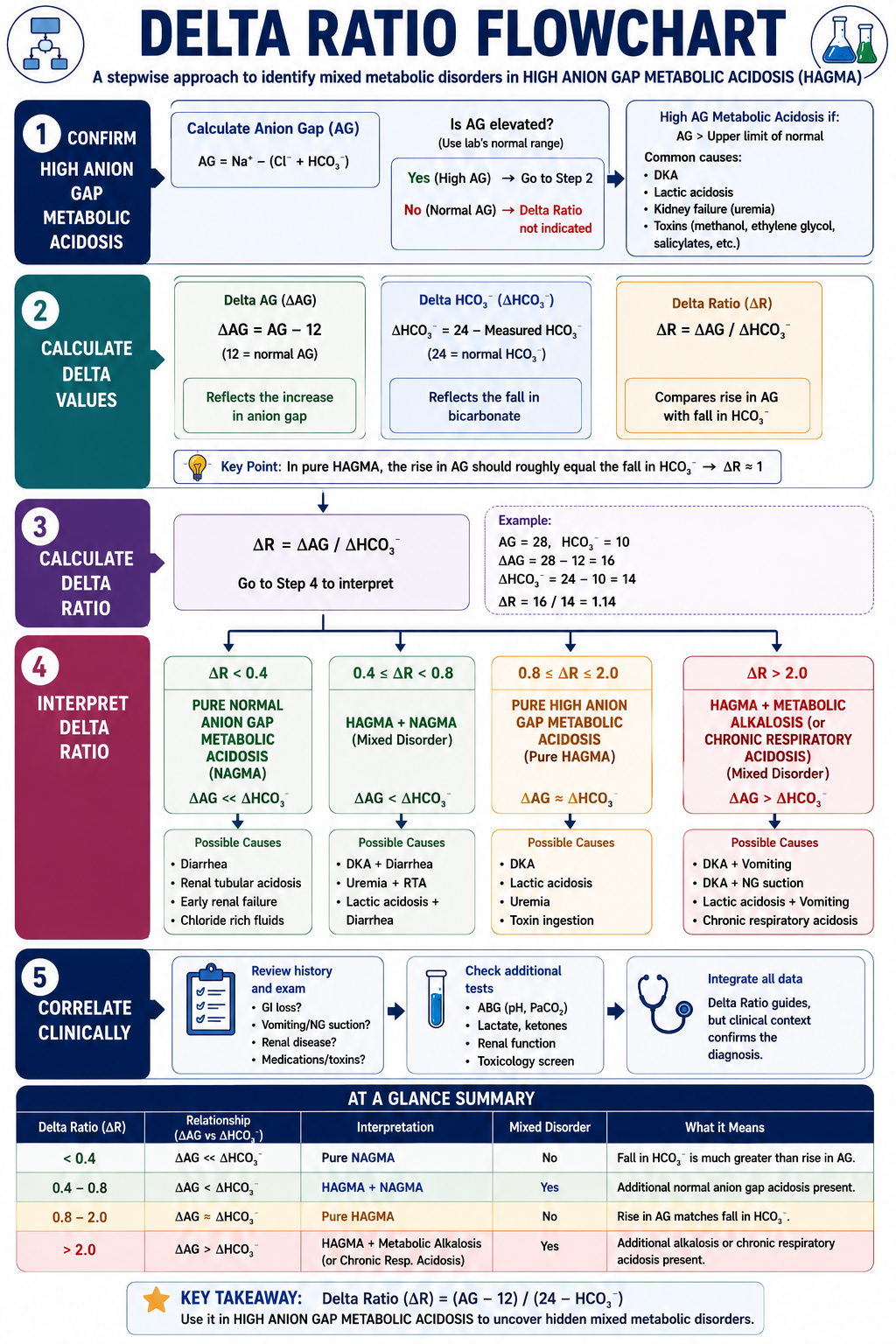
- Identify metabolic acidosis. Check pH and bicarbonate.
- Calculate the anion gap. Decide whether high AG metabolic acidosis is present.
- Correct the anion gap for albumin. Low albumin can hide a high gap.
- Use Winter's Formula. Assess respiratory compensation.
- Calculate Delta Ratio. Compare Delta AG with Delta HCO3-.
- Identify mixed disorders. Combine the result with the clinical picture.
For structured interpretation, use the Blood Gas Analyser. For the anion gap step, use the Anion Gap Calculator.
After understanding Delta Ratio, the next step is learning complete ABG interpretation, where pH, PaCO2, HCO3-, anion gap, Winter's Formula and Delta Ratio are combined into one structured approach.
One Minute Revision
- Delta Ratio is used mainly in high anion gap metabolic acidosis.
- Formula: (AG - 12) / (24 - HCO3-).
- < 0.4 suggests pure normal anion gap metabolic acidosis.
- 0.4-0.8 suggests HAGMA + NAGMA.
- 0.8-2 suggests pure HAGMA.
- > 2 suggests HAGMA + metabolic alkalosis.
- Always correct the anion gap for albumin when albumin is low.
- Always interpret the result in clinical context.
Frequently Asked Questions
This article is intended for medical education only. Delta Ratio is an interpretation aid and must be used with the full clinical picture, local laboratory ranges, albumin concentration, blood gas findings and senior or specialist input when patients are acutely unwell.