Winter's Formula is the bridge between diagnosing metabolic acidosis and interpreting whether the respiratory system is responding correctly. It turns an ABG from a collection of numbers into a structured answer.
This article builds on Acid-Base Disorders Explained, Metabolic Acidosis Explained and Anion Gap Explained. The aim is to make expected PaCO2 calculation simple, clinically useful and exam-ready.
Learning Objectives
- Define Winter's Formula and explain when it is used
- Explain why respiratory compensation occurs in metabolic acidosis
- Calculate expected PaCO2 from bicarbonate
- Recognise appropriate respiratory compensation
- Identify additional respiratory acidosis and respiratory alkalosis
- Apply the formula to DKA, lactic acidosis and renal failure
- Avoid common examination and clinical pitfalls
What Is Winter's Formula?
Winter's Formula is used to determine whether respiratory compensation for metabolic acidosis is appropriate. It predicts the expected PaCO2 for a given bicarbonate level.
Metabolic acidosis is primarily a bicarbonate problem. The bicarbonate is low, so the pH falls. The lungs then compensate by increasing ventilation and lowering PaCO2. Winter's Formula estimates how low the PaCO2 should be if compensation is appropriate.
Winter's Formula predicts the expected PaCO2 in metabolic acidosis.
Without Winter's Formula, a low bicarbonate and an abnormal PaCO2 can be difficult to interpret. With the formula, you compare measured PaCO2 with expected PaCO2 and decide whether a mixed disorder is present.

Why Compensation Occurs
When bicarbonate falls, the blood becomes more acidic. The body responds through the respiratory centre by increasing ventilation. This removes carbon dioxide from the blood.
Carbon dioxide is linked to acid-base balance because CO2 combines with water to form carbonic acid, which dissociates into hydrogen ions and bicarbonate. Lowering CO2 therefore helps reduce acidity.

Clinical Examples
This pattern is common in diabetic ketoacidosis, lactic acidosis, renal failure and severe diarrhoea. In DKA, deep Kussmaul breathing is a visible clinical sign of respiratory compensation for metabolic acidosis.
Compensation moves pH toward normal. It does not fully normalise pH and it should not overshoot. If compensation looks excessive, suspect a second acid-base disorder.
The Formula
The classic Winter's Formula is:
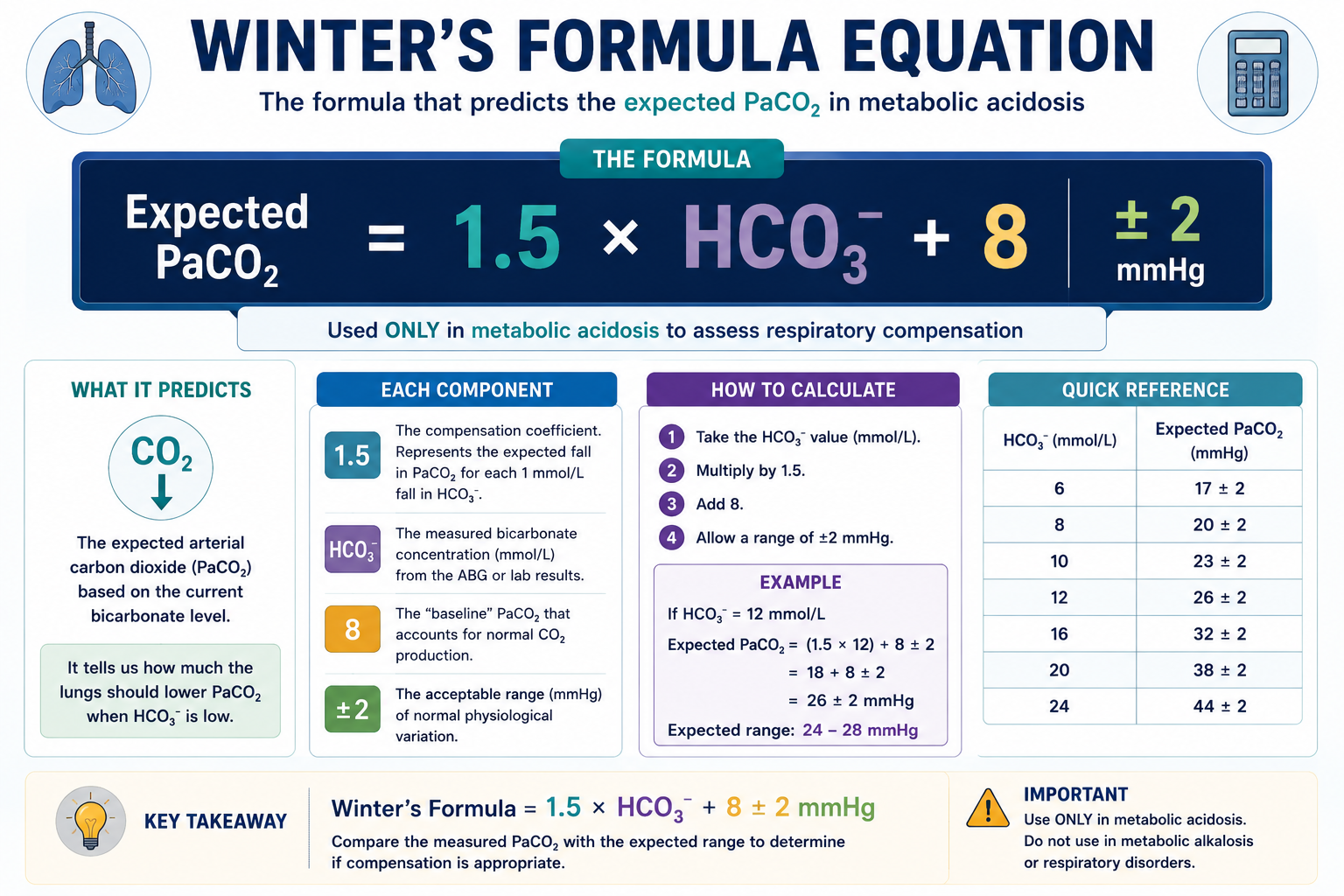
Components
| Part | Meaning | Clinical note |
|---|---|---|
| HCO3- | Measured bicarbonate concentration | This is the metabolic component of the ABG |
| 1.5 | Compensation coefficient | Estimates the expected ventilatory response |
| + 8 | Adjustment constant | Helps align the estimate with physiological observations |
| +/- 2 | Acceptable range | Small variation is normal; do not overcall mixed disorders within this range |
Winter's Formula is used only in metabolic acidosis. Do not use it in metabolic alkalosis, respiratory acidosis or respiratory alkalosis. Each of these disorders has different compensation rules.
For a structured ABG/VBG interpretation workflow, use the Blood Gas Analyser.
When Should Winter's Formula Be Used?
Winter's Formula should be used only after confirming that the primary disorder is metabolic acidosis. It is not a general ABG formula for every acid-base disorder.
| Primary disorder | Use Winter's Formula? | Reason |
|---|---|---|
| Metabolic acidosis | Yes | It predicts expected respiratory compensation by estimating PaCO2. |
| Metabolic alkalosis | No | Metabolic alkalosis has different respiratory compensation rules. |
| Respiratory acidosis | No | The primary problem is PaCO2 retention, so renal compensation rules are used instead. |
| Respiratory alkalosis | No | The primary problem is low PaCO2, so renal compensation rules are used instead. |
If the primary abnormality is low HCO3- with acidaemia, Winter's Formula is appropriate. If the primary abnormality is respiratory, do not use Winter's Formula.
How To Use Winter's Formula
Winter's Formula should be used after you identify metabolic acidosis. Do not start with the formula before checking pH and bicarbonate.
- Identify metabolic acidosis. Look for low pH and low HCO3-.
- Calculate expected PaCO2. Use 1.5 x HCO3- + 8.
- Apply the +/- 2 range. This gives the acceptable compensation range.
- Compare with measured PaCO2. Decide whether compensation is appropriate.
- Look for mixed disorders. A value outside the range suggests an additional respiratory disorder.

Use the anion gap to classify metabolic acidosis, then use Winter's Formula to judge respiratory compensation. These steps answer different questions.
Appropriate Compensation
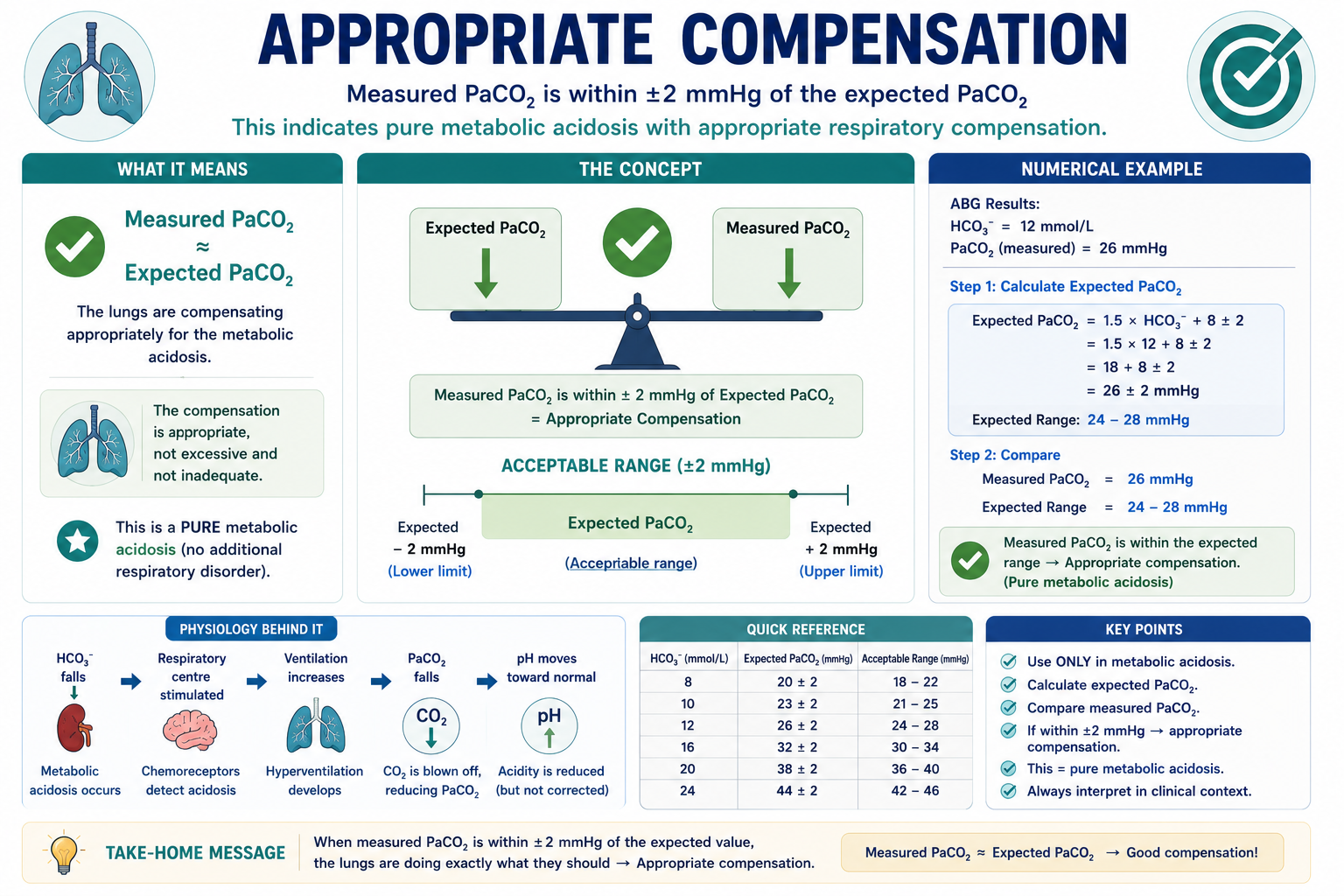
Respiratory compensation is appropriate when measured PaCO2 is approximately equal to the expected PaCO2 range predicted by Winter's Formula.
Example
| Step | Value |
|---|---|
| HCO3- | 12 mmol/L |
| Expected PaCO2 | 1.5 x 12 + 8 = 26 mmHg |
| Expected range | 24-28 mmHg |
| Measured PaCO2 | 26 mmHg |
| Interpretation | Pure metabolic acidosis with appropriate respiratory compensation |
Additional Respiratory Acidosis
If measured PaCO2 is higher than expected, the patient is retaining more carbon dioxide than they should for the degree of metabolic acidosis.
This means the patient has metabolic acidosis plus respiratory acidosis. Clinically, this is dangerous because the respiratory system is failing to compensate.
A patient with severe metabolic acidosis and a PaCO2 higher than expected may be tiring or heading toward respiratory failure. This can be a medical emergency, especially in DKA, sepsis, pneumonia or severe asthma.
Example
| Variable | Value |
|---|---|
| HCO3- | 12 mmol/L |
| Expected PaCO2 | 26 mmHg, range 24-28 |
| Measured PaCO2 | 38 mmHg |
| Interpretation | Metabolic acidosis with additional respiratory acidosis |

Common Causes
- COPD
- Severe asthma
- Respiratory muscle fatigue
- Sedative or opioid overdose
- Severe pneumonia
- Exhaustion in severe DKA or sepsis
Additional Respiratory Alkalosis
If measured PaCO2 is lower than expected, the patient is hyperventilating more than expected for metabolic acidosis alone.
This means metabolic acidosis is present, but there is also a primary respiratory alkalosis driving PaCO2 lower than compensation predicts.
Example
| Variable | Value |
|---|---|
| HCO3- | 12 mmol/L |
| Expected PaCO2 | 26 mmHg, range 24-28 |
| Measured PaCO2 | 18 mmHg |
| Interpretation | Metabolic acidosis with additional respiratory alkalosis |

Common Causes
- Sepsis
- Pregnancy
- Liver disease
- Anxiety or pain
- Salicylate toxicity
Worked Examples
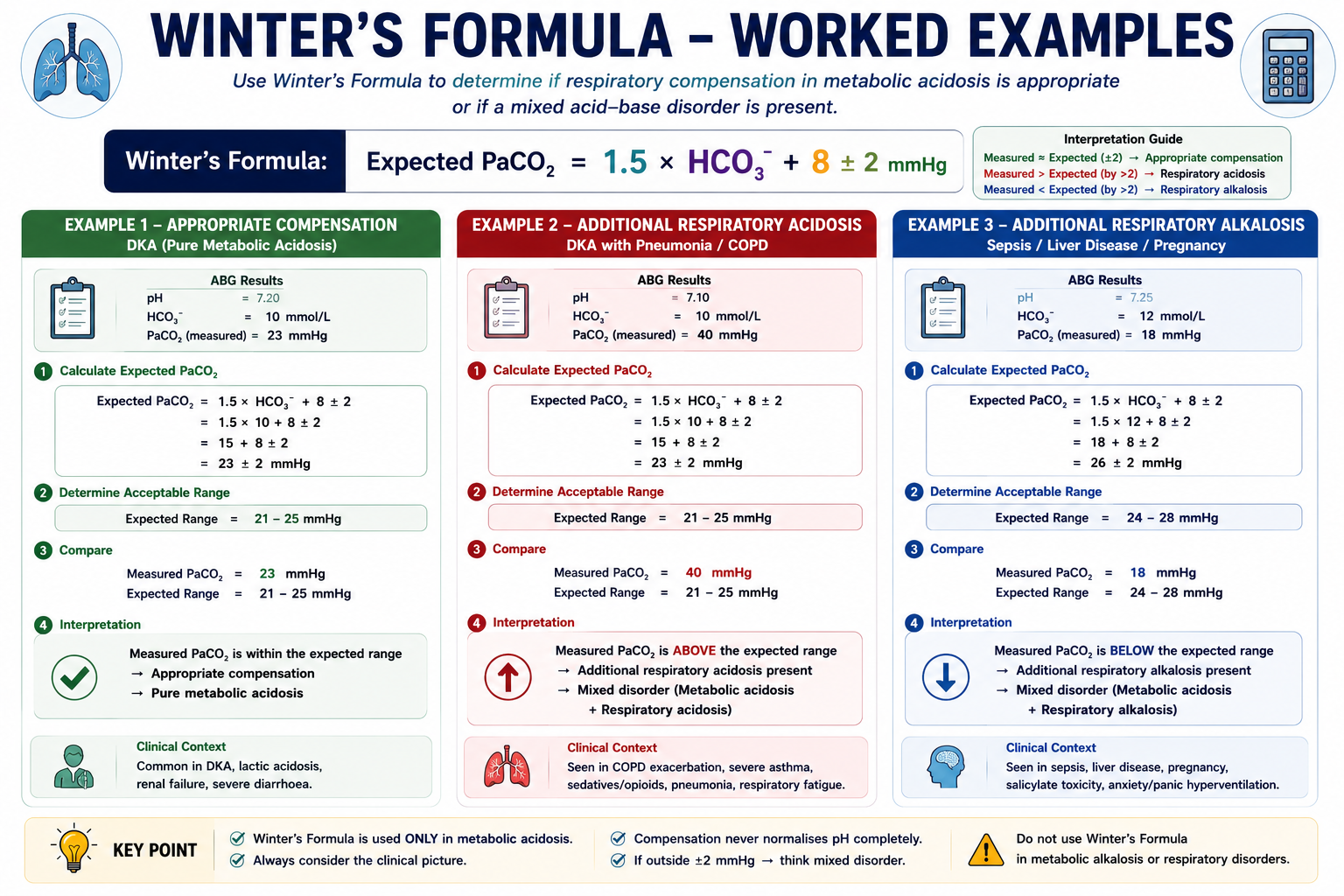
Worked examples are the best way to make Winter's Formula automatic. The calculation is simple, but the clinical meaning changes depending on whether measured PaCO2 is inside, above or below the expected range.
Example 1: DKA With Appropriate Compensation
| ABG value | Result |
|---|---|
| pH | 7.20 |
| HCO3- | 10 mmol/L |
| PaCO2 | 23 mmHg |
Expected PaCO2 = 1.5 x 10 + 8 = 23 mmHg. The acceptable range is 21-25 mmHg. The measured PaCO2 is 23 mmHg, so compensation is appropriate.
Metabolic acidosis with appropriate respiratory compensation.
Example 2: DKA With Pneumonia
| ABG value | Result |
|---|---|
| pH | 7.10 |
| HCO3- | 10 mmol/L |
| PaCO2 | 40 mmHg |
Expected PaCO2 is 23 mmHg, range 21-25 mmHg. The measured PaCO2 is 40 mmHg, which is far higher than expected.
Metabolic acidosis with additional respiratory acidosis. Think about pneumonia, fatigue, airway disease, sedatives or ventilatory failure.
Example 3: Sepsis
| ABG value | Result |
|---|---|
| pH | 7.25 |
| HCO3- | 12 mmol/L |
| PaCO2 | 18 mmHg |
Expected PaCO2 is 26 mmHg, range 24-28 mmHg. The measured PaCO2 is 18 mmHg, which is lower than expected.
Metabolic acidosis with additional respiratory alkalosis. Sepsis is a classic cause because lactate may rise while inflammatory drive causes hyperventilation.
Interpretation Algorithm
A consistent sequence prevents the common mistake of jumping straight to compensation before identifying the primary disorder.
- Confirm metabolic acidosis. pH is low and HCO3- is low.
- Classify the metabolic acidosis. Calculate the anion gap and correct for albumin when needed.
- Calculate expected PaCO2. Use Winter's Formula.
- Compare measured PaCO2. Decide whether it is within, above or below the expected range.
- Search for mixed disorders. Use the clinical picture, lactate, ketones, renal function, medications and respiratory assessment.
For rapid structured interpretation, use the Blood Gas Analyser. For the anion gap step, use the Anion Gap Calculator.
After calculating expected PaCO2 manually, use the Blood Gas Analyser to practise full ABG interpretation and the Anion Gap Calculator to classify metabolic acidosis.

Common Pitfalls
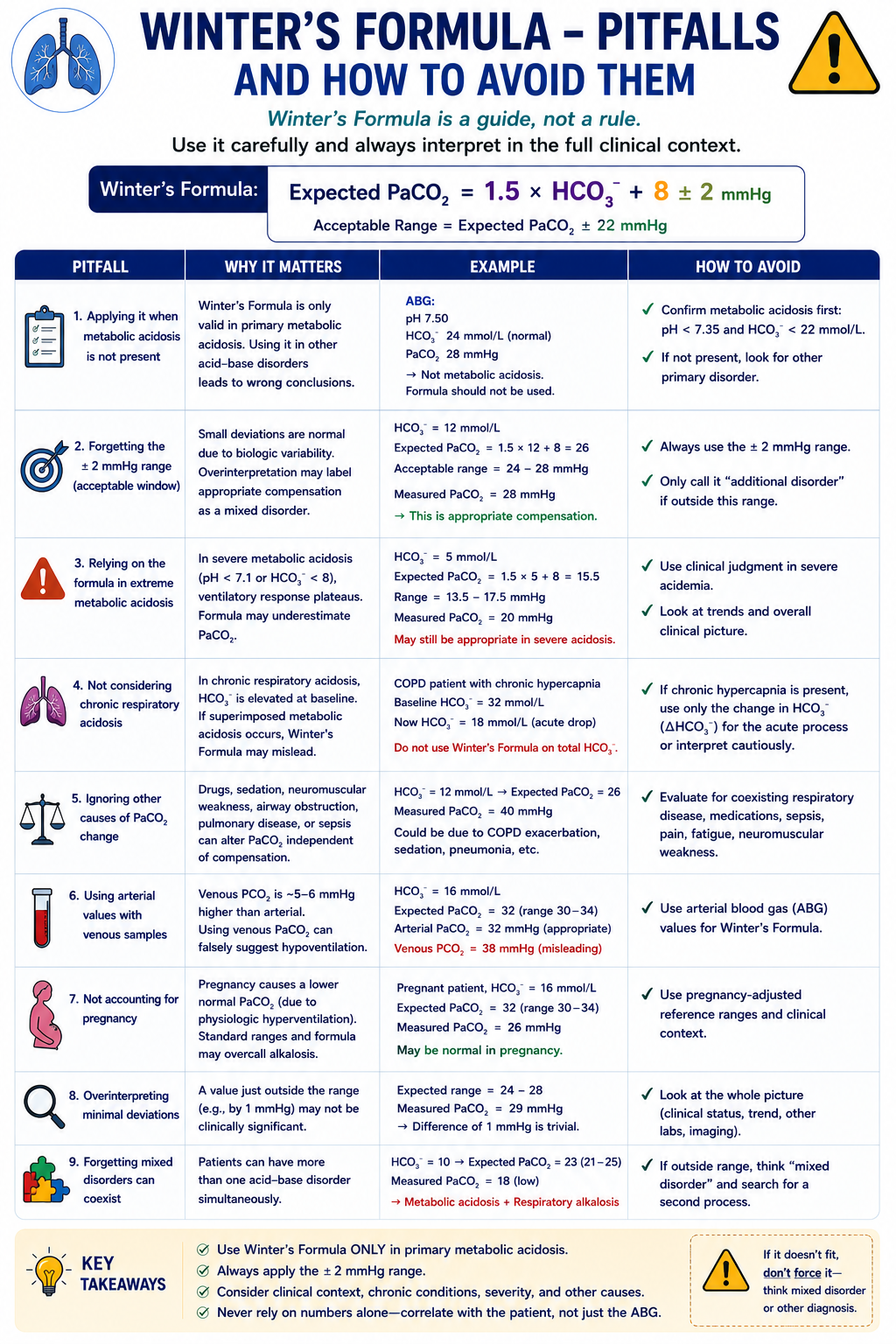
Most mistakes with Winter's Formula come from using the right formula at the wrong time, or ignoring the acceptable range.
| Pitfall | Why it is wrong | Correct approach |
|---|---|---|
| Using it in metabolic alkalosis | Winter's Formula is not designed for metabolic alkalosis | Use metabolic alkalosis compensation rules instead |
| Using it for primary respiratory disorders | The primary disorder is not metabolic acidosis | Use acute or chronic respiratory compensation rules |
| Ignoring the +/- 2 range | Small variation is physiological | Interpret measured PaCO2 against the expected range |
| Assuming compensation normalises pH | Compensation usually improves pH but does not fully correct it | If pH is normal, consider a mixed disorder |
| Forgetting the clinical context | The formula does not diagnose the cause | Combine it with history, examination, lactate, ketones and renal function |
If measured PaCO2 is outside the expected range, do not call it simple compensation. Outside the range means there is likely a second acid-base disorder.
One Minute Revision
- Winter's Formula predicts expected PaCO2 during metabolic acidosis.
- Formula: Expected PaCO2 = (1.5 × HCO3-) + 8 ± 2.
- If measured PaCO2 is within range, respiratory compensation is appropriate.
- If measured PaCO2 is above range, additional respiratory acidosis is present.
- If measured PaCO2 is below range, additional respiratory alkalosis is present.
- Winter's Formula is used only in metabolic acidosis.
- Compensation moves pH toward normal; it does not overshoot.
Frequently Asked Questions
This article is intended for medical education only. Winter's Formula is an interpretation aid and must be used with the full clinical picture, local laboratory context, ABG or VBG findings and senior or specialist input when patients are acutely unwell.