Metabolic acidosis is a metabolic acid-base disorder in which the primary abnormality is a fall in bicarbonate or accumulation of non-volatile acid. The pH tends to fall, and the lungs compensate by lowering PaCO2 through increased ventilation.
This article builds on Acid-Base Disorders Explained. If acid-base interpretation feels unfamiliar, read that foundation article first, then return here for the detailed metabolic acidosis pathway.
Metabolic acidosis occurs when HCO3- falls or fixed acids increase, causing blood pH to fall. The primary problem is metabolic, not respiratory.
Learning Objectives
- Define metabolic acidosis and identify the primary abnormality
- Explain why bicarbonate falls and why pH falls
- Recognise the typical ABG pattern in metabolic acidosis
- Separate high anion gap from normal anion gap metabolic acidosis
- Use GOLDMARK to remember important high anion gap causes
- Explain respiratory compensation and the purpose of Winter's Formula
- Apply a stepwise clinical approach to interpretation
What Is Metabolic Acidosis?
Metabolic acidosis is an acid-base disorder caused by a primary reduction in bicarbonate or a primary increase in fixed acid. Because bicarbonate is the major extracellular buffer, a fall in bicarbonate reduces the body's ability to buffer hydrogen ions. The result is a tendency toward lower blood pH.
The key phrase is primary abnormality. In metabolic acidosis, the primary abnormality is low HCO3- or acid accumulation. PaCO2 may also be low, but that is usually compensation by the lungs rather than the cause of the disorder.
The primary abnormality in metabolic acidosis is low HCO3-. PaCO2 falls later if the lungs compensate appropriately.
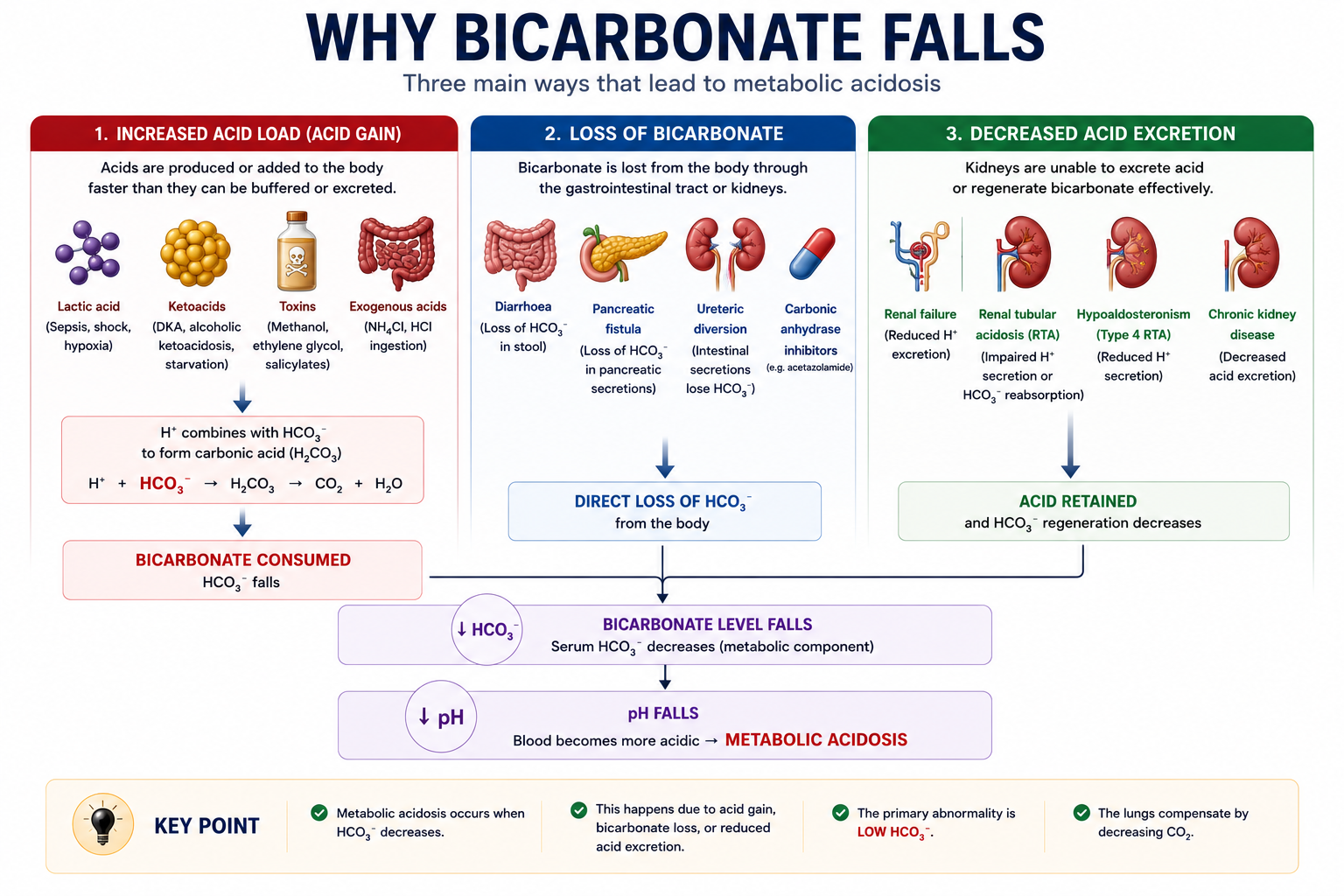
Why Does pH Fall?
Blood pH depends mainly on the relationship between bicarbonate and carbon dioxide. A simplified way to think about this is:
When bicarbonate falls, the ratio of HCO3- to CO2 falls. That pushes pH downward. The body then tries to reduce CO2 by increasing ventilation, which partially restores the ratio and limits the pH change.
Acid Gain
Acid gain means the body accumulates acids faster than they can be buffered or removed. Important examples include lactic acid in shock, ketoacids in diabetic ketoacidosis and toxic alcohol metabolites in poisoning. These disorders often produce a high anion gap.
Bicarbonate Loss
Bicarbonate can be lost from the gastrointestinal tract or kidneys. Severe diarrhoea is the classic example because intestinal fluid contains bicarbonate. Pancreatic fistula and renal tubular acidosis are other important causes. These disorders often produce a normal anion gap metabolic acidosis.
Reduced Acid Excretion
The kidneys normally excrete hydrogen ions and regenerate bicarbonate. In advanced chronic kidney disease or renal failure, acid excretion is impaired, so acids accumulate. Renal failure is an important cause of high anion gap metabolic acidosis.
Typical ABG Pattern
The classic arterial blood gas pattern in metabolic acidosis is low pH, low bicarbonate and low PaCO2 if respiratory compensation is present.
| Variable | Finding | Meaning |
|---|---|---|
| pH | Down | Acidaemia if pH is below 7.35 |
| HCO3- | Down | Primary metabolic abnormality |
| PaCO2 | Down | Respiratory compensation if appropriate |
In a metabolic disorder, HCO3- changes first. In metabolic acidosis, HCO3- is low and pH tends to be low.

Causes of Metabolic Acidosis
The most important classification is based on the anion gap. Metabolic acidosis is divided into:
- High anion gap metabolic acidosis, where additional acids accumulate and unmeasured anions rise.
- Normal anion gap metabolic acidosis, where bicarbonate is lost and chloride rises to maintain electrical neutrality.
This distinction is clinically useful because it narrows the differential diagnosis quickly. A high anion gap points toward acid accumulation such as lactate, ketones, renal failure or toxins. A normal anion gap points toward bicarbonate loss or renal tubular acidification problems.

Use the Anion Gap Calculator to calculate the anion gap and albumin-corrected anion gap when assessing metabolic acidosis.
What Is the Anion Gap?
The anion gap is a calculated value that estimates the amount of unmeasured anions in the blood. It helps determine whether metabolic acidosis is mainly caused by acid accumulation or bicarbonate loss.
In high anion gap metabolic acidosis, unmeasured anions increase because acids accumulate. In normal anion gap metabolic acidosis, bicarbonate is lost and chloride rises, so the anion gap remains normal.

High Anion Gap Metabolic Acidosis (HAGMA)
High anion gap metabolic acidosis occurs when acids accumulate in the body. The hydrogen ions are buffered by bicarbonate, so bicarbonate falls. The corresponding anions remain in the blood as unmeasured anions, so the anion gap rises.
Examples include lactate in lactic acidosis, ketoacid anions in ketoacidosis, and toxic metabolites from methanol or ethylene glycol poisoning. The anion gap is a clue that there is an additional unmeasured acid burden.
GOLDMARK Mnemonic
| Letter | Cause | Clinical notes |
|---|---|---|
| G | Glycols | Ethylene glycol and propylene glycol; consider toxic alcohol exposure |
| O | Oxoproline | 5-oxoproline; associated with chronic paracetamol use in susceptible patients |
| L | L-lactate | Shock, sepsis, hypoxia, seizures, severe beta-agonist use and other causes |
| D | D-lactate | Short bowel syndrome and bacterial carbohydrate metabolism |
| M | Methanol | Toxic alcohol; visual symptoms and severe acidosis are important warning signs |
| A | Aspirin | Salicylates can cause mixed respiratory alkalosis and metabolic acidosis |
| R | Renal failure | Reduced acid excretion in advanced kidney disease |
| K | Ketoacidosis | Diabetic, alcoholic and starvation ketoacidosis |

Modern exams and teaching increasingly prefer GOLDMARK over the older MUDPILES mnemonic because GOLDMARK better reflects contemporary causes of high anion gap metabolic acidosis.
The older MUDPILES mnemonic is still seen in textbooks and teaching notes. It includes methanol, uraemia, diabetic ketoacidosis, paraldehyde, iron/isoniazid, lactic acidosis, ethylene glycol and salicylates. It is historically useful, but GOLDMARK is usually more up to date.
Normal Anion Gap Metabolic Acidosis (NAGMA)
Normal anion gap metabolic acidosis is also called hyperchloraemic metabolic acidosis. It usually occurs when bicarbonate is lost and chloride rises to maintain electrical neutrality. Because there is no major accumulation of unmeasured anions, the anion gap remains normal.
Why Is It Called Hyperchloraemic Acidosis?
When bicarbonate is lost, the body must maintain electrical neutrality. Chloride rises to replace the lost bicarbonate. Therefore the anion gap stays normal, but chloride becomes relatively high.
The most exam-friendly way to remember this is: high anion gap means extra acid anions; normal anion gap often means bicarbonate loss replaced by chloride.
Common Causes
- Diarrhoea: the most common exam answer; bicarbonate is lost from the gastrointestinal tract.
- Renal tubular acidosis: impaired renal acid handling. Type 1 is distal, type 2 is proximal, and type 4 is commonly linked to hypoaldosteronism or aldosterone resistance.
- Pancreatic fistula: pancreatic secretions are bicarbonate-rich, so ongoing loss can produce metabolic acidosis.
- Ureteric diversion: bowel segments exposed to urine can exchange chloride and bicarbonate, producing hyperchloraemic acidosis.

Compensation and Winter's Formula
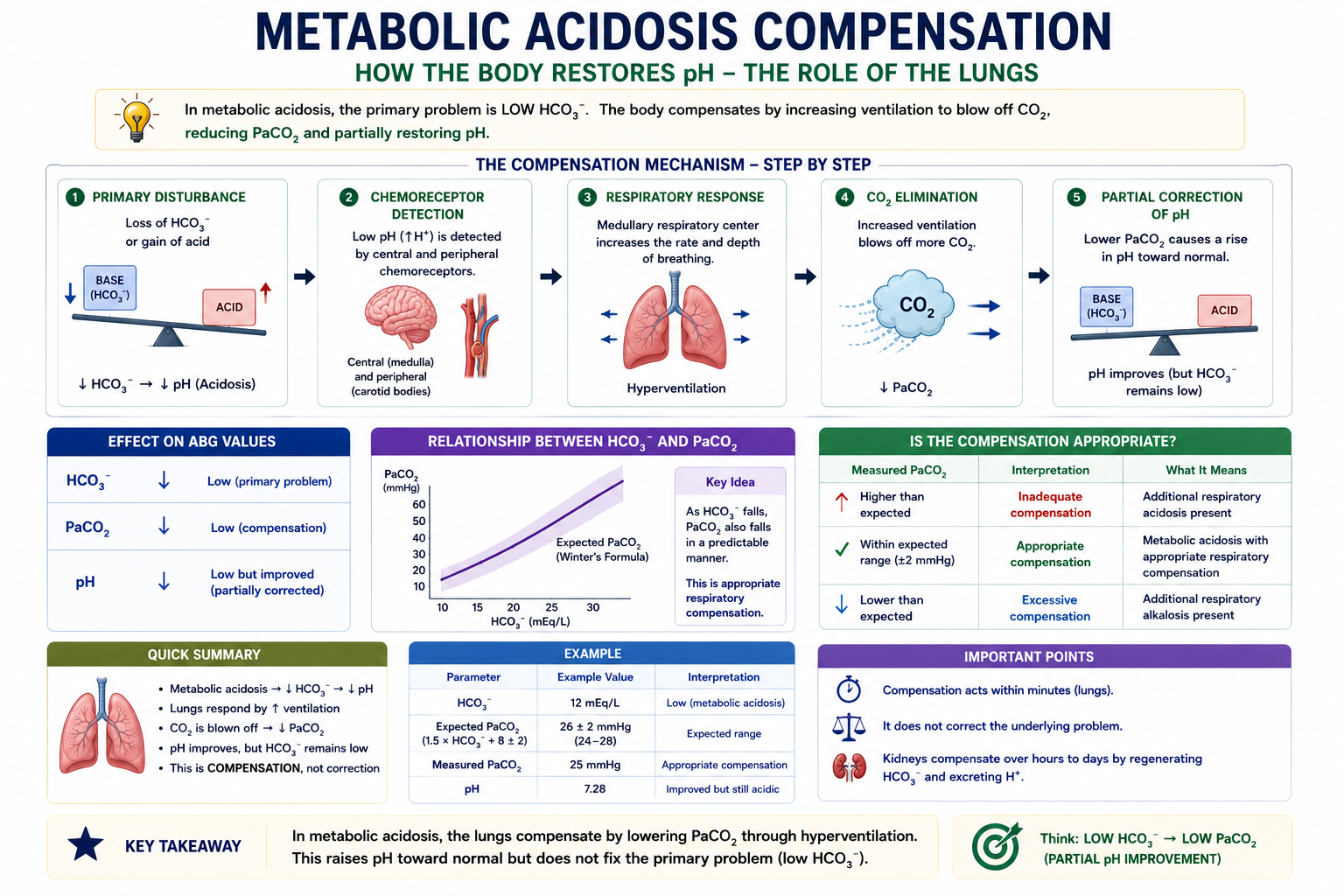
The lungs compensate for metabolic acidosis. When bicarbonate falls and pH begins to fall, ventilation increases. Increased ventilation removes more carbon dioxide. Since carbon dioxide is the respiratory acid component, lowering PaCO2 helps partially correct the pH.
This compensation can be obvious at the bedside. Patients with severe metabolic acidosis may develop deep, rapid breathing. In diabetic ketoacidosis, this pattern is classically described as Kussmaul respiration.
Kussmaul Respiration
Kussmaul respiration is deep, laboured breathing seen in severe metabolic acidosis, especially diabetic ketoacidosis. It is a respiratory compensatory response. The patient is trying to remove more CO2 to raise pH toward normal.
Deep, rapid breathing in an unwell patient should make you think of severe metabolic acidosis, especially DKA, lactic acidosis or renal failure.
Winter's Formula
Winter's Formula estimates the expected PaCO2 in metabolic acidosis. It helps decide whether respiratory compensation is appropriate or whether a second respiratory disorder is present.
- If measured PaCO2 is higher than expected, there is an additional respiratory acidosis.
- If measured PaCO2 is lower than expected, there is an additional respiratory alkalosis.
- If measured PaCO2 is within the expected range, compensation is broadly appropriate.
Compensation should move pH toward normal but should not overshoot. If the measured PaCO2 is much lower or higher than expected, suspect an additional respiratory acid-base disorder.
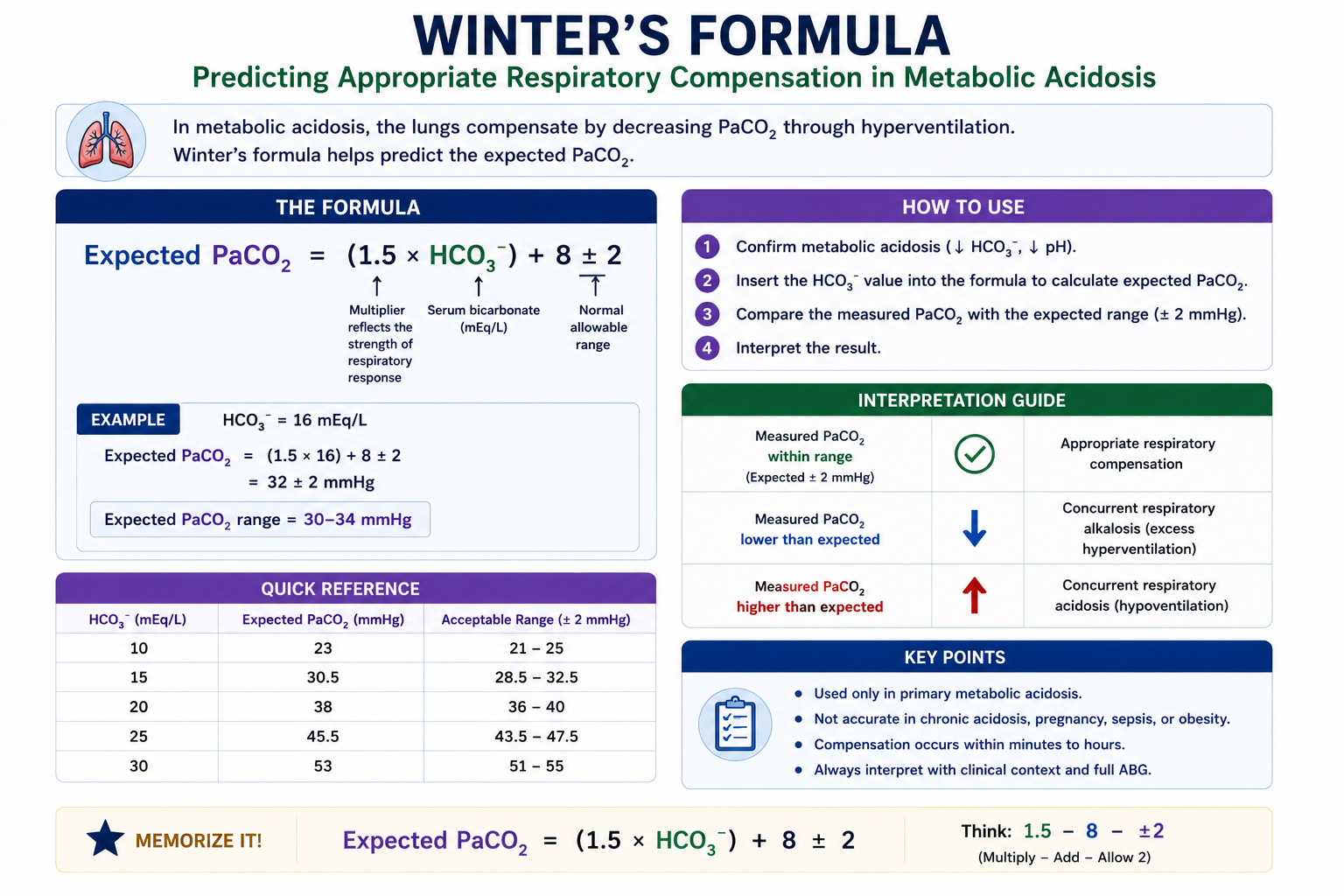
Worked Example
Consider this ABG:
| Parameter | Value | Interpretation |
|---|---|---|
| pH | 7.25 | Acidaemia |
| HCO3- | 12 mmol/L | Low bicarbonate |
| PaCO2 | 26 mmHg | Needs compensation assessment |
The low pH and low HCO3- indicate metabolic acidosis. Now check whether respiratory compensation is appropriate.
The measured PaCO2 is 26 mmHg, so respiratory compensation is appropriate. This is metabolic acidosis with appropriate respiratory compensation.
Approach to Metabolic Acidosis
A structured approach prevents two common mistakes: missing a mixed disorder and forgetting to calculate the anion gap. Use the blood gas, electrolytes and clinical context together.
- Confirm acidosis. Check whether pH is below 7.35. Remember that mixed disorders may make pH near normal.
- Confirm metabolic origin. Check whether HCO3- is low. A low bicarbonate supports metabolic acidosis.
- Calculate the anion gap. Use sodium, chloride and bicarbonate. Correct for albumin if needed.
- Assess compensation. Use Winter's Formula to estimate expected PaCO2.
- Search for the cause. Use the clinical picture: lactate, ketones, renal function, toxin history, diarrhoea, medication review and sepsis assessment.
The Blood Gas Analyser can help structure ABG/VBG interpretation, while the Anion Gap Calculator supports the anion gap step.

Clinical Examples
Pattern recognition is useful, but it must always be paired with clinical context. The following examples show common metabolic acidosis patterns.
| Example | Pattern | Likely category | Why it happens |
|---|---|---|---|
| Diabetic ketoacidosis | pH down, HCO3- down, anion gap up | High anion gap | Ketoacid accumulation consumes bicarbonate and leaves unmeasured anions |
| Septic shock | Lactate up, HCO3- down, anion gap up | High anion gap | Tissue hypoperfusion and altered metabolism increase lactate |
| Severe diarrhoea | HCO3- loss, chloride up, anion gap normal | Normal anion gap | Gastrointestinal bicarbonate loss is replaced by chloride |
| Advanced CKD | HCO3- down, acid retention, often anion gap up | High anion gap | Kidneys cannot excrete acid effectively |
Do not stop at naming the disorder. Metabolic acidosis is a clue to an underlying problem. The clinical task is to identify and treat the cause.
One Minute Revision
- Metabolic acidosis occurs when bicarbonate falls or fixed acids accumulate.
- The primary abnormality is low HCO3-.
- The two major categories are high anion gap metabolic acidosis and normal anion gap metabolic acidosis.
- High anion gap metabolic acidosis is commonly remembered using GOLDMARK.
- The lungs compensate by increasing ventilation and lowering PaCO2.
- Winter's Formula assesses whether respiratory compensation is appropriate.
Frequently Asked Questions
This article is intended for medical education only. Metabolic acidosis can indicate serious illness, including shock, sepsis, renal failure, diabetic ketoacidosis and poisoning. Clinical management requires urgent assessment, local protocols and senior or specialist input.