SIADH is best understood as persistent antidiuretic activity despite hypotonicity.
The concentration of sodium in the blood depends largely on the balance between body water and body solute. In many cases of hyponatremia, the problem is not a lack of sodium. It is an excess of water relative to sodium.
The hormone that plays a major role in conserving water is antidiuretic hormone, also called arginine vasopressin. Normally, when plasma becomes hypotonic, ADH secretion should fall. The kidney should then produce dilute urine and excrete excess water.
In SIADH, this normal response does not occur. Antidiuretic activity remains present despite hypotonicity. As a result, the kidney continues to reabsorb water, urine remains inappropriately concentrated, and serum sodium falls because body water has increased relative to body solute.
Persistent antidiuretic effect despite hypotonicity. Serum osmolality is low. Urine osmolality is usually above 100 mOsm/kg. Urine sodium is usually above 30 mmol/L in the correct setting. The patient appears euvolemic. The diagnosis is one of exclusion.

Learning Objectives
- Define SIADH and explain the modern term syndrome of inappropriate antidiuresis
- Explain why hypotonicity normally suppresses ADH
- Interpret urine osmolality and urine sodium in suspected SIADH
- Distinguish SIADH from hypovolemia, primary polydipsia, adrenal insufficiency, severe hypothyroidism, renal failure and thiazide-associated hyponatremia
- List the major causes of SIADH and explain treatment principles
Normal ADH Physiology
Suppose a person drinks a large amount of water. Plasma osmolality falls. The normal response is suppression of ADH, reduced collecting-duct water permeability, production of dilute urine, and excretion of excess water.
This is normal water homeostasis. The key point is that hypotonicity should switch off antidiuresis.
For the broader background, see Sodium Homeostasis Explained and Serum Osmolality Explained.
How SIADH Causes Hyponatremia
In SIADH, antidiuretic activity persists despite low plasma tonicity. The collecting duct remains water permeable, water continues to be reabsorbed, free-water excretion is impaired, and total body water increases.
SIADH is mainly a water problem. The usual abnormality is water retention causing dilutional hyponatremia, not simple sodium loss.
Although water is retained, patients with SIADH are usually described clinically as euvolemic. The retained water is distributed through body compartments and compensatory mechanisms promote some sodium excretion. The result is generally no obvious peripheral edema, no marked signs of dehydration and no gross fluid overload.
How SIADH Is Diagnosed
Before diagnosing SIADH, confirm that the patient truly has hyponatremia with low serum osmolality. Not every low sodium concentration represents hypotonic hyponatremia.
This first step is covered in detail in Serum Osmolality Explained and Hyponatremia Explained.
Diagnostic Algorithm
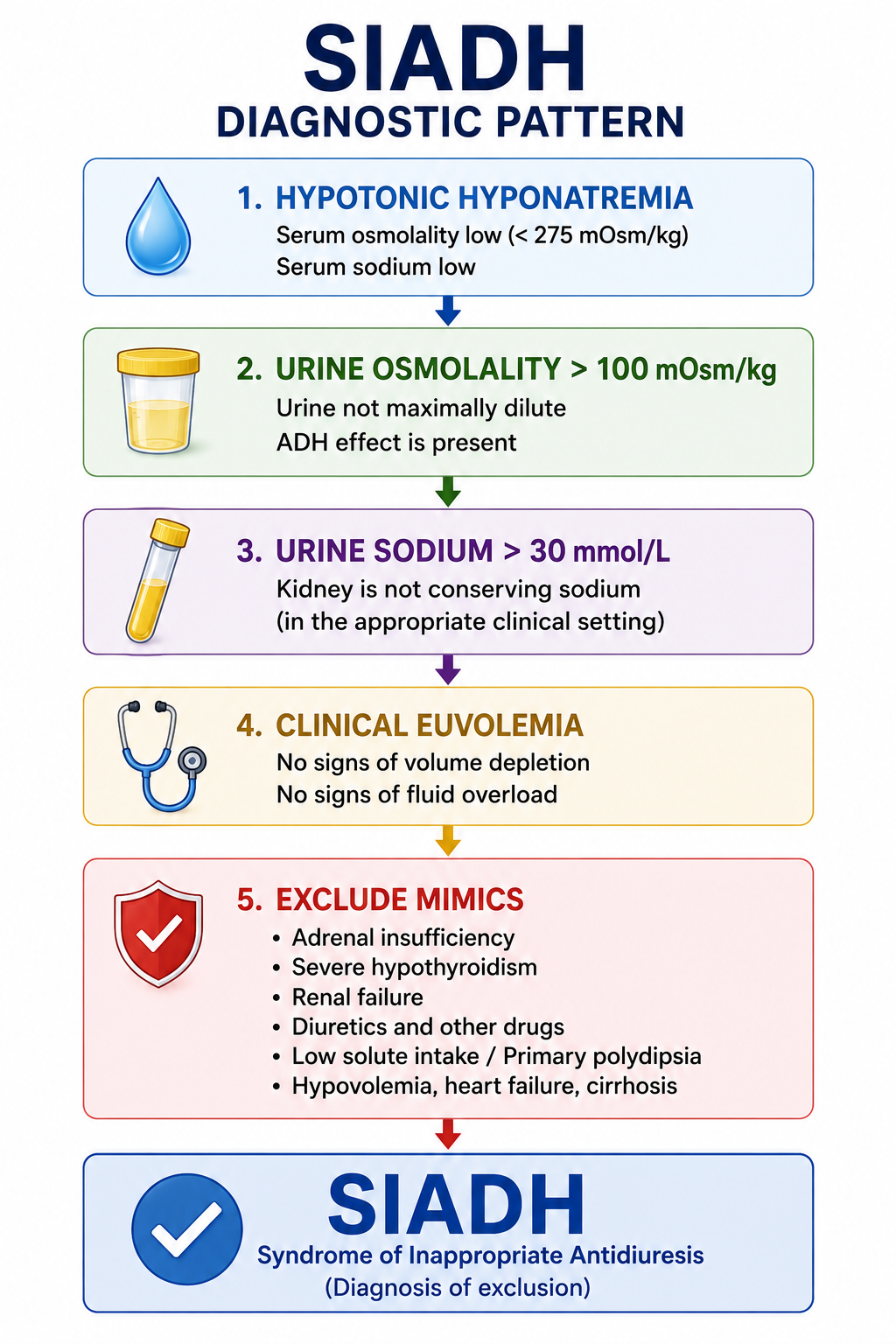
Urine Osmolality and Urine Sodium
In a hypotonic patient, the normal kidney should suppress ADH and produce very dilute urine. Therefore urine osmolality is extremely informative.
| Finding | Interpretation | Clinical Meaning |
|---|---|---|
| Uosm at or below 100 mOsm/kg | The kidney is producing maximally or near-maximally dilute urine | ADH is appropriately suppressed; this pattern argues against SIADH |
| Uosm above 100 mOsm/kg | The urine is not maximally dilute | Meaningful antidiuretic activity is present; now ask why ADH is active |
| Urine sodium usually above 30 mmol/L | The kidneys are not behaving as if the body is severely sodium depleted | Supports SIADH only in the appropriate clinical setting |
Urine sodium must never be interpreted alone. It must be considered together with clinical volume status, medications, renal function and endocrine status. The renal-water physiology behind these thresholds is expanded in Urine Osmolality Explained.
Typical SIADH Pattern
| Finding | Typical SIADH |
|---|---|
| Serum sodium | Low |
| Serum osmolality | Low |
| Urine osmolality | Above 100 mOsm/kg |
| Urine sodium | Usually above 30 mmol/L |
| Clinical volume status | Euvolemic |
| Renal function | No major renal failure |
| Adrenal function | Normal |
| Thyroid function | No severe hypothyroidism |
No single laboratory value proves SIADH. The diagnosis is based on the complete pattern and reasonable exclusion of alternative explanations.
Conditions That Mimic SIADH
Many conditions can produce hypotonic hyponatremia, urine osmolality above 100 mOsm/kg and persistent ADH activity. Important mimics include hypovolemia, heart failure, cirrhosis, adrenal insufficiency, thiazide-associated hyponatremia, severe hypothyroidism, significant renal failure, primary polydipsia and very low solute intake.
SIADH vs Hypovolemia
Both may have hypotonic hyponatremia and Uosm above 100. In hypovolemia, ADH activation is appropriate because the body needs to preserve circulation. Clues may include orthostatic symptoms, dry mucous membranes, tachycardia, recent vomiting or diarrhea, and low urine sodium in many cases.
In SIADH, there is no clear evidence of significant volume depletion. The patient appears approximately euvolemic and urine sodium is usually not suppressed.
SIADH vs Primary Polydipsia
In primary polydipsia, the kidney appropriately suppresses ADH. Therefore urine is very dilute, with a typical pattern of Uosm at or below 100 mOsm/kg. In SIADH, antidiuretic activity persists and the typical pattern is Uosm above 100 mOsm/kg.
SIADH vs Low Solute Intake
Low dietary solute intake limits the amount of water the kidney can excrete. The urine is often very dilute because ADH is appropriately suppressed. Very low Uosm argues against SIADH.
SIADH vs Adrenal Insufficiency
Adrenal insufficiency can produce hypotonic hyponatremia, persistent ADH activity and an apparently euvolemic clinical picture. It should be excluded before confidently diagnosing SIADH.
SIADH vs Severe Hypothyroidism
Severe hypothyroidism can impair water excretion and contribute to hyponatremia. Severe thyroid dysfunction should be considered when evaluating an apparent SIADH pattern.
SIADH vs Thiazide-Associated Hyponatremia
Thiazide diuretics can produce a biochemical picture that resembles SIADH. Medication history is essential before labeling a patient as having SIADH.
Causes of SIADH
SIADH causes are best organized into major categories.
| Category | Examples |
|---|---|
| Central nervous system disorders | Stroke, subarachnoid hemorrhage, meningitis, encephalitis, traumatic brain injury, brain tumors |
| Pulmonary disorders | Pneumonia, tuberculosis, severe respiratory disease |
| Malignancy | Small-cell lung carcinoma |
| Medications | SSRIs, carbamazepine, oxcarbazepine, cyclophosphamide, vincristine, some antipsychotic medications, desmopressin and other agents affecting water balance |
| Postoperative and stress states | Surgery, severe pain, nausea, physiological stress |
| Idiopathic | No clear cause identified despite appropriate investigation |
Medication review is essential in every suspected case. In some patients, especially older adults, no definite underlying cause is identified despite appropriate investigation.
Treatment of SIADH
Management depends on severity of symptoms, acuity of hyponatremia, underlying cause and ability to correct the cause. The first question is not simply whether the patient has SIADH. It is whether the patient is severely symptomatic from hyponatremia.
Severe Symptomatic Hyponatremia
If the patient has severe neurological symptoms attributable to hyponatremia, emergency treatment principles take priority. Examples include seizures, coma, severe confusion and signs of significant cerebral edema.
In this situation, urgent treatment of severe hyponatremia, including hypertonic saline according to established clinical protocols, takes priority while the underlying cause is investigated. This article does not provide a dosing protocol.
Stable or Chronic SIADH
In a stable patient, treatment focuses on the mechanism. The goals are to remove the cause if possible, reduce excess water and improve free-water excretion.
| Treatment Principle | Mechanism |
|---|---|
| Treat the cause | Examples include treating pneumonia, addressing a CNS disorder where possible, treating an underlying malignancy, or stopping an offending medication when clinically appropriate |
| Fluid restriction | Reduces water intake when the kidney cannot excrete enough free water |
| Increase solute intake | Oral urea acts as an osmotic solute and can increase water excretion with solute |
| Loop diuretics | May be used in selected situations as part of a broader management strategy |
| Vasopressin-receptor antagonists | Vaptans reduce the effect of vasopressin on the kidney in selected patients and require careful monitoring |
Some patients have very concentrated urine and continue to retain water despite restricting intake. Very high urine osmolality and high urine electrolyte content relative to plasma are associated with poor response.

Worked Clinical Cases
Case 1: Classic SIADH
A patient has serum sodium 122 mmol/L, low serum osmolality, urine osmolality 550 mOsm/kg, urine sodium 65 mmol/L, no edema and no signs of dehydration.
This is a typical SIADH pattern. However, the diagnosis still requires exclusion of adrenal insufficiency, severe thyroid dysfunction, medication effects and other mimics.
Case 2: Hypovolemia Mimicking SIADH
A patient has sodium 124 mmol/L, low serum osmolality and urine osmolality 600 mOsm/kg. The patient has had several days of vomiting and has tachycardia, dry mucous membranes and orthostatic dizziness.
The concentrated urine reflects appropriate ADH activation due to volume depletion. This is not SIADH.
Case 3: Primary Polydipsia
A patient has sodium 125 mmol/L, low serum osmolality and urine osmolality 70 mOsm/kg. The kidney is producing very dilute urine. ADH is appropriately suppressed. This pattern argues against SIADH.
Case 4: Adrenal Insufficiency
A patient has hypotonic hyponatremia, Uosm 500 mOsm/kg, urine sodium 50 mmol/L and apparent euvolemia. The biochemical pattern resembles SIADH, but adrenal insufficiency must be excluded before diagnosing SIADH.
Case 5: Medication-Related Hyponatremia
An older patient develops hyponatremia shortly after starting a thiazide diuretic. The laboratory pattern resembles SIADH. Medication history is essential.
Case 6: Small-Cell Lung Cancer
A patient with known small-cell lung carcinoma has persistent hypotonic hyponatremia, Uosm 700 mOsm/kg, urine sodium 60 mmol/L and no signs of volume depletion. This is a classic clinical setting for SIADH after appropriate exclusion of alternative causes.
Common Diagnostic Mistakes
- Misconception: SIADH means high ADH. Reality: the syndrome is defined by inappropriate antidiuretic activity.
- Misconception: Uosm above 100 diagnoses SIADH. Reality: it only shows that antidiuretic activity is present.
- Misconception: Urine sodium above 30 proves SIADH. Reality: urine sodium must be interpreted with volume status, medications, endocrine function and renal function.
- Misconception: SIADH causes sodium loss. Reality: the main abnormality is water retention causing dilutional hyponatremia.
- Misconception: Every euvolemic hyponatremia is SIADH. Reality: adrenal insufficiency, severe hypothyroidism, medications and other disorders can mimic it.
- Misconception: Fluid restriction always works. Reality: some patients have very limited free-water clearance and require additional strategies.
One Minute Revision
- SIADH means persistent antidiuretic effect despite hypotonicity.
- Water is retained and serum sodium is diluted.
- The typical pattern is low serum sodium, low serum osmolality, urine osmolality above 100 mOsm/kg, urine sodium usually above 30 mmol/L and clinical euvolemia.
- Always exclude hypovolemia, adrenal insufficiency, severe hypothyroidism, significant renal failure, thiazides and other drugs, primary polydipsia and low-solute intake.
- Treatment principles include treating the cause, fluid restriction, increasing solute such as urea, and selected use of loop strategies or vaptans.
- The golden rule: SIADH is a diagnosis of exclusion.
High-Yield Clinical Pearls
- SIADH is a disorder of persistent antidiuretic activity despite hypotonicity.
- The primary problem is water retention rather than simple sodium deficiency.
- Serum osmolality is low.
- Urine is not maximally dilute.
- Uosm above 100 mOsm/kg indicates antidiuretic activity but does not diagnose SIADH.
- Urine sodium is commonly above 30 mmol/L in the appropriate setting.
- Patients usually appear clinically euvolemic.
- SIADH is a diagnosis of exclusion.
- Adrenal insufficiency is an important mimic.
- Thiazide-associated hyponatremia can resemble SIADH.
- Primary polydipsia usually produces very dilute urine.
- Fluid restriction is often first-line therapy for stable cases.
- Very concentrated urine may predict poor response to fluid restriction.
- Oral urea increases solute-driven water excretion.
- Vaptans reduce the renal effect of vasopressin in selected patients.
Frequently Asked Questions
Key Take-Home Messages
SIADH is best understood as a disorder in which the normal suppression of antidiuretic activity fails. Normally, hypotonic plasma suppresses ADH, dilute urine is produced, and excess water is excreted. In SIADH, antidiuretic activity persists, water is reabsorbed, urine remains concentrated, free-water excretion falls and serum sodium becomes diluted.
Compare SIADH with the opposite AVP disorder in Diabetes Insipidus Explained.
The diagnosis is not based on one laboratory value. It requires hypotonic hyponatremia, urine that is not maximally dilute, urine sodium that is not appropriately suppressed in the correct setting, an approximately euvolemic clinical picture and reasonable exclusion of alternative causes.
SIADH is a diagnosis of exclusion based on inappropriate antidiuresis in the setting of hypotonic hyponatremia.
This article is intended for medical education only. Severe symptomatic hyponatremia requires urgent supervised clinical management according to local protocols.