Sodium homeostasis is often misunderstood because serum sodium concentration is confused with the total amount of sodium in the body. These are related, but they are not the same thing.
This article is the foundation for the sodium and water-balance cluster. It follows Electrolytes Explained and complements Potassium Homeostasis Explained by shifting attention from membrane potential to water, tonicity and extracellular fluid volume.
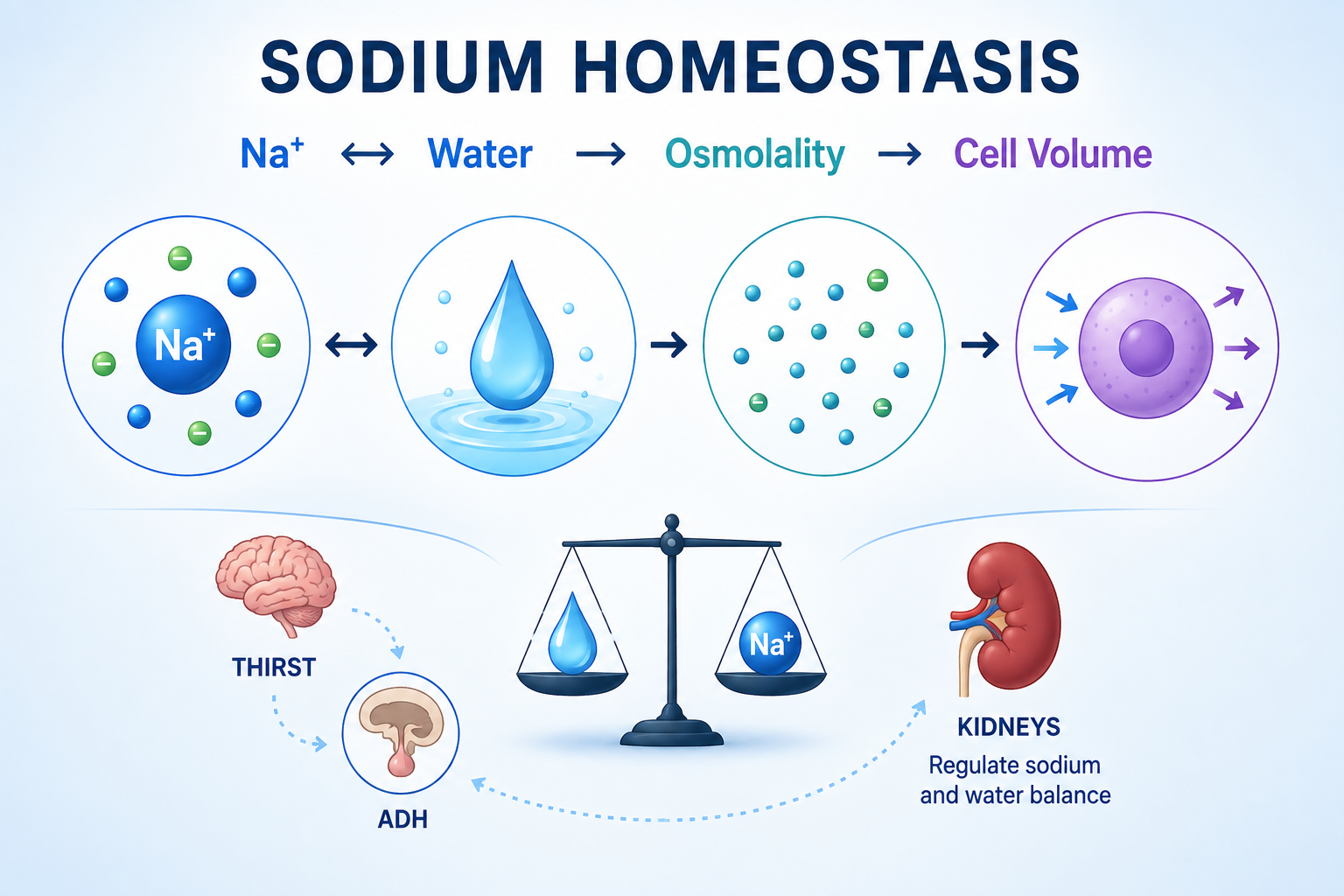
The key concept is simple but powerful: serum sodium is a concentration, not a measurement of total-body sodium. A patient can have low serum sodium with increased, decreased or approximately normal total-body sodium depending on the relationship between sodium-associated solute and water.
Serum sodium concentration mainly reflects water and tonicity balance. Total-body sodium is closely related to extracellular fluid volume.
Learning Objectives
- Describe sodium distribution within body-fluid compartments
- Explain why sodium is the major extracellular cation
- Distinguish serum sodium concentration from total-body sodium
- Explain osmolality, tonicity and water movement
- Describe how thirst and vasopressin regulate water balance
- Describe how the kidneys, RAAS, aldosterone and natriuretic peptides regulate sodium and volume
- Apply sodium physiology to hyponatremia, hypernatremia and oedematous states without duplicating future disorder articles
Body-Fluid Compartments
Total body water is distributed between intracellular and extracellular compartments. Roughly two-thirds of total body water is intracellular and one-third is extracellular. The extracellular fluid includes the interstitial fluid and the intravascular plasma compartment.
Sodium is the dominant extracellular cation. Potassium is the dominant intracellular cation. This separation is essential for cell volume, osmolality, membrane potentials and normal organ function.
| Compartment | Main Cation | Clinical Relevance |
|---|---|---|
| Extracellular fluid | Sodium | Volume status, plasma osmolality, blood pressure and tissue perfusion |
| Intracellular fluid | Potassium | Cell volume, membrane potential and cellular function |
Serum Sodium Versus Total-Body Sodium
The serum sodium concentration is the concentration of sodium in plasma water. It is not a direct measurement of the total amount of sodium in the body.
This is why hyponatremia can occur in very different volume states. A patient with heart failure may have increased total-body sodium but even more water retention, causing low serum sodium. A patient with diarrhoea may have decreased total-body sodium and water, with the sodium concentration depending on the relative losses and hormonal response.
Do not ask only "Is sodium low?" Ask whether the problem is water excess, water deficit, sodium deficit, sodium excess or a mixed disturbance.
Osmolality and Tonicity
Osmolality describes the concentration of dissolved particles per kilogram of water. Plasma osmolality is normally maintained within a narrow range, and under ordinary circumstances serum sodium is closely related to plasma osmolality.
Tonicity, or effective osmolality, refers to osmoles that produce sustained water movement across cell membranes and therefore influence cell volume. Osmolality and tonicity are related but not identical; the calculation and clinical interpretation are developed further in Serum Osmolality Explained.
| Concept | Meaning | Why It Matters |
|---|---|---|
| Osmolality | All dissolved particles per kg of water | Measured or estimated concentration of solute in plasma water |
| Tonicity | Effective osmoles that move water between compartments | Determines sustained cell swelling or shrinking |
This distinction becomes central when interpreting hyponatremia, hyperglycaemia-related sodium changes and other situations where measured osmolality and effective tonicity diverge.
Water Movement
Water crosses cell membranes freely. When effective osmolality differs between compartments, water shifts from the lower-tonicity compartment toward the higher-tonicity compartment until osmotic forces are balanced.
Because sodium and its accompanying anions are largely extracellular, changes in extracellular sodium-associated solute strongly influence extracellular tonicity and therefore water distribution between the extracellular and intracellular spaces.
Brain symptoms in severe sodium disorders occur because changes in tonicity alter water movement into or out of brain cells.
Two Related Control Systems
The body regulates two related variables: osmolality or tonicity, and extracellular fluid volume.
| Variable | Main Sensors | Main Effectors |
|---|---|---|
| Osmolality / tonicity | Hypothalamic osmoreceptors | Thirst and vasopressin-mediated water handling |
| Effective circulating volume | Baroreceptors, kidney perfusion signals | RAAS, aldosterone, sympathetic tone, natriuretic peptides and renal sodium handling |
These systems interact extensively. For example, reduced effective arterial volume may stimulate vasopressin even when serum sodium is low, because circulatory preservation can override pure osmolality regulation.
Thirst and ADH
Thirst and vasopressin, also called antidiuretic hormone or ADH, are the central short-term regulators of water balance. They respond strongly to changes in plasma osmolality and also respond to reductions in blood volume or blood pressure.
ADH acts on the collecting ducts of the kidney to increase water reabsorption. This concentrates the urine and retains water. If ADH is suppressed, the kidneys can excrete more free water and produce dilute urine.

Renal Sodium Handling
The kidneys are the main long-term regulators of sodium balance. Sodium is filtered at the glomerulus and then extensively reabsorbed along the nephron. Most filtered sodium is normally reclaimed rather than lost in urine.
The purpose of this article is not to memorise every transporter. The important principle is that renal sodium handling determines sodium excretion and therefore strongly influences extracellular fluid volume.
| Nephron Region | Simplified Role |
|---|---|
| Proximal tubule | Bulk sodium and water reabsorption |
| Loop of Henle | Sodium handling that supports medullary concentration gradients |
| Distal tubule | Fine-tuning of sodium and other electrolytes |
| Collecting duct | Aldosterone-sensitive sodium reabsorption and ADH-sensitive water handling |
RAAS and Aldosterone
The renin-angiotensin-aldosterone system responds to reduced effective circulating volume, reduced renal perfusion and sympathetic activation. Its overall effect is to preserve arterial pressure and extracellular fluid volume.
Aldosterone acts mainly in the distal nephron to increase sodium reabsorption through ENaC-related mechanisms. This sodium retention tends to support extracellular volume. Aldosterone also promotes potassium and hydrogen ion secretion, linking sodium homeostasis with potassium and acid-base physiology.
Natriuretic Peptides and Pressure Natriuresis
When cardiac chambers are stretched by increased volume, natriuretic peptides promote sodium and water excretion and counter-regulate RAAS activity. Intrarenal mechanisms also adjust sodium excretion in response to changes in perfusion pressure and tubular flow.
Together, these systems help the body avoid unlimited sodium and water retention when extracellular volume expands.

Volume Versus Concentration
This is the central synthesis: sodium amount and sodium concentration are not interchangeable.
| Question | Main Physiological Meaning |
|---|---|
| What is the serum sodium concentration? | What is the relationship between extracellular solute and water? |
| What is total-body sodium? | How much sodium is present in the body, influencing ECF volume? |
| What is the volume status? | Is extracellular fluid volume depleted, normal or expanded? |
Hyponatremia can occur with low, normal or high total-body sodium. The full diagnostic approach is covered in Hyponatremia Explained. Hypernatremia usually indicates water deficit relative to solute, and its diagnostic approach is covered in Hypernatremia Explained.
Clinical Patterns
Low Serum Sodium With Increased Total-Body Sodium
In heart failure, cirrhosis or nephrotic syndrome, total-body sodium and water may both be increased, but water retention is proportionally greater. The result can be oedema with hyponatremia.
Low Serum Sodium With Decreased Total-Body Sodium
Gastrointestinal sodium loss, diuretics or renal salt wasting may reduce total-body sodium. If water intake or ADH-mediated water retention is proportionally greater, serum sodium can fall.
Low Serum Sodium With Approximately Normal Total-Body Sodium
In SIADH-like physiology, retained water may dilute serum sodium without a large primary increase in total-body sodium. Detailed diagnostic criteria belong in the future SIADH article.
High Serum Sodium
Hypernatremia is most often a water problem: too little water relative to extracellular solute. Causes include reduced water intake, impaired thirst, diabetes insipidus physiology, osmotic diuresis and hypotonic losses. Detailed diagnosis belongs in the future hypernatremia article.
Serum Osmolality and Urine Studies
Measured serum osmolality quantifies dissolved particles in plasma water. A calculated estimate commonly uses sodium, glucose and urea; the full formula is covered in Serum Osmolality Explained.
Urine osmolality provides information about ADH effect and renal water handling. The detailed interpretation is covered in Urine Osmolality Explained. The opposite AVP patterns are covered in SIADH Explained and Diabetes Insipidus Explained.
Common Misconceptions
- Misconception: Low serum sodium always means low body sodium. Reality: serum sodium is a concentration and may be low despite increased total-body sodium.
- Misconception: ADH controls sodium directly. Reality: ADH primarily controls water, which changes serum sodium concentration by dilution or concentration.
- Misconception: Aldosterone mainly controls serum sodium concentration. Reality: aldosterone mainly supports sodium retention and extracellular volume.
- Misconception: Osmolality and tonicity are the same. Reality: tonicity depends on effective osmoles that cause sustained water movement across cell membranes.
- Misconception: Sodium disorders can be understood without volume status. Reality: serum sodium and volume status answer different but connected questions.
Clinical Examples
Example 1: Heart Failure and Hyponatremia
A patient with heart failure may have oedema, increased total-body sodium and low serum sodium. The low serum sodium reflects water retention relative to solute, while the oedema reflects expanded extracellular volume.
Example 2: Diarrhoea and Volume Depletion
A patient with severe diarrhoea may lose sodium and water. Serum sodium may be low, normal or high depending on the relative losses, water intake and ADH response. The volume problem and the concentration problem must be assessed separately.
Example 3: Diabetes Insipidus Physiology
If ADH secretion or response is impaired, the kidneys cannot retain water effectively. Free water loss can raise serum sodium and osmolality unless thirst and water intake compensate.
One Minute Revision
- Sodium is the major extracellular cation.
- Serum sodium is a concentration, not a direct measure of total-body sodium.
- Serum sodium mainly reflects the relationship between extracellular solute and water.
- Total-body sodium is closely related to extracellular fluid volume.
- Osmolality includes all dissolved particles; tonicity reflects effective osmoles that change cell volume.
- Thirst and ADH regulate water balance.
- RAAS, aldosterone, natriuretic peptides and renal sodium handling regulate sodium balance and volume.
- Hyponatremia and hypernatremia should be interpreted as water/tonicity problems first, then integrated with volume status.
Frequently Asked Questions
Conclusion
Sodium homeostasis is fundamentally the coordinated regulation of sodium and water. The most important conceptual distinction is that serum sodium concentration reflects the relationship between solute and water, whereas total-body sodium is closely related to extracellular fluid volume. Understanding this distinction prevents the common mistake of treating sodium disorders as simple sodium-deficit or sodium-excess states. It also provides the foundation for serum osmolality, hyponatremia, hypernatremia, SIADH and diabetes insipidus.
This article is intended for medical education only. Sodium and water-balance disorders can be life-threatening and require patient-specific clinical assessment, laboratory interpretation, local protocols and senior or specialist input when appropriate.