Clinical Medicine • Electrolytes • Sodium and Water Balance
Diabetes Insipidus Explained: Central vs Nephrogenic DI, Diagnosis and Treatment
A physiology-first guide to AVP deficiency, AVP resistance, hypotonic polyuria, urine osmolality, primary polydipsia, water-deprivation testing, copeptin and treatment principles.
Dr. Seneth Gajasinghe, MBBS, MD Updated 27 Aug 2026 38 min read Reviewed educational content
Diabetes insipidus is failure of appropriate renal water conservation.
Diabetes insipidus is a disorder of water balance in which the kidneys cannot appropriately conserve water because arginine vasopressin is deficient or because the kidneys are resistant to its effects.
When water becomes scarce, the kidneys should conserve water under the influence of arginine vasopressin, also traditionally called antidiuretic hormone. AVP makes the collecting duct more permeable to water. Water is reabsorbed, urine volume falls and urine becomes concentrated.
Diabetes insipidus occurs when this water-conservation system fails because AVP is deficient or the kidney does not respond adequately to AVP. The result is excessive loss of dilute urine.
Diabetes Insipidus at a Glance
DI means impaired water conservation. Central DI is AVP deficiency. Nephrogenic DI is kidney resistance to AVP. The typical pattern is polyuria, dilute urine and thirst. Normal serum sodium does not exclude DI.
Figure 1. Diabetes insipidus causes excessive dilute urine because effective AVP action is inadequate.
Learning Objectives
Define diabetes insipidus and the terms AVP deficiency and AVP resistance
Explain normal AVP, V2 receptor and aquaporin-2 physiology
Distinguish central DI from nephrogenic DI
Confirm hypotonic polyuria before diagnosing DI
Distinguish DI from primary polydipsia and solute diuresis
Understand the principles and limits of water-deprivation, desmopressin and copeptin testing
Explain treatment principles for central and nephrogenic DI
Normal AVP and Water-Balance Physiology
When water is lost, plasma osmolality rises. Hypothalamic osmoreceptors detect the change, AVP release increases, AVP reaches the kidney, V2 receptors are activated, aquaporin-2 water channels increase at the collecting-duct apical membrane, water reabsorption increases, urine volume decreases and urine becomes concentrated.
Plasma osmolality rises↓Hypothalamic osmoreceptors detect the change↓AVP release increases↓V2 receptors are activated↓Aquaporin-2 increases↓Water reabsorption increases↓Urine becomes concentrated
At the same time, thirst increases and water intake rises. These two mechanisms work together: renal water conservation plus drinking water.
The collecting duct determines how much water is ultimately lost in the urine. Without significant AVP effect, collecting-duct water permeability is low and large volumes of dilute urine can be excreted. With AVP, water moves from the collecting duct into the hyperosmotic renal medulla and water is conserved.
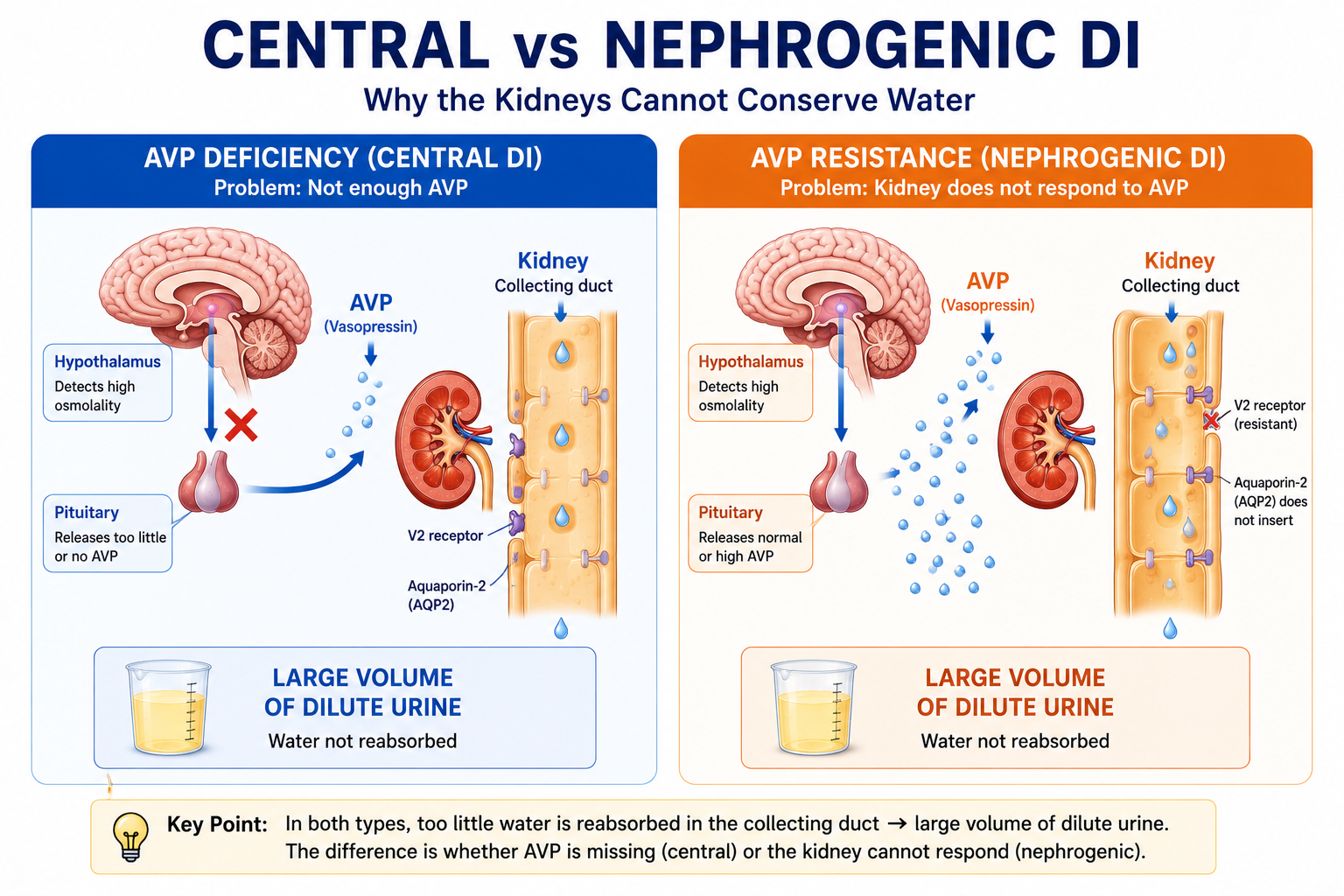
Central diabetes insipidus occurs when arginine vasopressin secretion is inadequate, causing impaired renal water conservation and large-volume dilute urine. The modern physiological term is arginine vasopressin deficiency, or AVP-D.
The kidney may be capable of responding normally, but it is not receiving an adequate hormonal signal. Giving a vasopressin analogue such as desmopressin can restore water conservation.
Nephrogenic Diabetes Insipidus
Nephrogenic diabetes insipidus occurs when the kidneys respond inadequately to arginine vasopressin despite the hormone being present. The modern physiological term is arginine vasopressin resistance, or AVP-R.
AVP reaches the kidney, but AQP2-mediated water conservation remains impaired. Giving additional AVP activity therefore produces much less benefit in complete nephrogenic DI.
Feature
Central DI / AVP-D
Nephrogenic DI / AVP-R
Main defect
Insufficient AVP
Renal AVP resistance
AVP signal
Inadequate
Present
Kidney response
Preserved
Impaired
Urine
Dilute
Dilute
Polyuria
Yes
Yes
Desmopressin response
Usually substantial in complete CDI
Little or none in complete NDI
Major treatment principle
Replace AVP effect
Correct cause and reduce urine loss
Partial disorders do not always follow perfect textbook patterns.
Figure 2. Central DI is AVP deficiency; nephrogenic DI is renal AVP resistance.
Symptoms of Diabetes Insipidus
The classic combination is polyuria plus polydipsia. Patients may report passing very large volumes of urine, frequent urination, nocturia, intense thirst, frequent drinking and sleep disruption from drinking and urination.
Severity depends on the degree of AVP deficiency or resistance, thirst response, access to water and ability to drink.
Polyuria Is Not Frequency
Urinary frequency means passing urine often. Polyuria means increased total urine volume. A commonly used practical adult definition is more than 3 L/day, while body-weight-based definitions such as approximately more than 40 to 50 mL/kg/day are also used.
Water loss raises plasma tonicity and activates thirst. Polydipsia is often compensatory. This explains why many patients with DI do not present with hypernatremia.
Normal serum sodium does not exclude diabetes insipidus. Patients with intact thirst and unrestricted water access can compensate for large urinary water losses. Hypernatremia develops when urinary water loss exceeds water replacement, especially when the patient cannot access water, communicate thirst, drink independently, or has impaired consciousness or impaired thirst.
Causes of Central DI
Central DI, or AVP deficiency, occurs when the hypothalamic-pituitary AVP pathway is impaired.
Category
Examples
Neurosurgery
Operations involving the pituitary, hypothalamus or pituitary stalk region
Head trauma
Traumatic injury affecting the hypothalamic-pituitary system
Tumors and structural lesions
Lesions involving the hypothalamus, pituitary stalk or posterior pituitary region
Inflammatory and infiltrative disease
Hypothalamic-pituitary involvement
Autoimmune or idiopathic disease
No immediately identifiable structural cause in selected patients
Genetic causes
Rare inherited AVP deficiency
Postoperative water-balance disorders require careful monitoring because AVP function can change during the postoperative period.
Causes of Nephrogenic DI
Nephrogenic DI, or AVP resistance, means the kidney is unable to respond normally to AVP.
Cause
Clinical Meaning
Lithium
One of the most important acquired causes; medication history is essential
Significant potassium depletion can impair renal concentrating ability
Renal disease
Tubulointerstitial and other renal disorders can reduce maximal urinary concentrating ability
Genetic AVP resistance
Inherited disorders affecting V2 receptor signalling or AQP2 water channels, including pathways involving AVPR2 and AQP2
How Diabetes Insipidus Is Diagnosed
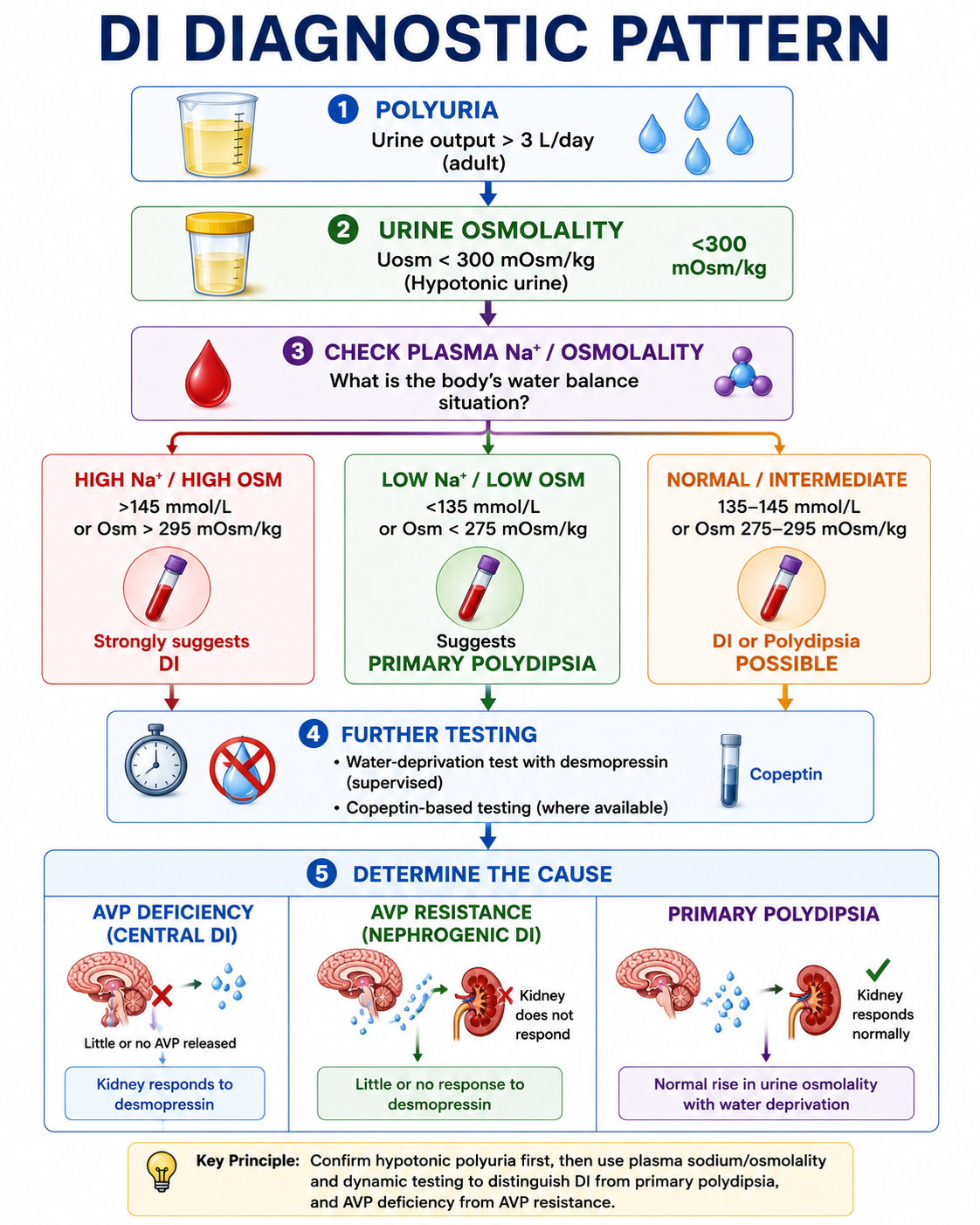
The first diagnostic question should not be whether the patient has central or nephrogenic DI. First establish whether the patient actually has hypotonic polyuria.
Confirm polyuria↓Determine whether urine is dilute↓Exclude obvious solute diuresis↓Assess plasma sodium and osmolality↓Differentiate DI from primary polydipsia↓Then determine AVP deficiency vs resistance
Step 1: Confirm True Polyuria
If history is uncertain, measure total urine output, often over 24 hours. Do not confuse DI with urinary frequency, urgency, nocturia without increased total volume or small-volume frequent urination.
Step 2: Measure Urine Osmolality
Urine osmolality tells us whether polyuria is primarily water diuresis or solute diuresis.
Finding
Meaning
Next Question
Uosm below 300 mOsm/kg
Hypotonic polyuria
DI and primary polydipsia remain important possibilities
Higher urine osmolality with polyuria
Solute or osmotic diuresis becomes more likely
Think glucose, urea, mannitol, sodium or other solute loads
In a patient with confirmed polyuria, urine osmolality below 300 mOsm/kg establishes hypotonic polyuria; diabetes insipidus must then be distinguished from primary polydipsia. The broader interpretation of urine concentration is covered in Urine Osmolality Explained.
Step 3: Check Serum Sodium and Plasma Osmolality
Once hypotonic polyuria is established, look at the plasma. High sodium or clearly elevated plasma osmolality with hypotonic polyuria strongly supports diabetes insipidus physiology because the body has a powerful reason to conserve water, yet the kidney continues producing dilute urine.
Low sodium or low plasma osmolality supports consideration of primary polydipsia. Normal sodium is the difficult zone because it may occur in central DI, nephrogenic DI or primary polydipsia. Further testing may be required.
Suspected DI
↓
Confirm polyuria
Increased total urine volume.
Measure urine osmolality
Uosm below 300 mOsm/kg
Hypotonic polyuria.
Check plasma sodium and osmolality
High sodium or high plasma osmolality
DI becomes strongly likely.
Low sodium or low plasma osmolality
Primary polydipsia becomes more likely.
Normal sodium
Further supervised testing may be required.
Determine AVP deficiency vs AVP resistance
Figure 3. First prove hypotonic polyuria, then decide whether the physiology fits DI or primary polydipsia.
DI vs Primary Polydipsia
In primary polydipsia, the initiating abnormality is excessive water intake. This lowers plasma tonicity, AVP is appropriately suppressed, and the kidney excretes large volumes of dilute urine.
Pattern
Diabetes Insipidus
Primary Polydipsia
Initial problem
Water loss begins in the kidney
Excessive water intake begins first
Thirst/drinking
Compensatory response to water loss
Primary driver of the syndrome
AVP
Deficient or ineffective
Appropriately suppressed by low plasma tonicity
Urine
Dilute
Dilute
Chronic excessive water intake can reduce the renal medullary concentration gradient and alter AQP2 expression. Therefore chronic primary polydipsia can partially mimic DI, particularly partial DI. This is one reason traditional water-deprivation testing is imperfect.
Water-Deprivation Testing
The physiological question is whether the patient can concentrate urine when water is withheld and endogenous AVP should increase.
Water deprivation↓Plasma osmolality rises↓Endogenous AVP should rise↓Normal kidney concentrates urine
After the endogenous system has been assessed, desmopressin can test whether the kidney can respond to an AVP-like signal. In central DI, endogenous AVP is deficient, so desmopressin can improve urine concentration. In nephrogenic DI, the kidney is resistant, so desmopressin produces much less benefit in complete disease.
The traditional test works best for complete central DI, complete nephrogenic DI and normal physiology. It is less clean when partial DI or chronic primary polydipsia are present, because these patterns can overlap substantially.
Supervised Test Only
Water-deprivation testing is a supervised diagnostic procedure because withholding water from a patient who cannot appropriately conserve it can cause significant dehydration and hypernatremia.
Copeptin in Diabetes Insipidus
Direct AVP measurement is difficult because AVP has significant pre-analytical and analytical limitations. Copeptin is released together with AVP and is considerably more stable for laboratory measurement, so it can act as a surrogate marker of AVP secretion.
In nephrogenic DI, the kidney is resistant to AVP. The body therefore has reason to produce substantial AVP. Accordingly, high basal copeptin can strongly support AVP resistance or nephrogenic DI.
The more difficult distinction is central DI versus primary polydipsia. Osmotic stimulation can provoke AVP and copeptin secretion. In AVP deficiency, the copeptin response is inadequate. In primary polydipsia, the system should be capable of responding once appropriately stimulated.
Stimulated copeptin testing requires controlled osmotic stimulation, repeated biochemical monitoring, an appropriate copeptin assay and experienced interpretation. It is specialist diagnostic testing and may not be routinely available everywhere.
SIADH vs Diabetes Insipidus
SIADH and diabetes insipidus are useful opposites in AVP physiology. Compare this article with SIADH Explained.
Feature
SIADH
Diabetes Insipidus
Effective ADH action
Excess or inappropriate
Deficient or ineffective
Water handling
Retained
Lost
Urine
Inappropriately concentrated
Inappropriately dilute
Typical sodium tendency
Hyponatremia
Normal or hypernatremia
Main problem
Cannot excrete water
Cannot conserve water
Treatment of Central DI
Central DI treatment addresses insufficient AVP effect. The major principles are to maintain access to water, replace missing antidiuretic activity, treat the underlying cause where possible and avoid excessive water retention during treatment.
The principal pharmacological treatment for central DI is desmopressin, or DDAVP. It provides antidiuretic activity and can reduce urine volume, reduce thirst and improve sleep disruption from nocturia.
Hyponatremia Risk
Once antidiuresis is restored, excessive water intake can produce water retention and hyponatremia. This article does not provide a desmopressin dosing protocol.
Adipsic DI is particularly dangerous because the patient may lack normal thirst protection. Management requires careful planned water intake and biochemical monitoring under specialist supervision.
Gestational DI is a special pregnancy-related water-balance disorder and requires obstetric and endocrine assessment.
Treatment of Nephrogenic DI
Nephrogenic DI treatment focuses on correcting or removing the cause where possible, maintaining water replacement, correcting hypercalcemia or hypokalemia, reducing excessive solute load where appropriate, thiazides in selected patients, amiloride particularly for lithium-associated disease, and other selected therapies according to clinical circumstances.
Thiazides can paradoxically reduce urine volume. They cause mild volume contraction, which increases proximal sodium and water reabsorption. Less fluid reaches the distal nephron, so less water ultimately becomes urine.
Amiloride is particularly useful conceptually in lithium-associated nephrogenic DI because lithium enters collecting-duct principal cells partly through epithelial sodium channels. NSAIDs may be used in selected situations, but require careful clinical judgement because of renal and other risks.
Worked Clinical Cases
Case 1: Classic Central DI
A patient develops marked thirst and large-volume dilute urine after pituitary-region surgery. Hypotonic polyuria is confirmed. The pattern supports central DI or AVP deficiency, but management still requires monitored clinical assessment.
Case 2: Lithium-Associated Nephrogenic DI
A patient taking long-term lithium develops persistent polyuria and polydipsia with dilute urine. The medication history is a major clue to nephrogenic DI or AVP resistance.
Case 3: Primary Polydipsia
A patient has large-volume dilute urine with low plasma osmolality. Excessive water intake and appropriate AVP suppression become more likely than DI.
Case 4: Hypernatremia With Dilute Polyuria
A patient with impaired consciousness has hypernatremia and large-volume dilute urine. This is dangerous because the kidney is failing to conserve water despite a strong physiological stimulus.
Common Diagnostic Mistakes
Misconception: Polyuria means DI. Reality: polyuria has many causes, including diabetes mellitus, solute diuresis and multiple other mechanisms.
Misconception: Frequent urination means polyuria. Reality: confirm total urine volume.
Misconception: Dilute urine means DI. Reality: primary polydipsia also produces dilute urine.
Misconception: Normal serum sodium excludes DI. Reality: intact thirst and water access may compensate for urinary losses.
Misconception: DI always causes hypernatremia. Reality: hypernatremia develops when water replacement cannot keep pace with losses.
Misconception: Central and nephrogenic DI look completely different clinically. Reality: both can produce polyuria, polydipsia and dilute urine.
Misconception: Water-deprivation testing always clearly distinguishes DI from primary polydipsia. Reality: partial DI and chronic primary polydipsia can overlap substantially.
Misconception: Desmopressin is the treatment for every DI. Reality: it is the major replacement therapy for AVP deficiency, while AVP resistance needs a different strategy.
Misconception: Thiazides worsen nephrogenic DI because they are diuretics. Reality: their physiological effects can paradoxically reduce final urine volume.
Misconception: Desmopressin cannot cause hyponatremia because DI causes water loss. Reality: once antidiuresis is restored, excessive water intake can produce water retention and hyponatremia.
One Minute Revision
Diabetes insipidus is inability to conserve water appropriately.
The typical pattern is large-volume dilute urine, polyuria, polydipsia and possible nocturia.
Central DI means AVP deficiency; nephrogenic DI means AVP resistance.
Do not diagnose DI from polyuria alone. First prove hypotonic polyuria.
Uosm below 300 mOsm/kg in confirmed polyuria means hypotonic polyuria, not automatic DI.
Normal sodium does not exclude DI if thirst and water access are intact.
Hypernatremia with hypotonic polyuria is a strong clue to DI physiology.
Water-deprivation testing is supervised and imperfect in partial disorders.
Copeptin can improve diagnostic discrimination in selected specialist settings.
Desmopressin treats AVP deficiency but can cause hyponatremia if water intake is excessive.
High-Yield Clinical Pearls
DI is a disorder of renal water conservation.
Central DI is caused by inadequate AVP.
Nephrogenic DI is caused by renal resistance to AVP.
AVP-D and AVP-R are modern physiological terms for these disorders.
Both central and nephrogenic DI cause large-volume dilute urine.
Confirm true polyuria before investigating DI.
Uosm below 300 mOsm/kg in polyuria establishes hypotonic polyuria.
Hypotonic polyuria is not the same as DI.
Primary polydipsia can mimic DI.
Normal serum sodium does not exclude DI.
Hypernatremia develops when water losses exceed replacement.
Water deprivation is supervised diagnostic testing, not a home test.
Traditional testing has overlap in partial disorders.
Copeptin is a more stable surrogate marker for AVP secretion.
Desmopressin can cause hyponatremia if water intake exceeds safe needs.
Frequently Asked Questions
What is diabetes insipidus?
Diabetes insipidus is a disorder in which the kidneys cannot appropriately conserve water because arginine vasopressin is deficient or because the kidneys are resistant to its effects. The result is large-volume dilute urine and increased thirst.
What is central diabetes insipidus?
Central DI occurs when the body produces or releases insufficient effective AVP. The modern physiological term is arginine vasopressin deficiency, or AVP-D.
What is nephrogenic diabetes insipidus?
Nephrogenic DI occurs when AVP is present but the kidneys respond inadequately. The modern term is arginine vasopressin resistance, or AVP-R.
What is urine osmolality in diabetes insipidus?
DI typically produces inappropriately dilute urine. In a patient with confirmed polyuria, Uosm below 300 mOsm/kg indicates hypotonic polyuria.
Does diabetes insipidus always cause high sodium?
No. Patients with intact thirst and access to water can replace their urinary water losses and maintain normal serum sodium.
When does DI cause hypernatremia?
Hypernatremia occurs when water loss exceeds water replacement, particularly when patients cannot access water, cannot drink, have impaired consciousness or have impaired thirst.
How do you distinguish central from nephrogenic DI?
Central DI results from AVP deficiency. Nephrogenic DI results from renal AVP resistance. Traditional testing assesses urine concentration before and after desmopressin, while modern pathways may use copeptin-based testing.
What is the water-deprivation test?
It is a supervised test that assesses whether the kidneys can concentrate urine when water is withheld and endogenous AVP should increase. A subsequent desmopressin response can help distinguish AVP deficiency from AVP resistance.
What is copeptin?
Copeptin is released with AVP and is more stable for laboratory measurement. It can act as a surrogate marker of endogenous AVP secretion in polyuria-polydipsia disorders.
What is the treatment for central DI?
The major treatment is desmopressin, together with appropriate water access and treatment of the underlying cause where possible.
What is the treatment for nephrogenic DI?
Treatment focuses on correcting or removing the cause where possible, maintaining water replacement, correcting hypercalcemia or hypokalemia, reducing excessive solute load where appropriate, and selected use of thiazides, amiloride or other therapies.
Why do thiazides reduce polyuria in DI?
Thiazides cause mild volume contraction, which increases proximal sodium and water reabsorption. Less fluid reaches the distal nephron, so less water ultimately becomes urine.
Key Take-Home Messages
Diabetes insipidus is best understood as failure of appropriate renal water conservation. Normally, plasma tonicity rises, AVP rises, V2 receptors are activated, AQP2 increases, water is reabsorbed, urine becomes concentrated and water is conserved.
In DI, either AVP is deficient, which is central DI or AVP-D, or the kidney cannot respond adequately, which is nephrogenic DI or AVP-R. Both can produce large-volume dilute urine. But dilute urine alone does not diagnose DI.
Confirm polyuria↓Confirm hypotonic urine↓Exclude solute diuresis↓Look at plasma sodium and osmolality↓Distinguish DI from primary polydipsia↓Determine AVP deficiency vs AVP resistance
Golden Rule
DI is not diagnosed by polyuria alone. First prove hypotonic polyuria, then determine why the kidney is failing to conserve water.
Medical Education Disclaimer
This article is intended for medical education only. Suspected diabetes insipidus, hypernatremia, water-deprivation testing, copeptin testing and desmopressin treatment require supervised clinical assessment and local specialist guidance.