Hyponatremia is one of the most common electrolyte abnormalities in clinical medicine, but it is often misunderstood as simply "too little sodium."
Hyponatremia means a low serum sodium concentration, conventionally below approximately 135 mmol/L. It does not automatically mean that total-body sodium is low. Serum sodium is a concentration reflecting the relationship between body solute and water.
The practical question is: when serum sodium is low, is this true hypotonic hyponatremia, why is the kidney retaining water, what is the cause, and how can correction be done safely?
Low serum sodium -> serum osmolality/tonicity -> urine osmolality -> urine sodium -> cause -> safe treatment plan.

Learning Objectives
- Define hyponatremia and explain why it does not automatically mean sodium depletion
- Distinguish hypotonic hyponatremia from hypertonic hyponatremia and pseudohyponatremia
- Recognise acute, chronic, mild, moderate and severe symptomatic patterns
- Use urine osmolality to decide whether vasopressin is suppressed or active
- Use urine sodium while recognising limitations from diuretics and kidney disease
- Distinguish hypovolemic, euvolemic and hypervolemic causes
- Understand emergency treatment principles and the risk of osmotic demyelination syndrome
What Is Hyponatremia?
Hyponatremia is a serum sodium concentration below the laboratory reference range, conventionally below approximately 135 mmol/L. The exact lower limit depends on the local laboratory.
The key distinction is that serum sodium is not a direct measurement of total-body sodium. A patient with hyponatremia may have decreased total-body sodium, approximately normal total-body sodium or increased total-body sodium.
| Statement | Correct Interpretation |
|---|---|
| Hyponatremia | Low serum sodium concentration |
| Not automatically | Sodium deficiency |
| Not always | Hypotonicity |
| Most true clinical cases | Water excess relative to effective solute |
For the upstream physiology, see Sodium Homeostasis Explained.
Why Does Serum Sodium Fall?
A useful simplification is: think of hyponatremia primarily as excess water relative to effective body solute. Sodium losses can matter, but they often lower effective circulating volume, trigger vasopressin and promote water retention.
Three patients can all have hyponatremia for very different reasons. One may lose sodium and water through the gastrointestinal tract, another may retain water through SIADH physiology, and another may have heart failure with increased total-body sodium and water but proportionally greater water retention.
Why ADH Is Central
Vasopressin, also called antidiuretic hormone or ADH, increases water reabsorption in the collecting duct. When ADH effect is present, the kidney cannot excrete maximally dilute urine, so water retention can worsen hyponatremia.
ADH is not always "inappropriate." It may be appropriate in hypovolemia, effective arterial volume depletion, pain, nausea, stress and severe illness. SIADH is only one possible explanation for persistent ADH effect.
Concentrated urine in hyponatremia tells us that vasopressin effect is present. It does not by itself diagnose SIADH.
First Question: Is the Patient Hypotonic?
A low serum sodium should not immediately be labelled hypotonic hyponatremia. The first step is to consider measured serum osmolality or effective tonicity.
| Pattern | Meaning | Examples |
|---|---|---|
| Hypotonic hyponatremia | Low sodium with low effective tonicity | Most true water-excess states |
| Hypertonic hyponatremia | Low sodium with high effective tonicity | Hyperglycemia, mannitol |
| Pseudohyponatremia | Falsely low sodium from analytical artifact | Severe hyperlipidemia or hyperproteinemia with susceptible methods |
The osmolality and tonicity logic is covered in Serum Osmolality Explained.
Symptoms of Hyponatremia
Symptoms depend on the sodium level, the speed of fall and the patient's vulnerability. Acute hypotonic hyponatremia is dangerous because water moves into brain cells, causing cerebral edema.
| Severity Pattern | Possible Features |
|---|---|
| Mild or nonspecific | Nausea, malaise, headache, poor concentration, gait instability |
| Moderate | Confusion, vomiting, drowsiness, worsening neurological function |
| Severe | Seizures, coma, respiratory arrest, signs of raised intracranial pressure |
Chronic hyponatremia may look deceptively mild because the brain adapts. That adaptation also makes overly rapid correction dangerous.
How to Diagnose Hypotonic Hyponatremia
After confirming hypotonic hyponatremia, the recommended diagnostic sequence is urine osmolality first, then urine sodium if urine osmolality is above 100 mOsm/kg. The renal-water physiology behind this step is explained in Urine Osmolality Explained.
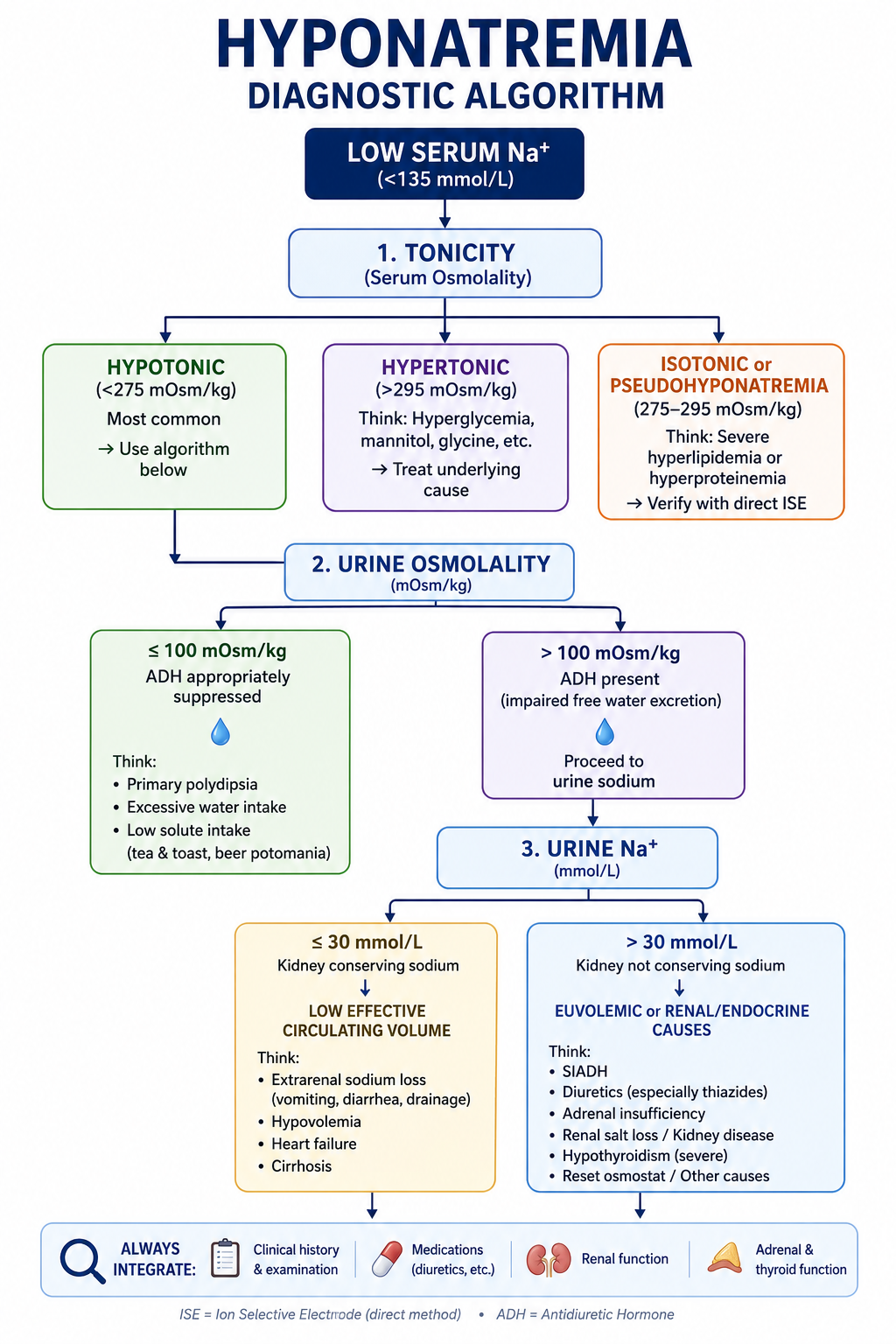
Step 1: Urine Osmolality
Urine osmolality indicates whether the kidney is excreting dilute water appropriately. In hypotonic hyponatremia, the normal response is suppression of vasopressin and production of very dilute urine.
| Urine Osmolality | Interpretation | Think About |
|---|---|---|
| At or below 100 mOsm/kg | ADH is largely suppressed; kidney is producing dilute urine | Primary polydipsia, low-solute intake, excess water intake |
| Above 100 mOsm/kg | ADH effect is present; water is being retained | Hypovolemia, SIADH physiology, adrenal insufficiency, heart failure, cirrhosis, drugs, nausea, pain |
Urine osmolality above 100 mOsm/kg does not diagnose SIADH. It says water excretion is not maximally dilute because vasopressin effect is present.
Step 2: Urine Sodium
If urine osmolality is above 100 mOsm/kg, urine sodium helps assess whether the kidney is avidly retaining sodium because effective arterial volume is low.
| Urine Sodium | Typical Meaning | Important Limits |
|---|---|---|
| At or below 30 mmol/L | Low effective arterial volume is likely | May occur with vomiting, diarrhoea, heart failure, cirrhosis or nephrotic physiology |
| Above 30 mmol/L | Renal sodium loss or euvolemic pattern becomes more likely | Diuretics, adrenal insufficiency, kidney disease and SIADH physiology must be considered |
Urine sodium is useful, but not magic. Recent diuretic use, chronic kidney disease, adrenal insufficiency and mixed clinical pictures can make interpretation harder.
Major Causes of Hyponatremia
Hypovolemic Hyponatremia
Hypovolemic hyponatremia occurs when sodium and water are both lost, but the resulting volume stimulus drives ADH-mediated water retention. Causes include vomiting, diarrhoea, diuretics, renal salt wasting, mineralocorticoid deficiency and third-space losses.
Euvolemic Hyponatremia
Euvolemic patterns include SIADH physiology, glucocorticoid deficiency, hypothyroidism in selected cases, drugs, postoperative states, pulmonary disease and central nervous system disease. SIADH should be considered only after appropriate exclusions.
Hypervolemic Hyponatremia
Hypervolemic hyponatremia occurs when total-body sodium and water are increased, but water retention is proportionally greater. Heart failure, cirrhosis, nephrotic syndrome and advanced kidney disease are classic contexts.
Low-Solute and Excess-Water States
Primary polydipsia and low-solute intake reduce the kidney's ability to excrete free water safely. Urine osmolality is often low when ADH is suppressed, but mixed patterns can occur.
SIADH
SIADH is a pattern of impaired water excretion due to vasopressin activity that is not explained by appropriate volume, endocrine or osmotic stimuli. It is not diagnosed by one urine result alone.
A typical SIADH-like pattern includes hypotonic hyponatremia, urine osmolality above 100 mOsm/kg, urine sodium often above 30 mmol/L, no oedematous state, no obvious hypovolemia and appropriate exclusion of adrenal insufficiency and other causes.
The disease-level explanation is covered in SIADH Explained.
Do not write "urine osmolality >100 equals SIADH" or "urine sodium >30 equals SIADH." These are clues inside a full clinical assessment.
Treatment of Hyponatremia
Treatment depends on symptoms, acuity, tonicity, cause, volume status and risk of overcorrection. A stable patient with chronic mild hyponatremia is approached very differently from a patient with seizures due to acute hypotonic hyponatremia.
| Clinical Situation | General Principle |
|---|---|
| Severe symptoms | Urgent monitored hypertonic saline treatment to reverse cerebral edema |
| Hypovolemic hyponatremia | Restore effective circulating volume and treat the cause |
| Euvolemic/SIADH-like pattern | Fluid restriction and cause-specific management are common starting points |
| Hypervolemic hyponatremia | Treat heart failure, cirrhosis, kidney disease or other underlying oedematous state |
| Low-solute or polydipsia | Correct intake pattern carefully and monitor for rapid water diuresis |
This page teaches principles rather than patient-specific dosing. Severe symptomatic hyponatremia is a medical emergency requiring local protocols, frequent monitoring and senior or specialist input.
Severe Symptomatic Hyponatremia
Severe symptomatic hypotonic hyponatremia generally requires urgent monitored treatment with 3% hypertonic saline. The early goal is not full normalization of sodium; it is a small rise, often around 4 to 6 mmol/L, sufficient to reduce life-threatening cerebral edema.
Guidelines and institutions differ in exact bolus volumes, infusion strategies and correction limits. The shared principle is controlled correction with frequent sodium monitoring and active prevention of overcorrection.

Avoiding Overcorrection
Overcorrection can occur when the underlying ADH stimulus reverses and the patient suddenly produces large volumes of dilute urine. This may happen after volume restoration, stopping a causative drug, treating adrenal insufficiency or improving nausea and pain.
Risk is higher in chronic severe hyponatremia and in patients with malnutrition, alcoholism, liver disease, hypokalemia or very low starting sodium. Potassium replacement can also raise serum sodium and must be considered in the correction plan.
Correction limits vary by guideline and risk category. The safest educational statement is that chronic hyponatremia should be corrected slowly, with stricter limits in high-risk patients.
Osmotic Demyelination Syndrome
Osmotic demyelination syndrome is a serious neurological complication associated with overly rapid correction of chronic hyponatremia. Symptoms may be delayed and can include dysarthria, dysphagia, weakness, movement disorders, reduced consciousness and locked-in syndrome.
The danger explains why the target in severe symptomatic hyponatremia is an initial controlled rise, not rapid normalization. Once immediate danger is reduced, the rest of correction must be carefully limited and monitored.
Worked Clinical Examples
Case 1: Primary Polydipsia Pattern
A patient has low sodium, low serum osmolality and urine osmolality at or below 100 mOsm/kg. The kidney is producing dilute urine, suggesting ADH suppression. Think excess water intake or low-solute intake rather than SIADH.
Case 2: Hypovolemic Pattern
A patient has vomiting, low serum sodium, urine osmolality above 100 mOsm/kg and urine sodium at or below 30 mmol/L. ADH is active because effective volume is low, and the kidney is retaining sodium.
Case 3: SIADH-Like Pattern
A patient has hypotonic hyponatremia, urine osmolality above 100 mOsm/kg and urine sodium above 30 mmol/L without oedema or obvious hypovolemia. SIADH becomes possible, but adrenal insufficiency, drugs and other causes still need exclusion.
Case 4: Heart Failure Pattern
A patient has oedema, low serum sodium and low urine sodium. Total-body sodium may be increased, yet effective arterial circulation is sensed as low, causing ADH and RAAS activation with proportionally greater water retention.
Common Mistakes
- Misconception: Hyponatremia means sodium deficiency. Reality: it is a low concentration and often a water-balance disorder.
- Misconception: All hyponatremia is hypotonic. Reality: hypertonic hyponatremia and pseudohyponatremia must be considered.
- Misconception: Urine osmolality above 100 means SIADH. Reality: it means vasopressin effect is present.
- Misconception: Urine sodium above 30 means SIADH. Reality: diuretics, adrenal insufficiency and kidney disease can create similar patterns.
- Misconception: Chronic severe hyponatremia can be corrected rapidly if the patient looks well. Reality: chronic adaptation increases the danger of osmotic demyelination.
One Minute Revision
- Hyponatremia is serum sodium below the reference range, usually below about 135 mmol/L.
- It does not automatically mean sodium depletion.
- First decide whether the patient is truly hypotonic.
- In hypotonic hyponatremia, urine osmolality asks whether ADH is suppressed or active.
- Urine osmolality at or below 100 mOsm/kg suggests excess water intake or low solute.
- Urine osmolality above 100 mOsm/kg indicates vasopressin effect.
- Urine sodium helps assess effective arterial volume, but diuretics and kidney disease can mislead.
- Severe symptomatic hyponatremia needs urgent monitored treatment.
- Chronic hyponatremia must not be corrected too rapidly because of ODS risk.
Frequently Asked Questions
Conclusion
The correct approach to hyponatremia is not "sodium is low, give sodium." It is a structured physiological sequence: identify low serum sodium, decide whether hypotonicity is present, use urine osmolality to determine whether water excretion is appropriately dilute or ADH-mediated, use urine sodium and the clinical context to identify the cause, then treat safely. Severe symptomatic hyponatremia is an emergency, but chronic hyponatremia requires controlled correction to avoid osmotic demyelination.
This article is intended for medical education only. Severe symptomatic hyponatremia is a medical emergency requiring monitored clinical management; treatment protocols should follow local institutional and specialist guidance.