RUNX2 links the skull, clavicles and teeth
RUNX2 loss of function → osteoblast differentiation and skeletal morphogenesis impaired → abnormal ossification.
Unlike CTSK-related pycnodysostosis, CCD primarily teaches osteoblast and ossification failure rather than osteoclast matrix-degradation failure.
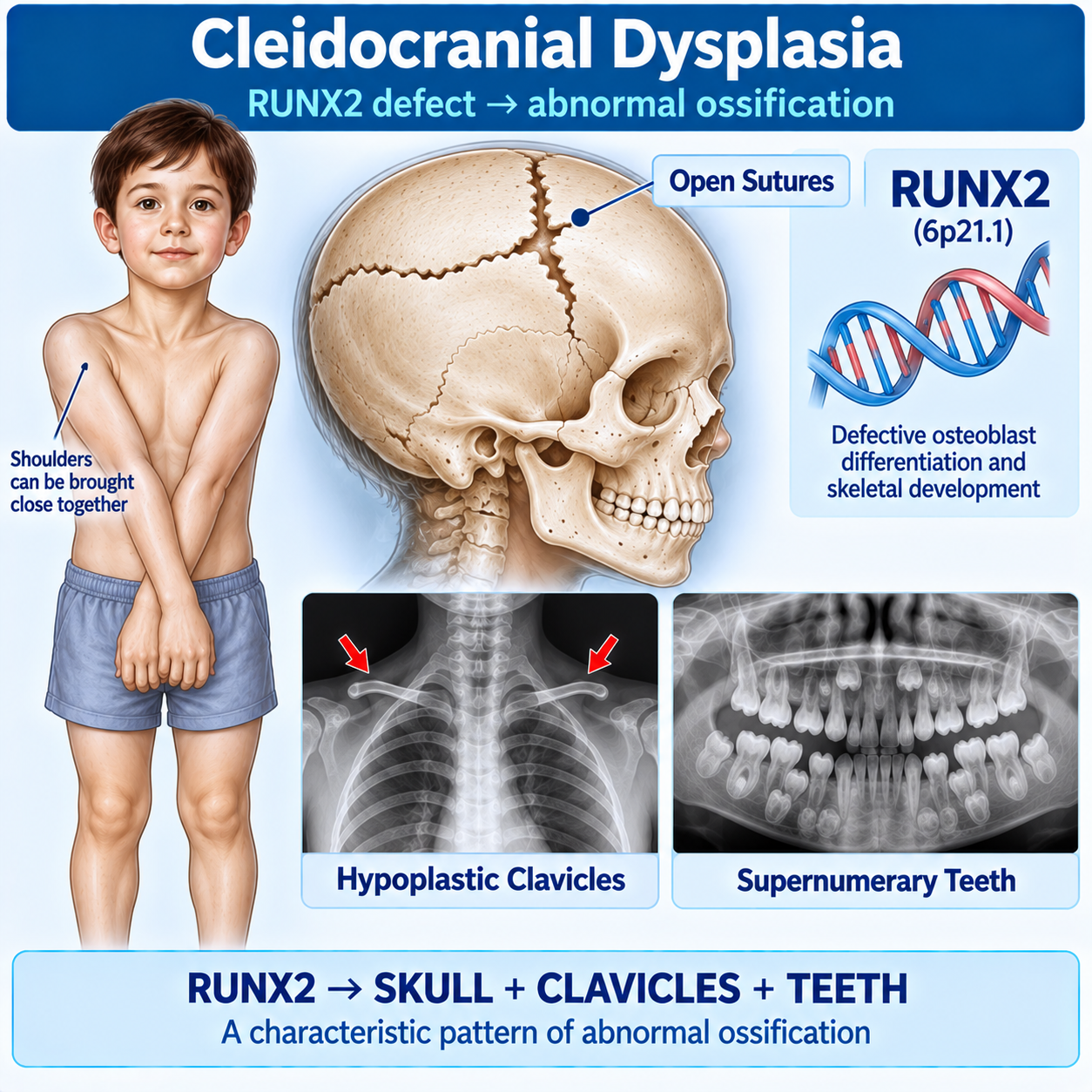
What Is Cleidocranial Dysplasia?
Core Teaching Question
How does RUNX2 dysfunction disrupt osteoblast differentiation and skeletal ossification, why does this produce delayed cranial-suture closure, hypoplastic clavicles and characteristic dental abnormalities, and how can cleidocranial dysplasia be distinguished from pycnodysostosis and other skeletal disorders?
Central Teaching Concept
RUNX2 IS A MASTER REGULATOR OF SKELETAL DEVELOPMENTCentral pathway:
HETEROZYGOUS RUNX2 PATHOGENIC VARIANT RUNX2 FUNCTION ↓ OSTEOBLAST DIFFERENTIATION / SKELETAL MORPHOGENESIS IMPAIRED OSSIFICATION ABNORMALthree particularly recognizable consequences:
CRANIAL SUTURESDelayed closure
CLAVICLESHypoplastic or aplastic
TEETHDelayed eruption + supernumerary teeth
GeneReviews confirms that RUNX2 is essential for osteoblast differentiation during intramembranous ossification and participates in chondrocyte maturation during endochondral ossification. (NCBI)
Opening Clinical Scenario
A child is referred because the anterior fontanelle remains unusually large.
Examination shows:
- frontal bossing;
- relatively short stature;
- narrow, sloping shoulders.
Then the child demonstrates something striking:
THE SHOULDERS CAN BE BROUGHT UNUSUALLY CLOSE TOGETHER IN FRONT OF THE CHESTChest radiography shows:
HYPOPLASTIC CLAVICLESDental imaging later demonstrates:
MULTIPLE UNERUPTED AND SUPERNUMERARY TEETHThis combination should immediately suggest:
CLEIDOCRANIAL DYSPLASIAThe underlying gene is:
RUNX2The disease therefore provides an excellent way to understand how abnormal regulation of osteoblast differentiation and ossification can simultaneously affect the:
SKULL + CLAVICLES + TEETHWhat Is Cleidocranial Dysplasia?
Cleidocranial dysplasia spectrum disorder is a genetic skeletal dysplasia.
The classic phenotype is characterized by the triad of:
DELAYED CLOSURE OF CRANIAL SUTURES HYPOPLASTIC OR APLASTIC CLAVICLES DENTAL ABNORMALITIESBut CCD is a:
SPECTRUM DISORDERThe phenotype can range from:
classic CCD
to:
mild skeletal disease
to:
predominantly or even isolated dental abnormalities.
Therefore:
NOT EVERY PATIENT HAS THE COMPLETE CLASSIC TRIADThere are no formal universally established clinical diagnostic criteria. (NCBI)
RUNX2 and Osteoblast Differentiation
The Gene — RUNX2
The major gene is:
RUNX2located at:
6p21.1It encodes:
RUNT-RELATED TRANSCRIPTION FACTOR 2RUNX2 is a transcription factor with a central role in:
- osteoblast differentiation;
- skeletal morphogenesis;
- intramembranous ossification;
- chondrocyte maturation during endochondral ossification.
The disease mechanism is predominantly:
LOSS OF FUNCTION(NCBI)
What Is A Transcription Factor?
Students need this short foundation.
A transcription factor is a protein that regulates expression of other genes.
Therefore RUNX2 is not:
- collagen;
- bone mineral;
- an osteoclast enzyme;
- a calcium-regulating hormone.
Instead:
RUNX2 CONTROLS A PROGRAM OF GENE EXPRESSION IMPORTANT FOR SKELETAL CELL DIFFERENTIATIONThis is fundamentally different from:
CTSK in pycnodysostosis.
Normal Osteoblast Differentiation
Mesenchymal progenitor cells can differentiate into several connective-tissue lineages.
For the osteoblast lineage:
MESENCHYMAL PROGENITOR OSTEOBLAST-LINEAGE COMMITMENT OSTEOBLAST OSTEOID PRODUCTION MINERALIZED BONERUNX2 is a crucial transcriptional regulator in this process.
Therefore reduced RUNX2 function disrupts normal skeletal development rather than simply changing serum calcium.
Intramembranous Ossification
This concept deserves a dedicated section.
In intramembranous ossification:
MESENCHYMAL TISSUE → BONEwithout first creating the classic cartilage template used in endochondral ossification.
Important structures substantially dependent on intramembranous ossification include portions of the:
- skull;
- clavicle.
Therefore impaired RUNX2 function helps explain why these structures are so prominent in CCD.
CCD is not only an intramembranous-ossification disorder because RUNX2 also contributes to chondrocyte maturation and endochondral skeletal development. (NCBI)
Endochondral Ossification
In endochondral ossification:
CARTILAGE MODEL CHONDROCYTE MATURATION CARTILAGE REPLACED BY BONEThis process forms much of the appendicular skeleton.
RUNX2 also contributes to chondrocyte maturation.
Therefore CCD can have manifestations beyond the skull and clavicles.
Master Mechanism
RUNX2 LOSS OF FUNCTION OSTEOBLAST DIFFERENTIATION ↓ SKELETAL MORPHOGENESIS ALTERED OSSIFICATION ABNORMALSkull
Delayed ossification / delayed suture closure
Clavicles
Hypoplasia or aplasia
Teeth
Abnormal eruption + supernumerary teeth
Skeleton
Short stature and additional skeletal abnormalities
Bottom memory:
RUNX2 → OSTEOBLASTS → OSSIFICATION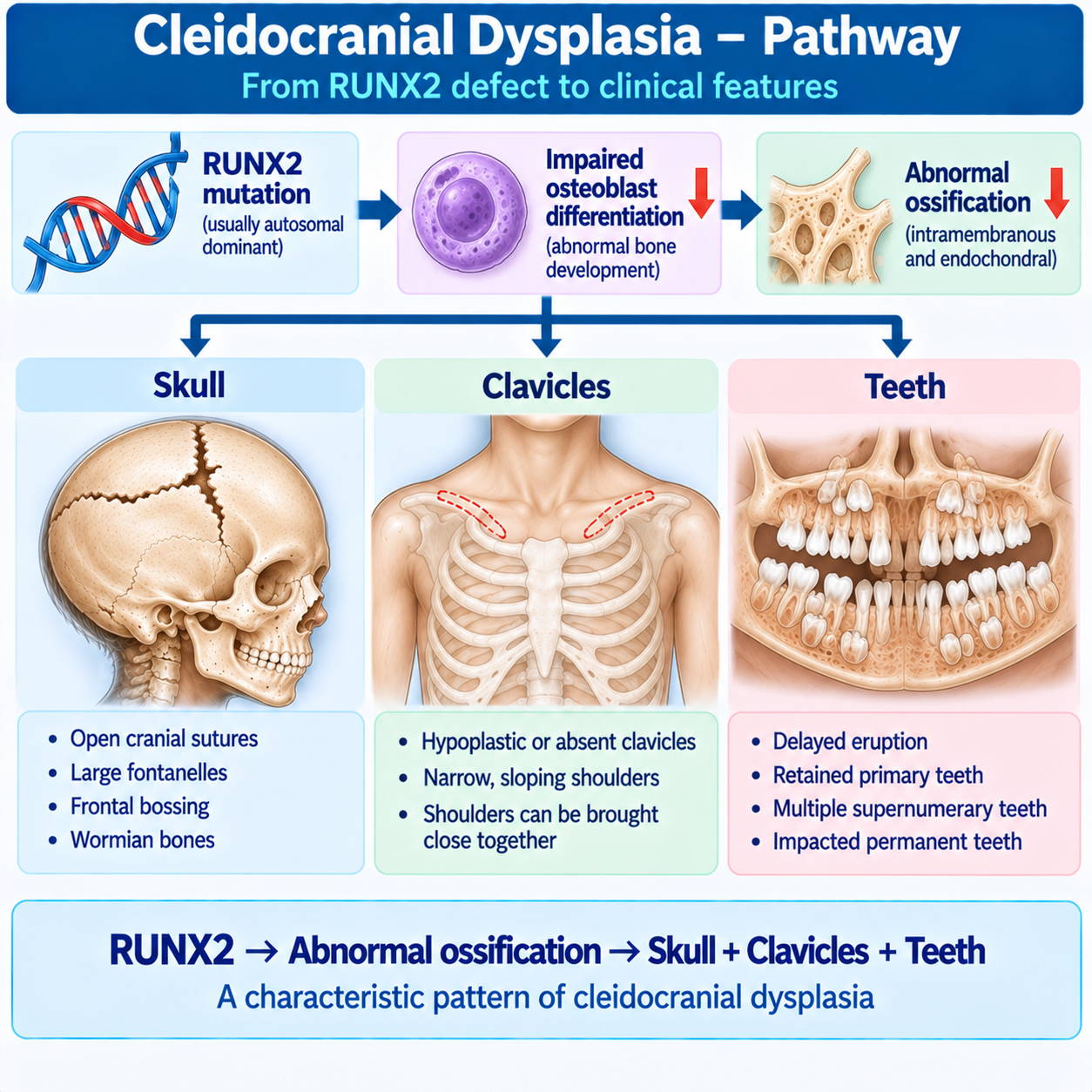
Cranial Sutures and Skull Morphology
Cranial Sutures
One of the most characteristic manifestations is:
DELAYED CLOSURE OF CRANIAL SUTURESThis can produce:
- persistently open sutures;
- large fontanelles;
- delayed closure of the anterior fontanelle.
Therefore:
PERSISTENT OPEN FONTANELLE IS AN IMPORTANT CCD CLUEbut it is not specific.
Other disorders can also delay cranial ossification.
Skull Morphology
Characteristic findings can include:
- delayed cranial ossification;
- open sutures/fontanelles;
- frontal bossing;
- parietal bossing;
- broad forehead;
- brachycephaly;
- Wormian bones.
No single skull feature is independently diagnostic.
The pattern matters.
Wormian Bones
Wormian bones are:
ACCESSORY OSSICLES WITHIN CRANIAL SUTURESThey may occur in CCD but are not specific to it.
They can also occur in other skeletal disorders.
Therefore:
WORMIAN BONES SUPPORT THE PATTERN — THEY DO NOT DIAGNOSE CCD BY THEMSELVESFacial Features
Possible craniofacial findings include:
- broad forehead;
- frontal bossing;
- midface retrusion;
- depressed/wide nasal bridge;
- relative mandibular prominence.
The apparent mandibular prominence can partly reflect:
MIDFACE / MAXILLARY HYPOPLASIArather than primary excessive mandibular growth.
Clavicles and Shoulder Approximation
The Clavicles
The clavicles provide one of the most memorable clues.
They may be:
HYPOPLASTICor:
PARTIALLY / COMPLETELY ABSENTThe abnormality may be bilateral or asymmetric.
GeneReviews identifies clavicular hypoplasia/aplasia as part of the classic CCD triad. (NCBI)
Shoulder Approximation
Because the clavicles normally brace the shoulders laterally, marked clavicular hypoplasia can permit:
EXCESSIVE ANTERIOR MOBILITY OF THE SHOULDERSSome patients can bring their shoulders:
VERY CLOSE TO THE MIDLINEin front of the chest.
This is a memorable clinical sign.
This finding is not obligatory.
Dental Disease
Dental Disease Is Central
Dental abnormalities are not a minor accessory finding.
They are one of the defining components of CCD.
Important abnormalities include:
DELAYED ERUPTION OF PERMANENT TEETH RETAINED PRIMARY TEETH SUPERNUMERARY TEETH IMPACTED PERMANENT TEETHOther dental abnormalities may occur.
The result can be complex dental crowding and malocclusion.
Supernumerary Teeth
A particularly important clue is:
MULTIPLE SUPERNUMERARY TEETHDental panoramic radiography may reveal numerous unerupted additional teeth.
This can be striking even when the external skeletal phenotype is relatively mild.
Therefore:
MULTIPLE SUPERNUMERARY TEETH + DELAYED ERUPTION → CONSIDER CCDWhy Teeth May Not Erupt Normally
This process is more than extra teeth mechanically blocking normal teeth.
Dental eruption abnormalities in CCD reflect the broader developmental consequences of RUNX2 dysfunction.
Supernumerary teeth can add mechanical complexity, but the underlying biology is broader.
Therefore avoid a single-cause explanation.
Dental Phenotype May Dominate
Because CCD is a spectrum, some individuals can present predominantly with:
DENTAL ABNORMALITIESwithout an immediately obvious classic skeletal phenotype.
This is important diagnostically.
A dentist or orthodontist may therefore be the first clinician to suspect CCD.
GeneReviews explicitly recognizes isolated dental-anomaly phenotypes within the RUNX2-related spectrum. (NCBI)
Other Skeletal Manifestations
Short Stature
Many affected individuals have:
SHORT STATUREusually mild to moderate.
SHORT STATURE = GROWTH-HORMONE DEFICIENCYGeneReviews does not recommend GH therapy as standard CCD treatment, and its efficacy has not been established. (NCBI)
Hands
Hand abnormalities can include:
- hypoplastic distal phalanges;
- short middle phalanges;
- abnormalities of the third, fourth and fifth digits;
- cone-shaped epiphyses.
These findings may support the diagnosis but should not replace the classic skull-clavicle-dental pattern. (NCBI)
Pelvis
Pelvic abnormalities can occur.
These may include developmental changes affecting pelvic morphology.
This becomes particularly relevant in affected women because:
CEPHALOPELVIC DISPROPORTIONmay complicate childbirth.
Pregnancy should therefore involve appropriate obstetric assessment rather than an assumption that every patient requires cesarean delivery. (NCBI)
Spine And Orthopedic Manifestations
Patients may develop orthopedic problems including:
- scoliosis;
- kyphosis;
- genu valgum;
- pes planus;
- other skeletal alignment abnormalities.
Management depends on the individual abnormality.
Bone Density And Fractures
A critical correction to the simplistic view of CCD:
CCD is not merely a disorder of the skull, clavicles and teeth.
Some affected individuals have:
LOW BONE MINERAL DENSITYand:
OSTEOPENIA / OSTEOPOROSISSome can sustain recurrent fractures.
GeneReviews recommends DXA assessment beginning in early adolescence and subsequently at intervals, reflecting this recognized bone-health component. (NCBI)
However:
FRACTURE FRAGILITY IS NOT THE PRIMARY DEFINING FEATURE OF CLASSIC CCDThis distinction is important when comparing it with pycnodysostosis.
Hearing, Sinus and Airway Disease
Hearing And Ear Disease
CCD may be associated with:
- recurrent otitis media;
- hearing loss.
Children should therefore be monitored for:
HEARING PROBLEMSand:
RECURRENT MIDDLE-EAR DISEASEGeneReviews includes these among ongoing surveillance concerns. (NCBI)
Sinus Disease
Craniofacial anatomy may predispose some patients to:
RECURRENT SINUS INFECTIONSThis belongs in the clinical spectrum but should not dominate the article.
Upper Airway And Sleep Apnea
Some affected individuals can develop:
UPPER-AIRWAY OBSTRUCTIONand symptoms suggestive of:
OBSTRUCTIVE SLEEP APNEAGeneReviews recommends sleep study when manifestations of OSA are present. (NCBI)
Universal polysomnography is not indicated for asymptomatic individuals.
Laboratory Findings
Routine serum biochemical testing does not diagnose CCD.
The disorder is fundamentally:
A GENETIC SKELETAL DEVELOPMENT DISORDERrather than a classic calcium/phosphate metabolic disorder.
There is no defining routine biochemical profile.
If laboratory testing is performed, its role is generally to investigate:
- bone health;
- alternative diagnoses;
- associated clinical problems.
Radiology
Radiology
Radiology is central to recognizing the phenotype.
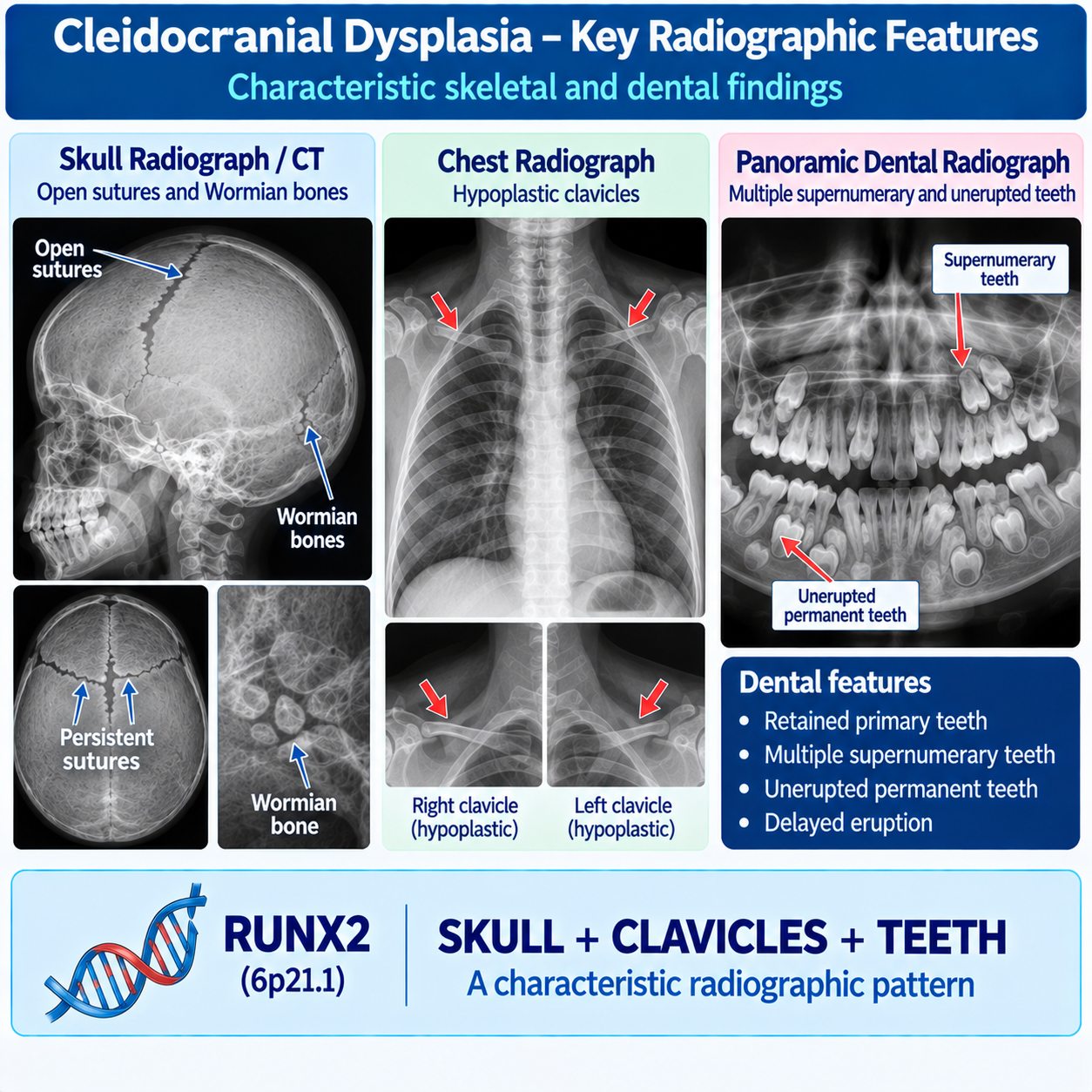
The highest-yield findings are:
DELAYED CRANIAL-SUTURE CLOSURE WORMIAN BONES HYPOPLASTIC / APLASTIC CLAVICLES MULTIPLE SUPERNUMERARY / UNERUPTED TEETHAdditional skeletal abnormalities may support the diagnosis.
Skull Radiograph
Potential findings include:
- open sutures;
- delayed fontanelle closure;
- Wormian bones;
- abnormal cranial ossification;
- craniofacial disproportion.
Avoid portraying one isolated Wormian bone as diagnostic.
Chest Radiograph
Look specifically at:
THE CLAVICLESThey may be:
- shortened;
- hypoplastic;
- discontinuous;
- partly absent;
- markedly reduced.
The clavicular finding explains the unusual shoulder mobility.
Panoramic Dental Radiograph
This is one of the most educational images.
It may demonstrate:
RETAINED PRIMARY TEETH UNERUPTED PERMANENT TEETH MULTIPLE SUPERNUMERARY TEETHThis combination is highly characteristic in the appropriate skeletal context.
Diagnosis and Molecular Testing
Diagnosis
There are no formal universally accepted clinical diagnostic criteria.
A clinical diagnosis can be established from:
CHARACTERISTIC CLINICAL + RADIOGRAPHIC FINDINGSA molecular diagnosis can be established in an individual with suggestive findings by identifying:
A HETEROZYGOUS PATHOGENIC OR LIKELY PATHOGENIC RUNX2 VARIANT(NCBI)
High-Yield Diagnostic Pattern
PERSISTENT OPEN CRANIAL SUTURES HYPOPLASTIC / ABSENT CLAVICLES SUPERNUMERARY + DELAYEDLY ERUPTING TEETH THINK CLEIDOCRANIAL DYSPLASIAThen:
CONFIRM THE PHENOTYPE CONSIDER RUNX2 TESTINGMolecular Testing
Testing approaches may include:
RUNX2 sequence analysis
This detects approximately:
70–80%of affected probands with detectable pathogenic variants by that method.
Deletion/duplication analysis
Approximately another:
15%may be detected through gene-targeted deletion/duplication analysis.
A multigene skeletal-dysplasia panel may be appropriate when the phenotype overlaps with other disorders.
In selected patients with additional congenital anomalies/developmental delay and nondiagnostic RUNX2 testing, chromosome-level evaluation may be considered.
(NCBI)
These approximate detection proportions are not guarantees.
VUS
A:
VARIANT OF UNCERTAIN SIGNIFICANCEdoes not establish the molecular diagnosis.
RUNX2 variant = CCD.
Instead:
PATHOGENICITY + PHENOTYPE + INHERITANCE MUST BE INTERPRETED TOGETHERInheritance
CCD spectrum disorder is usually:
AUTOSOMAL DOMINANTTherefore an affected individual with a heterozygous RUNX2 pathogenic variant has:
50% CHANCEof transmitting that variant to each child.
However, many affected individuals have a:
DE NOVO PATHOGENIC VARIANTTherefore:
NO FAMILY HISTORY DOES NOT EXCLUDE CCD(NCBI)
Penetrance And Variability
RUNX2 pathogenic variants have:
HIGH PENETRANCEbut phenotype severity can vary.
There can also be:
INTRAFAMILIAL VARIABILITYTherefore an affected parent and child do not necessarily have identical manifestations. (NCBI)
Genetic Counseling
Once the familial pathogenic RUNX2 variant is identified:
- testing of relatives may be possible;
- prenatal testing may be possible;
- preimplantation genetic testing may be possible.
Provide genetic counseling.
Differential Diagnosis
Differential Diagnosis
Prioritize:
Mistake 1
pycnodysostosis;
GeneReviews specifically recognizes ALPL-related hypophosphatasia and CBFB-related CCD among relevant genetic differentials. (NCBI)
CCD Versus Pycnodysostosis
This is the most important comparison because both articles exist locally.
Use:
| Feature | Cleidocranial dysplasia | Pycnodysostosis |
|---|---|---|
| Gene | RUNX2 | CTSK |
| Inheritance | AD | AR |
| Main biology | Osteoblast differentiation / ossification | Osteoclast matrix degradation |
| Open cranial sutures | Classic | Common |
| Clavicular abnormality | Classic/prominent | Can occur |
| Dental abnormalities | Very prominent | Prominent |
| Supernumerary teeth | Characteristic | Not defining |
| Osteosclerosis | Not defining | Characteristic |
| Acroosteolysis | Not characteristic | Characteristic |
| Dense fragile bones | Not central phenotype | Central |
| Shoulder approximation | Characteristic clue | Not defining |
| Obtuse mandibular angle | Not defining | Characteristic |
| Inheritance clue | Vertical AD pattern possible | AR pattern |
Bottom memory:
OPEN SUTURES + CLAVICLES + EXTRA TEETH → CCDversus:
OSTEOSCLEROSIS + ACROOSTEOLYSIS → PYCNODYSOSTOSISDo Not Duplicate Pycnodysostosis Content
Do not repeat long explanations of:
- osteoclast resorption;
- cathepsin K;
- collagen degradation by osteoclasts;
- osteosclerosis;
- acroosteolysis;
- dense-but-fragile bone biology.
Instead provide the comparison table and internal link.
The CCD article owns:
RUNX2 + OSTEOBLAST DEVELOPMENT + OSSIFICATION + SKULL + CLAVICLES + TEETHThe pycnodysostosis article owns:
CTSK + OSTEOCLAST MATRIX DEGRADATION + OSTEOSCLEROSIS + ACROOSTEOLYSISCCD Versus Hypophosphatasia
Use:
| Feature | CCD | Hypophosphatasia |
|---|---|---|
| Gene | RUNX2 | ALPL |
| Main mechanism | Skeletal development/ossification | Mineralization failure |
| Cranial sutures | Delayed closure | May be abnormal in severe childhood disease |
| Dental clue | Supernumerary/unerupted teeth | Premature tooth loss with intact roots |
| Clavicles | Hypoplastic/aplastic | Generally much less characteristic |
| ALP | Not defining | Persistently low |
| Rickets/osteomalacia | Not defining | Major phenotype |
GeneReviews specifically notes very low ALP as a differentiating feature of HPP. (NCBI)
CCD Versus Osteogenesis Imperfecta
CCD
RUNX2 / skeletal development
Think:
- open sutures;
- clavicles;
- supernumerary teeth.
OI
collagen matrix disorder
Think:
- recurrent fractures;
- bone fragility;
- blue sclerae in some types;
- dentinogenesis imperfecta in some types.
Wormian bones can occur in both.
Therefore:
WORMIAN BONES ALONE DO NOT DISTINGUISH CCD FROM OITreatment and Management
Treatment Philosophy
There is no simple therapy that:
RESTORES NORMAL RUNX2 FUNCTION THROUGHOUT THE SKELETONManagement is therefore:
MANIFESTATION-DIRECTED + MULTIDISCIPLINARYMajor domains:
- dental/orthodontic;
- craniofacial;
- orthopedic;
- hearing/ENT;
- airway/sleep;
- bone health;
- obstetric;
- genetic counseling.
Dental Management
This should be the largest management subsection.
Dental management may require coordinated:
DENTAL + ORTHODONTIC + ORAL/MAXILLOFACIALcare.
Depending on the patient, approaches can involve management of:
- retained primary teeth;
- supernumerary teeth;
- impacted permanent teeth;
- eruption;
- alignment;
- malocclusion.
GeneReviews describes several dental strategies, including prosthetic approaches and combined surgical/orthodontic approaches. (NCBI)
However:
DENTAL MANAGEMENT MUST BE INDIVIDUALIZEDbecause management is individualized.
Why Early Dental Planning Matters
Dental treatment can be:
- prolonged;
- staged;
- multidisciplinary.
Therefore recognition before severe crowding and eruption problems accumulate can improve planning.
Early intervention does not guarantee a particular outcome.
Craniofacial Management
Most skull abnormalities do not automatically require surgery.
Selected structural problems may require craniofacial specialist evaluation.
Orthopedic Management
Monitor for clinically important:
- scoliosis;
- limb alignment abnormalities;
- other orthopedic complications.
Treatment depends on symptoms and severity.
Bone Health
Because reduced BMD/osteoporosis can occur, bone health should not be ignored.
GeneReviews recommends:
DXA BEGINNING IN EARLY ADOLESCENCEand suggests repeat assessment approximately:
EVERY 5–10 YEARSdepending on clinical context. (NCBI)
Growth Hormone
Important warning:
GH IS NOT STANDARD TREATMENT FOR CCD SHORT STATUREGeneReviews states that efficacy has not been proven and notes theoretical concerns because RUNX2 participates in chondrocyte differentiation and growth-plate maintenance. (NCBI)
ENT And Hearing
Monitor clinically for:
- recurrent otitis;
- hearing loss;
- sinus disease.
GeneReviews recommends timely treatment of sinus/middle-ear infections and consideration of appropriate ENT interventions for recurrent disease. (NCBI)
Sleep And Airway
If symptoms suggest OSA:
PERFORM APPROPRIATE SLEEP EVALUATIONGeneReviews specifically recommends sleep study in patients with manifestations of obstructive sleep apnea. (NCBI)
Routine sleep studies are not recommended for every asymptomatic patient.
Pregnancy
Affected women should be assessed for:
CEPHALOPELVIC DISPROPORTIONduring pregnancy.
This may affect delivery planning.
CCD requires cesarean delivery.
Instead:
DELIVERY PLANNING SHOULD BE INDIVIDUALIZED(NCBI)
Initial Assessment After Diagnosis
Assess:
Skeletal
- stature;
- posture;
- scoliosis;
- orthopedic symptoms;
- fracture history.
Craniofacial
- fontanelles/sutures;
- facial structure;
- functional concerns.
Dental
- eruption;
- retained teeth;
- supernumerary teeth;
- orthodontic needs.
ENT
- hearing;
- recurrent ear infections;
- sinus problems.
Respiratory
- symptoms of upper-airway obstruction/OSA.
Bone health
- age-appropriate BMD assessment.
Genetics
- family history;
- counseling;
- testing strategy.
Master Diagnostic Algorithm
DELAYED FONTANELLE / OPEN CRANIAL SUTURES LOOK AT THE CLAVICLESHypoplastic / absent?
If yes:
LOOK AT THE TEETHDelayed eruption / retained primary / supernumerary teeth?
If yes:
CLEIDOCRANIAL DYSPLASIA STRONGLY SUSPECTED ASSESS COMPLETE SKELETAL + DENTAL PHENOTYPE RUNX2 MOLECULAR TESTING CONFIRM MOLECULAR DIAGNOSIS WHEN PATHOGENIC VARIANT IDENTIFIEDBottom:
SKULL + CLAVICLES + TEETHOpen-Fontanelle Differential Algorithm
PERSISTENTLY OPEN FONTANELLE / DELAYED CRANIAL OSSIFICATIONHypoplastic clavicles + supernumerary teeth?
CCDOsteosclerosis + acroosteolysis?
PYCNODYSOSTOSISPersistently low ALP + mineralization failure/premature tooth loss?
HYPOPHOSPHATASIAMajor fracture phenotype/collagen clues?
CONSIDER OSTEOGENESIS IMPERFECTAOther biochemical/systemic clues?
Investigate alternative causes.
Bottom:
DO NOT DIAGNOSE THE DISORDER FROM THE FONTANELLE ALONEWhich Cell Is the Problem?
WHO IS THE PROBLEM?
Osteogenesis imperfecta
BONE MATRIXHypophosphatasia
MINERALIZATIONOsteopetrosis
OSTEOCLAST RESORPTIONPycnodysostosis
OSTEOCLAST MATRIX DEGRADATIONCleidocranial dysplasia
OSTEOBLAST DIFFERENTIATION / SKELETAL DEVELOPMENTThis strengthens the entire AtMedStu skeletal-disease cluster.
Worked Clinical Cases
Case 1 — Open fontanelle
A school-age child has persistent open cranial sutures and frontal bossing.
Next useful examination
EXAMINE THE SHOULDERS / CLAVICLES AND DENTITIONThe skull finding alone does not diagnose CCD.
Case 2 — Shoulder approximation
A child can bring both shoulders unusually close together anteriorly.
Chest radiography shows bilateral clavicular hypoplasia.
Key diagnosis
CLEIDOCRANIAL DYSPLASIAespecially when cranial/dental findings coexist.
Case 3 — Dental presentation
An adolescent presents because permanent teeth have failed to erupt.
Panoramic imaging shows:
- retained primary teeth;
- multiple unerupted permanent teeth;
- multiple supernumerary teeth.
Think
CLEIDOCRANIAL DYSPLASIAAssess the skull and clavicles.
Case 4 — Mild phenotype
Adult has several supernumerary teeth but only subtle skeletal abnormalities.
Important principle
CCD IS A SPECTRUMA mild phenotype does not exclude RUNX2-related disease.
Case 5 — Parent and child
A parent with mild dental/clavicular abnormalities has a child with classic CCD.
Explanation
AUTOSOMAL-DOMINANT INHERITANCE + VARIABLE EXPRESSIVITYThe phenotype does not have to be identical.
Case 6 — No family history
Child has classic CCD but both parents appear unaffected.
Wrong conclusion
“Autosomal dominant disease is impossible.”
Correct principle
DE NOVO RUNX2 PATHOGENIC VARIANTS OCCURCase 7 — Pycnodysostosis differential
Child has open cranial sutures, short stature and dental abnormalities.
Radiographs additionally show:
- generalized osteosclerosis;
- acroosteolysis.
Better diagnosis
PYCNODYSOSTOSISnot classic CCD.
Case 8 — Hypophosphatasia differential
Child has delayed cranial ossification and dental abnormalities.
ALP is persistently markedly low and there is premature tooth loss.
Better direction
HYPOPHOSPHATASIAnot typical CCD.
Case 9 — Wormian bones
Skull radiograph shows Wormian bones.
Wrong conclusion
“Wormian bones prove CCD.”
Correct answer
THEY ARE NONSPECIFICInterpret them with the clavicular and dental phenotype.
Case 10 — Short stature
Child with confirmed CCD is short.
Family asks for GH.
Correct principle
SHORT STATURE DOES NOT AUTOMATICALLY JUSTIFY GHIts efficacy in CCD has not been established. (NCBI)
Case 11 — Snoring
Patient with CCD has loud snoring and witnessed apneas.
Correct action
ASSESS FOR OSAA sleep study is appropriate when clinical manifestations suggest it. (NCBI)
Case 12 — Pregnancy
Woman with CCD becomes pregnant.
Important issue
ASSESS FOR CEPHALOPELVIC DISPROPORTIONDelivery planning should be individualized. (NCBI)
Common Mistakes
- CCD is primarily an osteoclast disease. Wrong.
Mistake 2
RUNX2 encodes collagen. Wrong.
Mistake 3
RUNX2 is a calcium-regulating hormone. Wrong.
Mistake 4
Every patient has the complete classic triad. Wrong.
Mistake 5
An open fontanelle alone diagnoses CCD. Wrong.
Mistake 6
Wormian bones are specific for CCD. Wrong.
Mistake 7
Clavicles must be completely absent. Wrong.
Mistake 8
Shoulder approximation occurs in every patient. Wrong.
Mistake 9
Dental abnormalities are secondary minor findings. Wrong.
Mistake 10
Supernumerary teeth alone always mean CCD. Wrong.
Mistake 11
Delayed eruption occurs only because extra teeth mechanically block eruption. Oversimplified.
Mistake 12
No family history excludes an AD disorder. Wrong.
Mistake 13
An affected parent transmits CCD to every child. Wrong — each child has a 50% risk when the parent carries the heterozygous pathogenic variant.
Mistake 14
A RUNX2 VUS proves CCD. Wrong.
Mistake 15
CCD and pycnodysostosis are the same disease. Wrong.
Mistake 16
Acroosteolysis is a classic CCD feature. Wrong.
Mistake 17
Generalized osteosclerosis is the defining radiological feature of CCD. Wrong.
Mistake 18
Short stature means GH deficiency. Wrong.
Mistake 19
GH is established routine therapy for CCD. Wrong.
Mistake 20
All women with CCD must have cesarean delivery. Wrong.
Cleidocranial Dysplasia in One Minute
CLEIDOCRANIAL DYSPLASIA IN ONE MINUTEGene:
RUNX2Inheritance:
AUTOSOMAL DOMINANTMechanism:
RUNX2 FUNCTION ↓ OSTEOBLAST DIFFERENTIATION / OSSIFICATION ABNORMALClassic triad:
OPEN CRANIAL SUTURES HYPOPLASTIC / ABSENT CLAVICLES DENTAL ABNORMALITIESDental clues:
SUPERNUMERARY TEETH DELAYED ERUPTION RETAINED PRIMARY TEETHClinical clue:
SHOULDERS MAY APPROXIMATE ANTERIORLYDiagnosis:
CLINICAL + RADIOGRAPHIC PATTERN±
HETEROZYGOUS PATHOGENIC RUNX2 VARIANTManagement:
DENTAL + ORTHODONTIC + SKELETAL + ENT/AIRWAY + BONE HEALTHMemory:
RUNX2 → SKULL + CLAVICLES + TEETHFrequently Asked Questions
What is cleidocranial dysplasia?
Cleidocranial dysplasia is a genetic skeletal dysplasia characterized classically by delayed cranial-suture closure, hypoplastic or absent clavicles and dental abnormalities. The phenotype exists on a spectrum.
What gene causes cleidocranial dysplasia?
Most molecularly confirmed cases involve a heterozygous pathogenic variant in RUNX2.
What does RUNX2 do?
RUNX2 is a transcription factor essential for osteoblast differentiation and skeletal morphogenesis and also participates in chondrocyte maturation.
What is the classic triad of CCD?
Delayed cranial-suture closure, hypoplastic/aplastic clavicles and dental abnormalities.
Why can patients move their shoulders unusually far forward?
Hypoplastic or absent clavicles reduce the normal bony restraint on shoulder position, allowing unusually marked anterior approximation.
What are the major dental abnormalities?
Delayed eruption, retained primary teeth, impacted permanent teeth and multiple supernumerary teeth are important manifestations.
Are supernumerary teeth diagnostic by themselves?
No. They should be interpreted with the complete dental, cranial and skeletal phenotype.
What are Wormian bones?
They are accessory bones within cranial sutures. They may occur in CCD but are not specific to it.
How is CCD inherited?
It is usually autosomal dominant. An affected individual with a heterozygous pathogenic RUNX2 variant has a 50% chance of transmitting it in each pregnancy.
Can a child have CCD when neither parent is affected?
Yes. De novo RUNX2 pathogenic variants are well recognized.
How is CCD diagnosed?
The clinical diagnosis can be made from characteristic clinical and radiographic findings; molecular diagnosis can be established by identifying an appropriate heterozygous pathogenic or likely pathogenic RUNX2 variant.
How is CCD different from pycnodysostosis?
CCD is primarily a RUNX2-related osteoblast/skeletal-development disorder characterized by clavicular and dental abnormalities. Pycnodysostosis is a CTSK-related osteoclast matrix-degradation disorder characterized particularly by osteosclerosis and acroosteolysis.
Is growth hormone routinely used?
No. GeneReviews states that GH efficacy in CCD has not been established.
Can CCD affect bone density?
Yes. Osteopenia/osteoporosis and reduced BMD have been reported in affected individuals.
What is the main treatment?
There is no single disease-correcting treatment. Management is multidisciplinary and particularly emphasizes dental/orthodontic care, with management of skeletal, ENT, airway and other manifestations as required.
Key Take-Home Messages
Cleidocranial dysplasia is principally caused by:
HETEROZYGOUS RUNX2 PATHOGENIC VARIANTSRUNX2 is a major regulator of:
OSTEOBLAST DIFFERENTIATIONand:
SKELETAL MORPHOGENESISTherefore reduced RUNX2 function causes:
ABNORMAL OSSIFICATIONThe classic phenotype involves:
SKULLDelayed closure of cranial sutures/fontanelles
CLAVICLESHypoplasia or aplasia
TEETHDelayed eruption, retained primary teeth and supernumerary teeth.
The most useful clinical memory is:
OPEN SUTURES + ABNORMAL CLAVICLES + EXTRA TEETH = THINK CCDBut:
CCD IS A SPECTRUMand some patients have mild or predominantly dental disease.
Inheritance is usually:
AUTOSOMAL DOMINANTand:
DE NOVO CASES ARE COMMONThe key distinction from the neighboring AtMedStu article is:
CCD = RUNX2 / OSTEOBLAST DEVELOPMENTwhereas:
PYCNODYSOSTOSIS = CTSK / OSTEOCLAST MATRIX DEGRADATIONTherefore:
OSTEOSCLEROSIS + ACROOSTEOLYSIS → PYCNODYSOSTOSISwhile:
CLAVICULAR HYPOPLASIA + SUPERNUMERARY TEETH → CCDFinal memory:
CLEIDOCRANIAL DYSPLASIA = RUNX2 → ABNORMAL OSSIFICATION → OPEN CRANIAL SUTURES + HYPOPLASTIC CLAVICLES + SUPERNUMERARY/DELAYED TEETH