Persistent low ALP is the central diagnostic clue
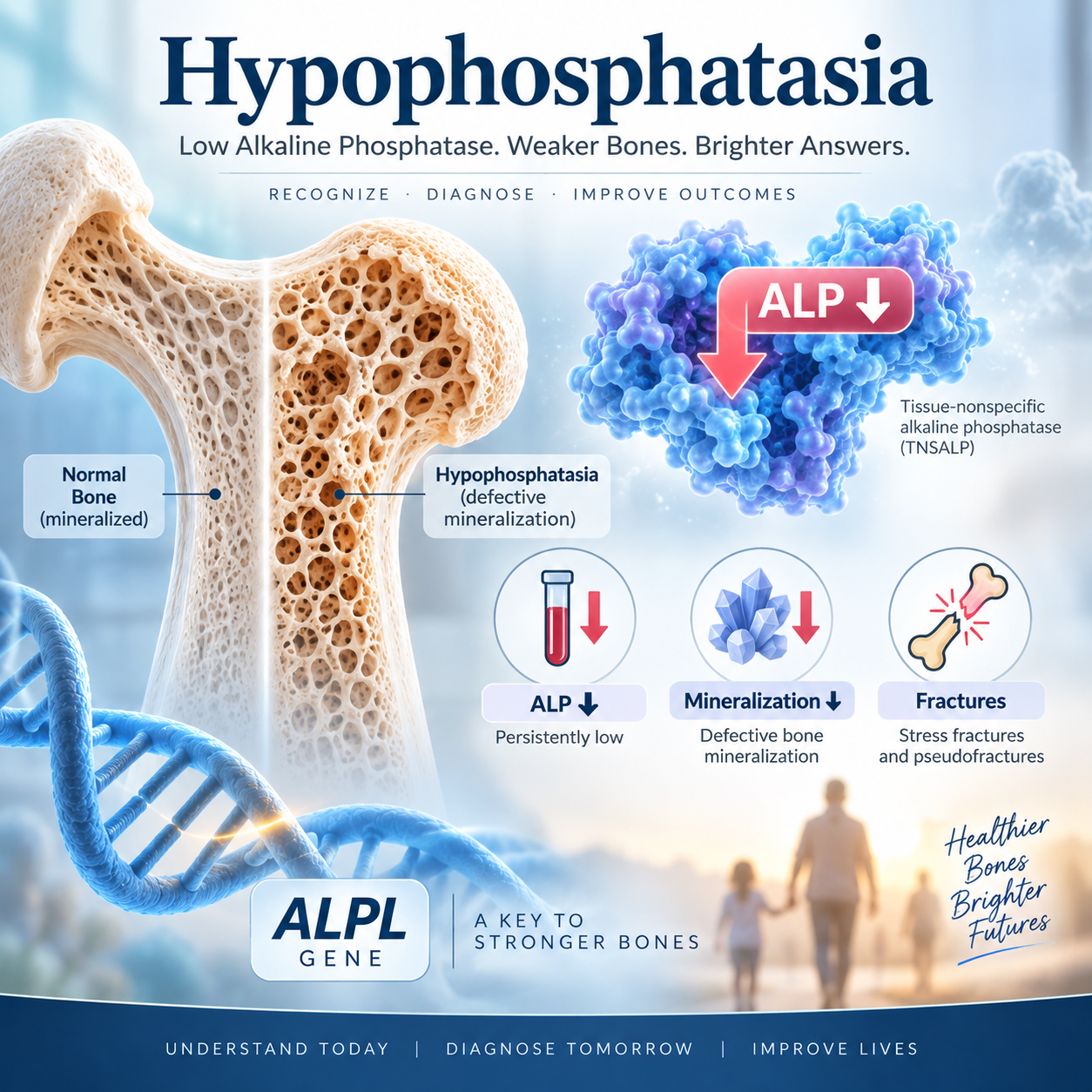
Hypophosphatasia is an inherited disorder of bone and tooth mineralization caused by deficient tissue-nonspecific alkaline phosphatase activity.
LOW ALP + FRACTURES / DENTAL CLUES → THINK HPP
What Is Hypophosphatasia?
Opening
Alkaline phosphatase is often taught as a laboratory value that becomes elevated in bone disease.
But one important metabolic bone disorder teaches the opposite lesson:
A PERSISTENTLY LOW ALP CAN BE THE CLUEHypophosphatasia, or HPP, is a rare inherited disorder caused by pathogenic variants affecting:
ALPLthe gene encoding tissue-nonspecific alkaline phosphatase.
Reduced tissue-nonspecific alkaline phosphatase activity interferes with normal mineralization of bone and teeth.
The clinical spectrum is extremely broad.
Severe disease may present before or shortly after birth.
Milder disease may remain unrecognized until adulthood, when a patient presents with:
- recurrent metatarsal stress fractures;
- femoral pseudofractures;
- poor fracture healing;
- bone or muscle pain;
- premature tooth loss;
- chondrocalcinosis;
- or an apparent diagnosis of osteoporosis.
GeneReviews describes adult HPP particularly in association with osteomalacia, lower-extremity stress fractures and pseudofractures, dental disease, musculoskeletal pain and weakness. (NCBI)
The central diagnostic sequence is:
CLINICAL CLUE ALP PERSISTENTLY LOW EXCLUDE OTHER CAUSES OF LOW ALP LOOK FOR ACCUMULATED ALP SUBSTRATES ASSESS HPP CLINICAL FEATURES ALPL GENETIC TESTING WHEN APPROPRIATE CONFIRM THE DIAGNOSIS AND PHENOTYPEFirst Important Concept — The Name Is Misleading
Create a callout:
HYPOPHOSPHATASIA ≠ HYPOPHOSPHATEMIAThe name refers to:
LOW ALKALINE PHOSPHATASE ACTIVITYnot simply low serum phosphate.
The distinction is:
Hypophosphatasia
with:
See hypophosphatemia.
or:
X-linked hypophosphatemia
These are different disorders.
- Hypophosphatemia
- X-Linked Hypophosphatemia
Why Alkaline Phosphatase Matters
Alkaline phosphatase exists in several tissue-associated forms.
The major enzyme involved in HPP is:
TISSUE-NONSPECIFIC ALKALINE PHOSPHATASEabbreviated:
TNSALPIt is expressed particularly in:
- bone;
- liver;
- kidney.
In bone, TNSALP is produced prominently by osteoblast-lineage cells and contributes to normal mineralization.
Its critical role includes controlling extracellular concentrations of:
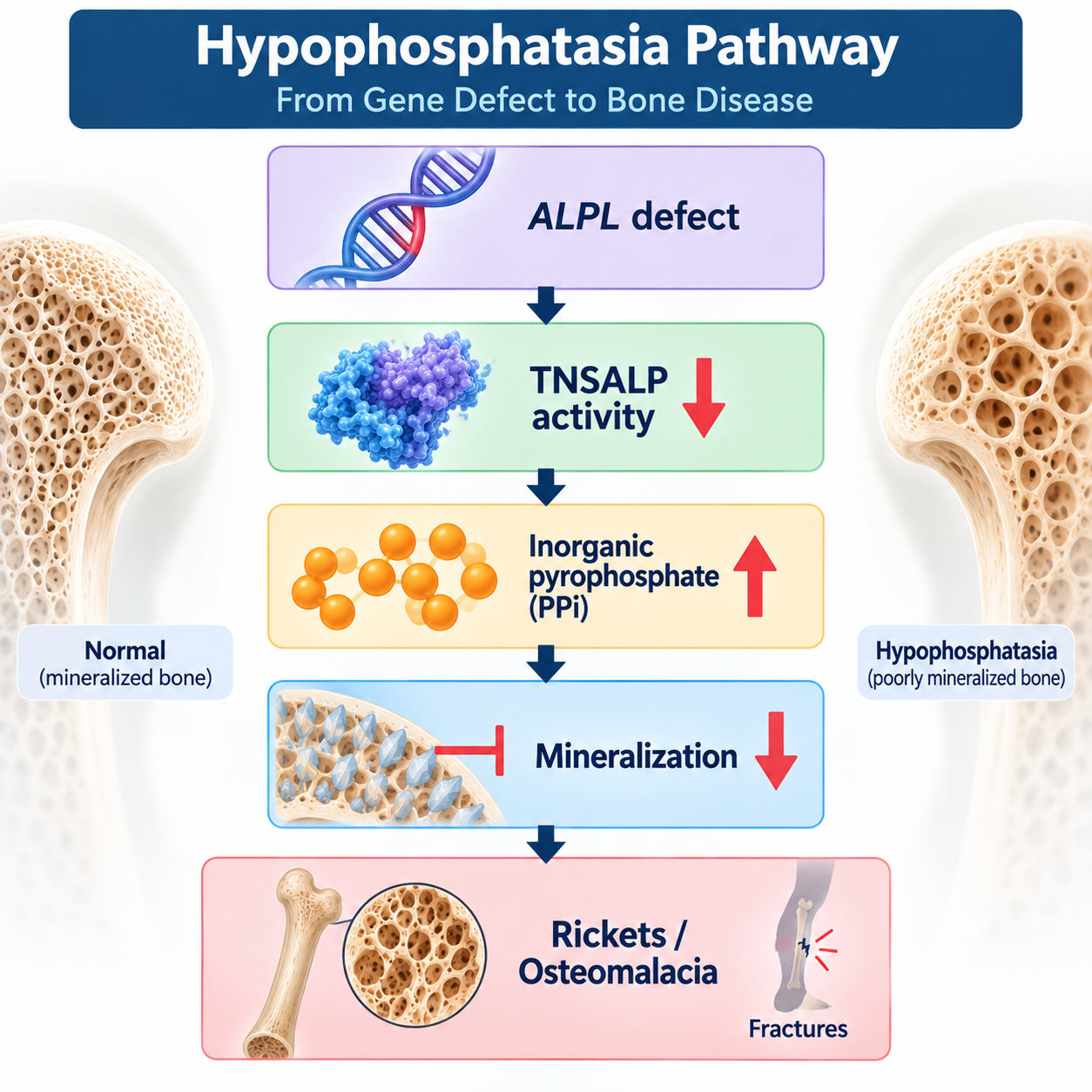
INORGANIC PYROPHOSPHATE — PPiPPi inhibits hydroxyapatite crystal formation.
Normally:
TNSALP BREAKS DOWN PPiThis reduces the mineralization inhibitor and permits normal hydroxyapatite formation.
ALPL and TNSALP
ALPL PATHOGENIC VARIANT TNSALP ACTIVITY ↓ INORGANIC PYROPHOSPHATE — PPi ↑ HYDROXYAPATITE FORMATION INHIBITED MINERALIZATION ↓ RICKETS / OSTEOMALACIA / FRACTURESThis is the core physiology of the article.
How Hypophosphatasia Causes Defective Mineralization
Bone formation is not complete simply because osteoblasts produce osteoid.
That osteoid must subsequently become mineralized.
Hydroxyapatite crystals must form and propagate within the matrix.
In HPP, excess extracellular PPi acts as:
A MINERALIZATION INHIBITORTherefore:
OSTEOID MAY BE FORMEDbut:
NORMAL MINERALIZATION IS IMPAIREDIn children this may produce:
RICKETSIn adults:
OSTEOMALACIAOsteomalacia Explained
PLP, PEA and Pyrophosphate
Other Tnsalp Substrates
Reduced TNSALP activity also leads to accumulation of substrates including:
PYRIDOXAL-5′-PHOSPHATE — PLPand:
PHOSPHOETHANOLAMINE — PEAThese biochemical abnormalities can support the diagnosis.
Another relevant substrate is:
INORGANIC PYROPHOSPHATE — PPibut PPi testing is generally less routinely accessible.
PLP And Vitamin B6
PLP is the major circulating phosphorylated form of vitamin B6.
TNSALP participates in dephosphorylation of extracellular PLP.
When TNSALP activity is deficient:
PLP CAN ACCUMULATE IN BLOODTherefore elevated PLP can provide supportive biochemical evidence of HPP.
Important:
PLP IS SUPPORTIVE — NOT A STANDALONE DIAGNOSISAlso recognize that vitamin B6 supplementation can affect PLP interpretation.
Why Severe HPP Can Cause Vitamin B6-Responsive Seizures
Although circulating PLP may be elevated, phosphorylated PLP does not freely cross cell membranes.
TNSALP normally helps generate forms capable of supporting intracellular vitamin B6 metabolism.
In severe infantile HPP, disturbed vitamin-B6 metabolism in the central nervous system can contribute to:
PYRIDOXINE-RESPONSIVE / VITAMIN-B6-DEPENDENT SEIZURESThis is a marker of severe disease.
Genetics and Inheritance
HPP results from pathogenic variants in:
ALPLClinical severity and inheritance are variable.
Severe forms are commonly associated with:
BIALLELIC PATHOGENIC VARIANTSand typically follow:
AUTOSOMAL RECESSIVE INHERITANCEMilder disease may occur with:
- biallelic variants;
- or a single heterozygous pathogenic variant.
Some heterozygous variants can produce disease through a dominant-negative effect.
Therefore HPP may demonstrate:
AUTOSOMAL RECESSIVEor:
AUTOSOMAL DOMINANTinheritance depending on the variant and phenotype.
GeneReviews emphasizes the broad phenotypic variability, including substantial variability within families. (NCBI)
Clinical Spectrum of HPP
HPP is a continuous clinical spectrum rather than a collection of completely separate diseases.
HPP IS A CONTINUOUS CLINICAL SPECTRUMTraditional clinical categories remain useful for teaching.
Include:
- severe perinatal HPP;
- benign prenatal/perinatal form;
- infantile HPP;
- severe childhood/juvenile HPP;
- mild childhood HPP;
- adult HPP;
- odontohypophosphatasia.
GeneReviews currently recognizes these clinical forms while emphasizing that the phenotype represents a continuum. (NCBI)
Perinatal and Infantile HPP
Severe Perinatal HPP
Severe prenatal/perinatal disease may cause profound skeletal hypomineralization.
Potential features include:
- markedly impaired skeletal mineralization;
- shortened or bowed limbs;
- poorly mineralized bones;
- chest deformity;
- respiratory compromise.
The most serious consequence is:
RESPIRATORY FAILUREbecause inadequate mineralization of the thoracic skeleton can impair respiratory mechanics.
Severe disease may also be associated with:
- hypercalcemia;
- vitamin-B6-dependent seizures;
- high morbidity and mortality.
(NCBI)
Infantile HPP
Infantile disease becomes clinically apparent during early infancy.
Potential features include:
- rickets;
- poor growth;
- skeletal deformity;
- hypotonia;
- respiratory problems;
- hypercalcemia;
- hypercalciuria;
- nephrocalcinosis;
- craniosynostosis;
- vitamin-B6-responsive seizures.
Important examination clue:
RICKETS + LOW ALPis very different from the usual nutritional-rickets pattern where ALP is generally elevated.
Childhood HPP
Childhood disease may include:
- premature loss of primary teeth;
- bone pain;
- fractures;
- skeletal deformity;
- short stature;
- abnormal gait;
- muscle weakness;
- impaired mobility;
- rachitic abnormalities.
One particularly characteristic dental clue is:
PREMATURE LOSS OF PRIMARY TEETH WITH INTACT ROOTSGeneReviews notes that premature deciduous-tooth loss often begins with the incisors. (NCBI)
Dental Manifestations
Why The Teeth Fall Out
TNSALP deficiency affects mineralized dental tissues, particularly:
CEMENTUMCementum contributes to attachment of the periodontal ligament to the tooth root.
Defective cementum formation can impair tooth anchoring.
Therefore:
TOOTH LOSS MAY OCCUR WITHOUT NORMAL ROOT RESORPTIONgiving the characteristic:
ROOT-INTACT PREMATURE TOOTH LOSSThis is a valuable clinical clue.
Odontohypophosphatasia
Some patients predominantly show dental manifestations without obvious skeletal disease.
This phenotype is called:
ODONTOHYPOPHOSPHATASIAFeatures may include:
- premature primary-tooth loss;
- severe dental caries;
- alveolar bone abnormalities.
However, some individuals initially presenting with apparently isolated dental disease may later develop additional manifestations. (NCBI)
Adult Hypophosphatasia
Adult HPP is particularly important because it can be:
MISSEDor:
MISDIAGNOSED AS OSTEOPOROSISAdult manifestations may include:
- recurrent stress fractures;
- metatarsal fractures;
- femoral pseudofractures;
- poor fracture healing;
- bone pain;
- muscle pain;
- muscle weakness;
- reduced mobility;
- early tooth loss;
- chondrocalcinosis;
- osteoarthropathy;
- fatigue;
- reduced quality of life.
(NCBI)
Stress Fractures and Pseudofractures
Metatarsal Stress Fractures
A classic adult presentation is:
RECURRENT OR SLOW-HEALING METATARSAL STRESS FRACTUREThe patient may present with:
- foot pain;
- recurrent fractures;
- prolonged healing;
- fractures after relatively limited trauma.
Repeated metatarsal fractures plus persistently low ALP should strongly raise suspicion for HPP.
Femoral Pseudofractures
Adult HPP may produce:
PSEUDOFRACTURESalso called:
LOOSER ZONESThese represent areas of incomplete fracture through poorly mineralized bone.
Thigh or hip pain may precede recognition.
GeneReviews particularly describes pseudofractures involving the lateral cortex of the femoral diaphysis. (NCBI)
Pseudofracture Versus Ordinary Fracture
A pseudofracture reflects:
MINERALIZATION FAILURErather than simply an acute traumatic break through otherwise normally mineralized bone.
It is therefore an important clue to:
OSTEOMALACIAOsteomalacia Explained
Chondrocalcinosis and Joint Disease
HPP can also be associated with:
CHONDROCALCINOSISand:
CPPD / PSEUDOGOUTThis is biologically related to abnormal extracellular pyrophosphate metabolism.
Therefore an adult with:
- persistently low ALP;
- fractures;
- and chondrocalcinosis;
deserves consideration of HPP.
GeneReviews includes chondrocalcinosis and osteoarthropathy among adult manifestations. (NCBI)
Persistently Low ALP
The Most Important Laboratory Clue
Display prominently:
PERSISTENTLY LOW SERUM ALPThis is the biochemical hallmark.
But the word:
PERSISTENTLYis essential.
A single low result should not establish the diagnosis.
The 2024 consensus recommendations advise at least two separate ALP measurements, both low relative to appropriate age- and sex-specific reference ranges, when HPP is suspected. (Springer)
ALP Must Be Interpreted Correctly
ALP varies substantially with:
- age;
- sex;
- growth;
- laboratory method/reference interval.
Children normally have higher ALP because of active skeletal growth.
Therefore:
NEVER INTERPRET A CHILD'S ALP USING AN ADULT REFERENCE RANGE AGE- AND SEX-APPROPRIATE REFERENCE VALUESBone-Specific ALP
Bone-specific ALP is not required to diagnose HPP.
The recent consensus specifically recommends:
TOTAL SERUM ALP USING APPROPRIATE REFERENCE VALUESand does not recommend bone-specific ALP measurement as the diagnostic test for HPP. (Springer)
Causes of Low ALP
LOW ALP ≠ AUTOMATIC HPPOther causes must be considered.
Possible explanations for low ALP can include, depending on clinical context:
- malnutrition;
- deficiencies of relevant micronutrients;
- hypothyroidism;
- severe anemia;
- celiac disease/malabsorption;
- severe systemic illness;
- certain medications;
- antiresorptive treatment;
- laboratory/pre-analytical factors;
- other uncommon disorders.
The exact differential should be individualized rather than using low ALP as a genetic diagnosis.
Consensus guidance specifically recommends excluding alternative causes of low ALP. (Springer)
Diagnostic Approach
Diagnostic Approach
Create a major algorithm.
LOW ALP IDENTIFIED IS IT TRULY LOW FOR AGE AND SEX?No
→ HPP biochemical criterion not established.
Yes
REPEAT ALPNot persistently low
→ investigate according to context.
Persistently low
EXCLUDE OTHER CAUSES OF LOW ALP LOOK FOR HPP CLINICAL CLUES- stress fractures;
- pseudofractures;
- poor fracture healing;
- bone/muscle pain;
- premature tooth loss;
- chondrocalcinosis;
- childhood rickets/deformity;
- family history.
PLP ↑?
PEA ↑?
ALPL GENETIC TESTING WHEN APPROPRIATE INTEGRATE CLINICAL + BIOCHEMICAL + GENETIC EVIDENCE HYPOPHOSPHATASIADiagnostic Criteria — Teach Cautiously
Recent expert criteria use combinations of major and minor clinical features in individuals with persistently low ALP after alternative explanations have been excluded.
Diagnosis cannot be reduced to:
ALP LOW + ALPL VARIANT = ALWAYS DISEASEbecause:
- variant interpretation matters;
- heterozygous variants may have variable expression;
- biochemical and clinical phenotype matter.
Likewise:
A NEGATIVE ROUTINE GENETIC TEST DOES NOT AUTOMATICALLY ERASE A STRONGLY COMPATIBLE CLINICAL PHENOTYPEConsensus diagnostic frameworks for adults and children have been proposed, but evidence quality remains limited and the field continues to evolve. (Springer)
PLP and PEA Testing
Supportive Biochemical Testing
When HPP is suspected, useful investigations may include:
- repeated total ALP;
- PLP;
- urinary PEA where available;
- calcium;
- phosphate;
- magnesium;
- renal function;
- PTH;
- 25-hydroxyvitamin D;
- urine calcium where clinically relevant.
Recent recommendations support assessment of broader calcium-phosphate metabolism because HPP can be associated with abnormalities such as hypercalcemia and hypercalciuria, particularly in more severe phenotypes. (Springer)
Not every listed test is abnormal in every patient.
Serum Phosphate
Important:
SERUM PHOSPHATE DOES NOT HAVE TO BE LOWAgain:
HYPOPHOSPHATASIA IS NOT DEFINED BY HYPOPHOSPHATEMIAThis should be repeated because of the confusing terminology.
Calcium
Calcium may be:
- normal;
- or elevated in severe disease.
Hypercalcemia can occur when impaired skeletal mineralization reduces incorporation of calcium into bone.
This is particularly relevant in severe infantile disease.
Hypercalcemia is not required for diagnosis.
Pth
PTH is not the primary diagnostic biomarker for HPP.
It should be interpreted as part of:
CALCIUM–PHOSPHATE HOMEOSTASISImaging and DXA
Imaging
Imaging findings depend on:
- age;
- disease severity;
- fracture history.
Potential findings include:
- rickets;
- hypomineralization;
- fractures;
- pseudofractures;
- poorly healing stress fractures;
- skeletal deformities.
Adult imaging may reveal metatarsal stress fractures or femoral pseudofractures.
Imaging supports the phenotype but does not replace biochemical/genetic assessment.
DXA
DXA may demonstrate:
- reduced BMD;
- normal BMD;
- variable findings.
Therefore:
DXA DOES NOT DIAGNOSE HPPA patient with HPP can be incorrectly labeled as having ordinary osteoporosis if clinicians focus on DXA while ignoring persistently low ALP and the clinical history.
Memory:
CHECK THE BIOCHEMISTRY — NOT JUST THE BMDHPP vs Osteoporosis
Pycnodysostosis typically has normal alkaline phosphatase, distinguishing it from the persistently low ALP pattern of hypophosphatasia.
Implement as a table.
| Feature | Hypophosphatasia | Conventional osteoporosis |
|---|---|---|
| Core problem | Defective mineralization due to TNSALP deficiency | Reduced bone strength with multiple mechanisms |
| ALP | Persistently low for age/sex | Usually not characteristically persistently low |
| ALPL | Pathogenic variant may be present | Not defining |
| PLP | May be elevated | Not defining |
| PEA | May be elevated | Not defining |
| Pseudofractures | Can occur | Not typical |
| Premature root-intact tooth loss | Important clue | Not typical |
| Chondrocalcinosis | Can occur | Not defining |
| DXA | Variable | Often low |
| Antiresorptive approach | Requires major caution/avoidance in established HPP | Standard treatment class in appropriate patients |
GeneReviews specifically emphasizes distinguishing adult HPP from osteoporosis because antiresorptive treatment can be inappropriate. (NCBI)
HPP vs Osteomalacia
Implement:
| Feature | HPP | Vitamin-D-deficiency osteomalacia |
|---|---|---|
| ALP | Low | Usually high |
| Main mechanism | TNSALP deficiency → PPi accumulation | Inadequate substrate/mineral physiology from vitamin-D deficiency |
| 25OHD | Not defining | Usually reduced |
| PLP | May be elevated | Not characteristic |
| ALPL variant | May confirm HPP | Not causal |
| Dental root-intact tooth loss | Can be characteristic | Not typical |
| Treatment | HPP-specific/supportive strategy | Correct vitamin-D/mineral abnormality |
Memory:
OSTEOMALACIA + LOW ALP → THINK HPPHPP vs XLH
Implement briefly.
| Feature | HPP | XLH |
|---|---|---|
| Primary gene | ALPL | PHEX |
| ALP | Low | Usually elevated in active rickets/osteomalacia |
| Phosphate | Not necessarily low | Low |
| Mechanism | PPi accumulation / mineralization inhibition | FGF23-mediated renal phosphate wasting |
| Main targeted therapy concept | TNSALP replacement in eligible HPP | FGF23-directed/conventional phosphate therapy depending context |
X-Linked Hypophosphatemia Explained
Why Misdiagnosis Matters
Why Osteoporosis Misdiagnosis Matters
This is one of the most important sections.
An adult with:
- fractures;
- low BMD;
- older age;
may appear to have conventional osteoporosis.
But if the patient also has:
PERSISTENTLY LOW ALPplus:
- metatarsal stress fractures;
- femoral pseudofractures;
- poor fracture healing;
- premature tooth loss;
HPP should be considered.
The distinction matters because therapies designed to suppress bone turnover may be inappropriate in a mineralization disorder caused by deficient alkaline phosphatase activity.
Bisphosphonates
DO NOT REFLEXIVELY TREAT HPP AS OSTEOPOROSISGeneReviews lists bisphosphonates among agents/circumstances to avoid in HPP. (NCBI)
Conceptually:
Bisphosphonates are pyrophosphate analogues and suppress bone turnover.
In a disorder already characterized by abnormal pyrophosphate metabolism and defective mineralization, this creates biological and clinical concern.
Denosumab
GeneReviews also lists:
DENOSUMABamong agents to avoid in HPP. (NCBI)
The HPP-specific lesson is simply:
CORRECT DIAGNOSIS BEFORE ANTIRESORPTIVE TREATMENTTreatment Principles
Treatment depends on:
- age;
- phenotype;
- severity;
- fracture burden;
- mobility;
- respiratory involvement;
- dental disease;
- neurological complications;
- renal complications.
Goals may include:
- improve skeletal mineralization;
- reduce disease burden;
- support fracture healing;
- improve mobility/function;
- manage pain;
- protect dentition;
- manage complications;
- improve quality of life.
Asfotase Alfa
Asfotase Alfa
Create a major section.
ASFOTASE ALFAis:
ENZYME REPLACEMENT THERAPYIt is a recombinant form of tissue-nonspecific alkaline phosphatase engineered for skeletal targeting.
Conceptually:
TNSALP DEFICIENT ASFOTASE ALFA FUNCTIONAL ALP ACTIVITY RESTORED PPi BREAKDOWN ↑ MINERALIZATION IMPROVESThis is targeted treatment of the underlying enzyme deficiency.
Current U.S. Indication
Be precise.
Current U.S. prescribing information states that Strensiq is indicated for:
PERINATAL/INFANTILE-ONSET HPPand:
JUVENILE-ONSET HPPIt should not be written as:
“FDA-approved for every adult with HPP.”
Adults whose disease began in childhood may fall within pediatric-onset disease even if treated as adults, but regulatory eligibility and clinical treatment decisions must follow current jurisdiction-specific prescribing information.
Asfotase Alfa Safety
The current U.S. label carries a boxed warning for:
HYPERSENSITIVITY REACTIONS INCLUDING ANAPHYLAXISThe label states that anaphylaxis has occurred both early in treatment and after extended therapy, and initiation should occur under healthcare supervision with appropriate monitoring/support. (FDA Access Data)
Adult HPP And Enzyme Replacement
The following statement is too simplistic:
“Adult HPP cannot be treated with asfotase alfa.”
Adult age and age of disease onset are different concepts.
Instead teach:
TREATMENT ELIGIBILITY DEPENDS ON PHENOTYPE, AGE OF ONSET, SEVERITY AND JURISDICTION-SPECIFIC REGULATORY CRITERIAFracture and Dental Management
Fracture Management
Stress fractures and pseudofractures in HPP may heal slowly.
Management may require:
- metabolic-bone expertise;
- orthopedic assessment;
- appropriate mechanical support;
- selected surgical fixation.
GeneReviews notes that internal fixation has been suggested for difficult pseudofractures/stress fractures in adults. (NCBI)
Teriparatide
Limited adult experience and case reports describe teriparatide use for fracture healing, pain or osteomalacia in HPP.
However:
TERIPARATIDE IS NOT ESTABLISHED UNIVERSAL HPP THERAPYEvidence is limited.
It should not replace disease-specific therapy where that therapy is indicated.
GeneReviews describes adult experience as limited. (NCBI)
Dental Care
Dental care is an important part of management.
Goals include:
- preserve teeth;
- monitor periodontal/dental complications;
- recognize premature tooth loss;
- maintain oral function.
Children with early tooth loss may require coordinated dental and metabolic assessment.
HPP management extends beyond skeletal treatment.
Multidisciplinary Care
Depending on phenotype, management may involve:
- metabolic bone/endocrinology specialists;
- pediatrics;
- genetics;
- orthopedics;
- dentistry;
- nephrology;
- neurology;
- respiratory specialists;
- physiotherapy/rehabilitation.
Severe disease is multisystem.
Genetic Counseling
Because HPP can follow autosomal recessive or autosomal dominant inheritance patterns:
GENETIC COUNSELING IS IMPORTANTCounseling may address:
- inheritance;
- variant interpretation;
- family testing;
- recurrence risk;
- phenotypic variability.
Master Diagnostic Algorithm
BONE PAIN / FRACTURES / DENTAL CLUES / RICKETS CHECK ALPALP normal/high for age and sex
HPP LESS LIKELY — CONSIDER OTHER DIAGNOSESALP low
REPEAT ALP PERSISTENTLY LOW FOR AGE + SEX?No
→ investigate other explanations.
Yes
EXCLUDE ACQUIRED / SECONDARY LOW-ALP CAUSES LOOK FOR HPP FEATURESMetatarsal stress fractures?
Femoral pseudofractures?
Poor fracture healing?
Root-intact premature tooth loss?
Chondrocalcinosis?
Childhood rickets/deformity?
Family history?
PLP / PEA SUPPORTIVE TESTING ALPL GENETIC TESTING INTEGRATE CLINICAL + BIOCHEMICAL + GENETIC DATA HYPOPHOSPHATASIA DEFINE PHENOTYPE / SEVERITY / AGE OF ONSET SUPPORTIVE CARE ± TARGETED THERAPY WHERE APPROPRIATE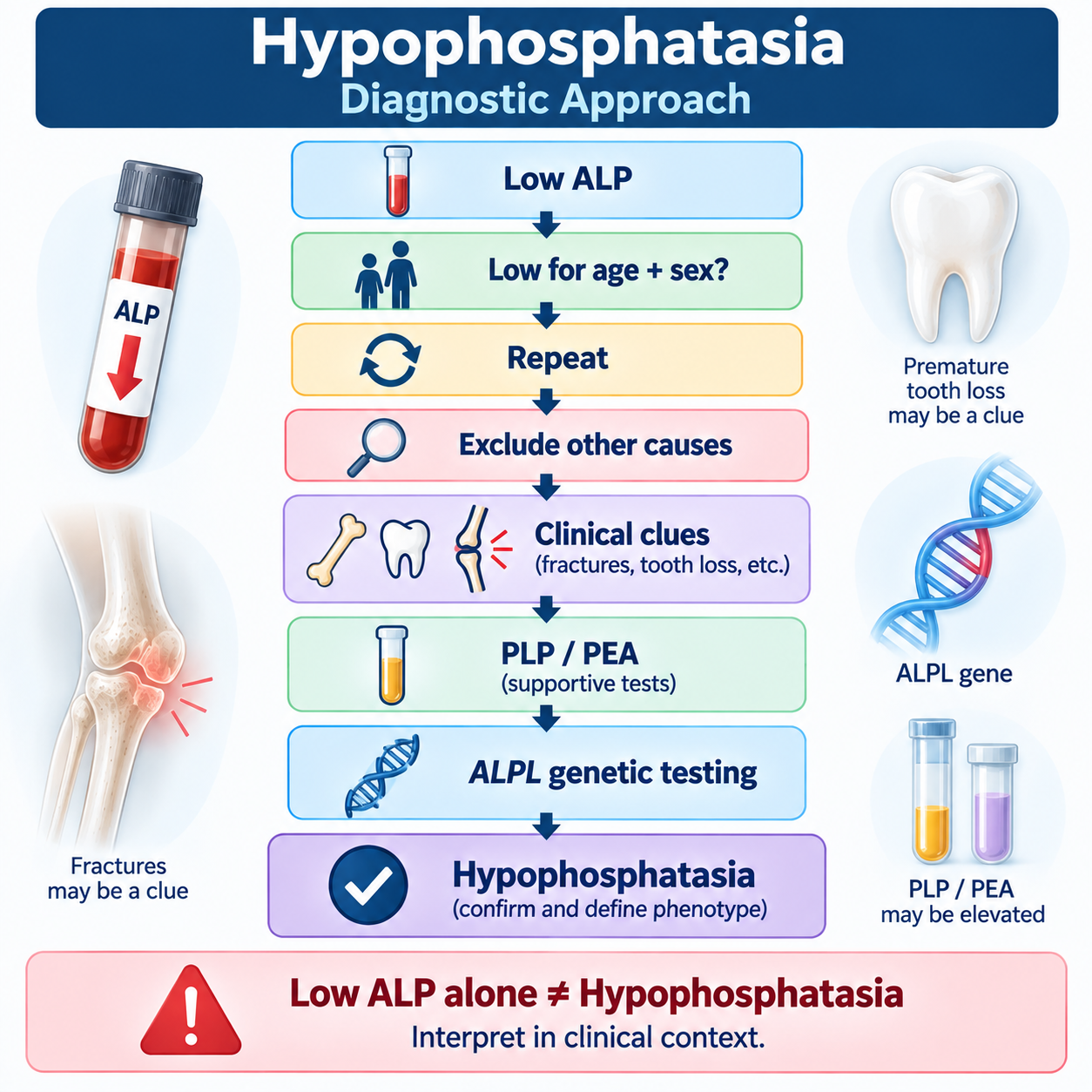
Worked Clinical Cases
Case 1 — Low ALP and metatarsal fractures
A 48-year-old has recurrent metatarsal stress fractures and repeatedly low ALP.
Next thought
HYPOPHOSPHATASIAConfirm that ALP is persistently low for the appropriate reference range, exclude alternative causes, and evaluate supportive clinical/biochemical features.
Case 2 — One low ALP
A healthy adult has one mildly low ALP result without symptoms.
Wrong conclusion
“HPP confirmed.”
Correct approach
REPEAT AND INTERPRET IN CONTEXTOne low ALP value does not establish HPP.
Case 3 — Child with low ALP
A child has an ALP value that appears normal by an adult laboratory interval.
Problem
Children normally have higher ALP.
Lesson
USE AGE-APPROPRIATE REFERENCE VALUESA value apparently “normal” by adult standards may be abnormally low for a growing child.
Case 4 — Rickets with low ALP
Child has:
- bowed legs;
- rachitic imaging;
- low ALP.
Key clue
RICKETS + LOW ALP IS UNUSUALThink HPP rather than assuming nutritional vitamin-D deficiency.
Case 5 — Premature tooth loss
Four-year-old loses incisors prematurely with intact roots.
Key clue
ROOT-INTACT PREMATURE TOOTH LOSSEvaluate for HPP.
Case 6 — Osteoporosis misdiagnosis
A 55-year-old with low BMD and recurrent foot fractures has persistently low ALP.
Wrong approach
“DXA low → conventional osteoporosis → antiresorptive.”
Better approach
EXCLUDE HPP BEFORE REFLEXIVE ANTIRESORPTIVE THERAPYCase 7 — Femoral pseudofracture
Adult has chronic thigh pain and a lateral femoral pseudofracture.
ALP is persistently low.
Lesson
PSEUDOfracture + LOW ALP = STRONG HPP CLUECase 8 — Chondrocalcinosis
Adult has:
- chondrocalcinosis;
- recurrent musculoskeletal pain;
- persistently low ALP.
Lesson
Abnormal PPi metabolism makes HPP an important consideration.
Case 9 — Elevated PLP
Patient has persistently low ALP and elevated PLP.
Interpretation
Elevated PLP:
SUPPORTS HPPbut does not replace clinical/genetic assessment.
Case 10 — Low ALP from another cause
Patient has low ALP during severe malnutrition without characteristic HPP manifestations.
Lesson
EXCLUDE SECONDARY CAUSESLow ALP is not specific for HPP.
Case 11 — Adult with ALPL variant
Adult has persistently low ALP, fractures and an ALPL pathogenic variant.
Lesson
Interpret:
GENOTYPE + BIOCHEMISTRY + PHENOTYPE TOGETHERCase 12 — Adult seeking asfotase alfa
An adult newly diagnosed with HPP asks whether all adults receive enzyme replacement.
Answer
NO UNIVERSAL RULETreatment depends on phenotype, severity, age of onset, regulatory indication and specialist assessment.
Common Mistakes
Mistake 1
Hypophosphatasia means low phosphate.
Wrong.
Mistake 2
One low ALP diagnoses HPP.
Wrong.
Mistake 3
Any ALP below an adult reference interval diagnoses HPP.
Wrong.
Mistake 4
Adult ALP reference ranges can be applied to children.
Wrong.
Mistake 5
Bone-specific ALP is required to diagnose HPP.
Wrong.
Mistake 6
Low ALP has no differential diagnosis.
Wrong.
Mistake 7
All patients with HPP have fractures.
Wrong.
Mistake 8
All patients with HPP have low BMD.
Wrong.
Mistake 9
DXA diagnoses HPP.
Wrong.
Mistake 10
HPP and osteoporosis are the same disorder.
Wrong.
Mistake 11
HPP and hypophosphatemia are the same disorder.
Wrong.
Mistake 12
HPP and XLH are the same disorder.
Wrong.
Mistake 13
PLP alone proves HPP.
Wrong.
Mistake 14
A normal serum phosphate excludes HPP.
Wrong.
Mistake 15
Premature tooth loss is irrelevant to bone diagnosis.
Wrong.
Mistake 16
Every adult with low BMD should automatically receive a bisphosphonate.
Wrong.
Mistake 17
Antiresorptive therapy is automatically appropriate in established HPP.
Wrong.
Mistake 18
All HPP follows autosomal recessive inheritance.
Wrong.
Mistake 19
Asfotase alfa is FDA-approved for every adult with HPP.
Wrong. (FDA Access Data)
Mistake 20
HPP is only a childhood disease.
Wrong.
Hypophosphatasia in One Minute
HYPOPHOSPHATASIA IN ONE MINUTE ALPL VARIANT TNSALP ↓ PPi ↑ MINERALIZATION ↓ RICKETS / OSTEOMALACIA / FRACTURESDiagnostic clue:
ALP ↓ PERSISTENTLYThen ask:
LOW FOR AGE AND SEX? REPEAT EXCLUDE OTHER CAUSESLook for:
Stress fractures
Pseudofractures
Poor healing
Premature root-intact tooth loss
Chondrocalcinosis
PLP / PEA ALPL TESTINGTreatment principle:
CORRECT DIAGNOSIS BEFORE OSTEOPOROSIS TREATMENTTargeted therapy:
ASFOTASE ALFA = TNSALP ENZYME REPLACEMENTFinal memory:
OSTEOMALACIA + PERSISTENTLY LOW ALP = THINK HYPOPHOSPHATASIAFrequently Asked Questions
What is hypophosphatasia?
Hypophosphatasia is an inherited metabolic disorder caused by deficient tissue-nonspecific alkaline phosphatase activity, usually due to pathogenic ALPL variants, resulting in defective mineralization of bone and teeth.
What is the main laboratory clue?
Persistently low serum alkaline phosphatase relative to appropriate age- and sex-specific reference values.
Does one low ALP diagnose HPP?
No. Current recommendations advise repeated ALP measurements and exclusion of alternative causes.
Does HPP mean the serum phosphate is low?
No. The name refers to low alkaline phosphatase activity, not hypophosphatemia.
What gene causes HPP?
The principal gene is ALPL, which encodes tissue-nonspecific alkaline phosphatase.
Why does HPP cause osteomalacia?
Reduced TNSALP allows inorganic pyrophosphate to accumulate, inhibiting hydroxyapatite formation and normal skeletal mineralization.
What is PLP?
Pyridoxal-5′-phosphate is a vitamin-B6-related TNSALP substrate that can become elevated in HPP and provide supportive biochemical evidence.
What dental finding suggests HPP?
Premature tooth loss, particularly loss of primary teeth with intact roots, is an important clue.
How can adult HPP present?
Adults may have metatarsal stress fractures, femoral pseudofractures, poor fracture healing, bone or muscle pain, weakness, dental problems and chondrocalcinosis.
Can HPP look like osteoporosis?
Yes. Adult HPP may be mistaken for osteoporosis, particularly when low BMD and fractures are present.
Does DXA diagnose HPP?
No. BMD can be variable and DXA does not diagnose the enzyme defect or mineralization disorder.
Are bisphosphonates appropriate in HPP?
Established HPP should not be reflexively managed as conventional osteoporosis. GeneReviews lists bisphosphonates among agents to avoid in HPP.
What is asfotase alfa?
Asfotase alfa is a bone-targeted recombinant tissue-nonspecific alkaline phosphatase used as enzyme-replacement therapy for HPP.
Is asfotase alfa FDA-approved for every adult with HPP?
No. The current U.S. indication is treatment of patients with perinatal/infantile- and juvenile-onset HPP.
What is the most important diagnostic lesson?
Do not ignore persistently low ALP in a patient with fractures, osteomalacia, poor fracture healing or characteristic dental findings.
Key Take-Home Messages
Hypophosphatasia is a disorder of:
DEFECTIVE MINERALIZATIONcaused by deficient:
TISSUE-NONSPECIFIC ALKALINE PHOSPHATASEThe fundamental pathway is:
ALPL DEFECT TNSALP ↓ PPi ↑ HYDROXYAPATITE FORMATION ↓ RICKETS / OSTEOMALACIAThe major biochemical clue is:
PERSISTENTLY LOW ALPbut:
LOW ALP ALONE DOES NOT DIAGNOSE HPPFirst establish that ALP is genuinely low for:
AGE + SEXThen:
REPEAT IT EXCLUDE OTHER CAUSES LOOK FOR CHARACTERISTIC CLINICAL FEATURES USE PLP / PEA AS SUPPORTIVE BIOCHEMISTRY USE ALPL GENETIC TESTING WHEN APPROPRIATEAdult HPP deserves particular attention because it may masquerade as:
OSTEOPOROSISA history of:
- recurrent metatarsal fractures;
- femoral pseudofractures;
- poor fracture healing;
- premature tooth loss;
- chondrocalcinosis;
combined with persistently low ALP should raise suspicion.
This matters because:
CORRECT DIAGNOSIS CHANGES TREATMENTAsfotase alfa provides targeted enzyme replacement for appropriate HPP populations, while conventional antiresorptive osteoporosis treatment should not be applied reflexively to established HPP. (NCBI)
Final memory:
HIGH ALP CAN SIGNAL BONE DISEASE — BUT SO CAN PERSISTENTLY LOW ALPand:
OSTEOMALACIA + PERSISTENTLY LOW ALP = THINK HYPOPHOSPHATASIA