Pycnodysostosis has a specific place among dense-bone disorders
Osteopetrosis explains broad osteoclast-resorption failure. Pycnodysostosis explains a more specific defect in cathepsin K–mediated degradation of organic bone matrix, producing a distinctive phenotype of osteosclerosis with acroosteolysis, short stature and craniofacial/dental abnormalities.
CTSK variants → cathepsin K ↓ → organic matrix degradation ↓ → osteosclerosis with fragility.
What Is Pycnodysostosis?
Central Teaching Concept
The entire article should revolve around:
DENSE BONE DOES NOT NECESSARILY MEAN STRONG BONECentral mechanism:
BIALLELIC CTSK PATHOGENIC VARIANTS CATHEPSIN K ACTIVITY ↓ OSTEOCLAST DEGRADATION OF ORGANIC BONE MATRIX ↓ BONE RESORPTION / REMODELING IMPAIRED OSTEOSCLEROSISbut simultaneously:
ABNORMAL BONE QUALITY FRAGILITY + FRACTURESThe characteristic phenotype adds:
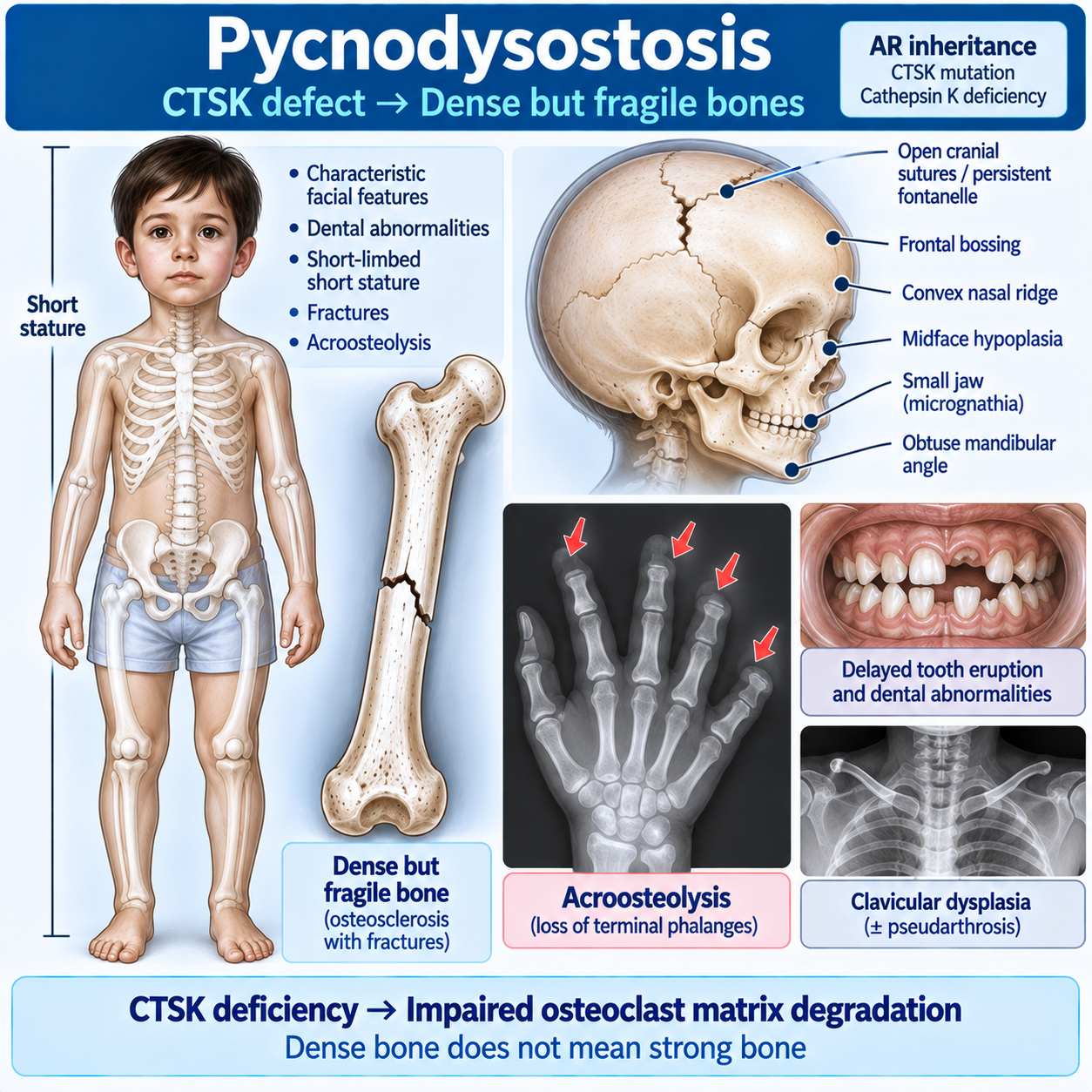
ACROOSTEOLYSIS SHORT STATURE CRANIOFACIAL / DENTAL ABNORMALITIESGeneReviews describes the core phenotype as short-limbed short stature, characteristic facial appearance, osteosclerosis with fragility, terminal-phalanx acroosteolysis, delayed cranial-suture closure and clavicular dysplasia. (NCBI)
Opening — Use This Content
A child has:
- short stature;
- recurrent fractures;
- dense bones on radiographs.
At first, this sounds like:
OSTEOPETROSISBut hand radiographs reveal another striking finding:
LOSS OF THE TERMINAL PHALANGESor:
ACROOSTEOLYSISThe child also has:
- a persistently open anterior fontanelle;
- frontal bossing;
- a small jaw;
- delayed tooth eruption.
This combination should immediately suggest:
PYCNODYSOSTOSISThe disease results from pathogenic variants affecting:
CTSKwhich encodes:
CATHEPSIN KCathepsin K is a major osteoclast protease required for degradation of the organic bone matrix.
Therefore pycnodysostosis teaches an important principle:
AN OSTEOCLAST MAY BE PRESENT — YET STILL FAIL TO RESORB BONE NORMALLYWhat Is Pycnodysostosis?
Pycnodysostosis is a rare inherited skeletal dysplasia caused by:
BIALLELIC PATHOGENIC VARIANTS IN CTSKIt is characterized by:
- generalized osteosclerosis;
- increased bone fragility;
- recurrent fractures;
- short-limbed short stature;
- acroosteolysis;
- delayed closure of cranial sutures/fontanelle;
- characteristic craniofacial morphology;
- dental abnormalities;
- clavicular abnormalities.
Inheritance is:
AUTOSOMAL RECESSIVEThe condition belongs to the group of osteopetrosis and related osteoclast disorders in the 2023 Nosology of Genetic Skeletal Disorders. (NCBI)
Terminology
Pycnodysostosis may also be spelled:
PYKNODYSOSTOSISGeneReviews uses both terms and identifies the disorder as:
CTSK-RELATED PYKNODYSOSTOSISThe historical term:
TOULOUSE-LAUTREC SYNDROMEis sometimes used because the artist Henri de Toulouse-Lautrec has retrospectively been considered likely to have had the disorder.
Avoid using Maroteaux-Lamy syndrome as the main synonym because that term is much more commonly used for the unrelated lysosomal-storage disorder mucopolysaccharidosis VI. (NCBI)
CTSK and Cathepsin K
Cathepsin K
Cathepsin K is a:
LYSOSOMAL CYSTEINE PROTEASEhighly expressed in osteoclasts.
It functions particularly well in the acidic environment of the osteoclast resorption compartment.
Important substrates include:
- type I collagen;
- type II collagen;
- osteopontin;
- osteonectin.
Its major skeletal role is degradation of:
ORGANIC BONE MATRIXGeneReviews identifies defective degradation of these matrix proteins as central to CTSK-related pycnodysostosis. (NCBI)
CTSK
The relevant gene is:
CTSKlocated on chromosome:
1q21.3CTSK encodes:
CATHEPSIN KPycnodysostosis results from:
LOSS-OF-FUNCTIONpathogenic variants.
Therefore:
CTSK LOSS OF FUNCTION CATHEPSIN K DEFICIENCY COLLAGEN/MATRIX DEGRADATION IMPAIRED OSTEOCLAST RESORPTION IMPAIRED ABNORMAL SKELETAL REMODELING(NCBI)
Osteoclasts Are Present
This is a crucial distinction.
Osteoclasts are present in pycnodysostosis, but their matrix-degrading function is impaired.
In pycnodysostosis:
OSTEOCLAST NUMBERS CAN BE NORMALand osteoclasts can have:
- ruffled borders;
- clear zones.
The major defect lies in effective degradation of the organic matrix after mineral dissolution. (NCBI)
This makes the disease an excellent mechanistic teaching model.
Pycnodysostosis Versus Osteopetrosis Mechanism
Osteopetrosis
Broad group of disorders in which osteoclast-mediated bone resorption is impaired through mechanisms such as:
- osteoclast dysfunction;
- acidification failure;
- chloride/proton handling abnormalities;
- differentiation defects.
Pycnodysostosis
A much more specific defect:
CATHEPSIN K–DEPENDENT MATRIX DEGRADATION FAILURETherefore:
OSTEOPETROSIS = BROADER RESORPTION FAILUREwhile:
PYCNODYSOSTOSIS = CTSK/CATHEPSIN K MATRIX-DEGRADATION FAILURE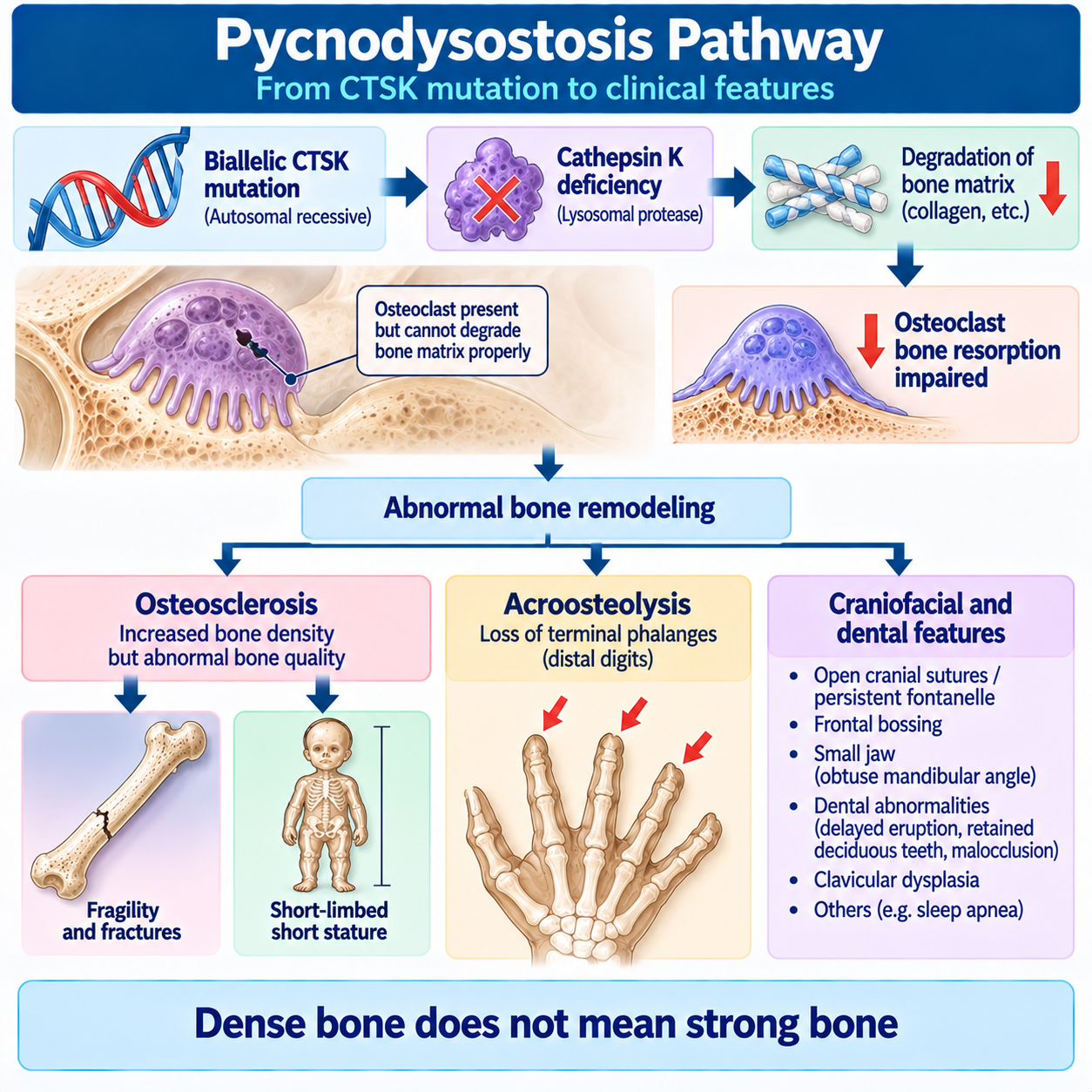
Distinctive Skeletal Phenotype
Short Stature
Short stature is a major feature.
The typical pattern is:
SHORT-LIMBED SHORT STATUREGeneReviews describes short-limbed short stature as present in essentially all affected individuals, although severity varies. (NCBI)
Growth impairment varies among affected children.
Growth Hormone
Some affected individuals have:
- growth-hormone deficiency;
- low IGF-1.
Therefore growth assessment should include consideration of endocrine evaluation where clinically appropriate.
GeneReviews recommends evaluation for:
GH AND IGF-1 DEFICIENCYearly in the assessment of an affected individual. (NCBI)
Important:
SHORT STATURE IN PYCNODYSOSTOSIS IS NOT AUTOMATICALLY GH DEFICIENCYThe skeletal dysplasia itself contributes substantially.
Acroosteolysis
One of the most characteristic findings is:
ACROOSTEOLYSISThis means resorption/loss of bone involving the:
DISTAL / TERMINAL PHALANGESHand radiographs may show partial or substantial loss of terminal phalangeal bone.
This can produce:
- shortened fingertips;
- brachydactyly;
- abnormal distal digits.
The Paradox Of Acroosteolysis
The disease causes:
GENERALIZED OSTEOSCLEROSISyet also:
LOCALIZED ACROOSTEOLYSISThis initially seems contradictory.
The precise biological explanation for this regional phenotype is more complex than simply “too much osteoclast activity.”
Instead teach:
PYCNODYSOSTOSIS CHARACTERISTICALLY COMBINES GENERALIZED DENSE BONE WITH DISTAL PHALANGEAL BONE LOSSThis combination is diagnostically powerful.
Brachydactyly
Affected individuals commonly have:
BRACHYDACTYLYThe fingers may appear:
- short;
- broad;
- abnormal at the distal phalanges.
Nail abnormalities can also occur.
Examples include:
- dysplastic nails;
- flattened nails;
- grooved nails. (NCBI)
Skull Findings
Important cranial manifestations include:
- delayed fusion of cranial sutures;
- persistently open anterior fontanelle;
- frontal bossing;
- craniofacial disproportion.
Therefore an older child with:
PERSISTENTLY OPEN FONTANELLE + OSTEOSCLEROSISshould trigger consideration of pycnodysostosis.
Facial Phenotype
Characteristic features can include:
FRONTAL BOSSING CONVEX NASAL RIDGE MIDFACE RETRUSION SMALL JAWThe facial phenotype can become more apparent with age. (NCBI)
Avoid portraying facial appearance as sufficient for diagnosis by itself.
The Mandible
A particularly useful radiographic clue is:
LOSS OF THE NORMAL MANDIBULAR ANGLEproducing an:
OBTUSE MANDIBULAR ANGLEThis is a classic feature.
Therefore the diagnostic combination:
OSTEOSCLEROSIS + ACROOSTEOLYSIS + OBTUSE MANDIBULAR ANGLEis highly characteristic.
GeneReviews notes that the combination of acroosteolysis, osteosclerosis and loss of the normal jaw angle is almost pathognomonic, although formal diagnostic criteria have not been established. (NCBI)
Dental Abnormalities
Dental manifestations are important.
They can include:
- delayed eruption of deciduous teeth;
- delayed eruption of permanent teeth;
- retained deciduous teeth;
- double rows of teeth;
- hypodontia;
- malocclusion;
- dental crowding;
- increased dental-management complexity.
The maxilla and mandible may be hypoplastic.
Dental care should therefore be part of multidisciplinary management. (NCBI)
Why Dental Care Matters
Dental problems are not merely cosmetic.
They can affect:
- chewing;
- oral hygiene;
- dental alignment;
- infection risk;
- orthodontic planning;
- surgical planning.
Therefore:
PYCNODYSOSTOSIS REQUIRES LONG-TERM DENTAL / ORTHODONTIC ATTENTIONClavicles
Clavicular abnormalities can include:
CLAVICULAR DYSPLASIAand occasionally:
CONGENITAL PSEUDARTHROSISThis contributes to overlap with:
CLEIDOCRANIAL DYSPLASIAbut the underlying disorders are different. (NCBI)
Fractures and Orthopedic Features
Fractures
Despite generalized osteosclerosis:
FRACTURES ARE COMMONFractures can occur after relatively modest trauma.
Long bones are particularly relevant.
The important teaching point is:
HIGH RADIOGRAPHIC DENSITY DOES NOT PROTECT AGAINST FRACTUREFracture Healing
Fracture management can be challenging.
Reported orthopedic complications include:
NON-UNIONand operative treatment can be technically difficult because abnormal dense bone is not equivalent to normal healthy cortical bone.
GeneReviews notes that a substantial proportion of reported patients have required orthopedic intervention and that non-union after surgery has been described. (NCBI)
Scoliosis
Scoliosis can occur.
Clinical examination should therefore include assessment of:
- spinal alignment;
- asymmetry;
- functional effects.
Management is individualized by orthopedics.
Airway, Sleep and Craniofacial Complications
Airway And Sleep Apnea
Craniofacial anatomy can predispose to:
UPPER-AIRWAY OBSTRUCTIONPotential manifestations include:
- narrow upper airway;
- stridor;
- laryngomalacia;
- obstructive sleep apnea.
GeneReviews recommends early sleep assessment and specialist management when needed. (NCBI)
Obstructive Sleep Apnea
OSA is an important complication because it may affect:
- sleep quality;
- daytime function;
- cardiovascular health;
- perioperative risk.
GeneReviews recommends polysomnography as part of initial evaluation and includes ongoing sleep surveillance. (NCBI)
Anesthesia
Craniofacial abnormalities may make:
AIRWAY MANAGEMENT / INTUBATION DIFFICULTTherefore before planned general anesthesia:
THE ANESTHESIA TEAM SHOULD BE AWARE OF THE DIAGNOSIS AND POTENTIAL DIFFICULT AIRWAYGeneReviews explicitly recommends consideration of difficult intubation before general anesthesia. (NCBI)
Neurological/Craniofacial Complications
Selected patients may have additional craniofacial abnormalities such as:
- craniosynostosis;
- cleft/high-arched palate;
- maxillary or mandibular hypoplasia.
If neurological symptoms raise concern for structural abnormalities such as Chiari malformation, targeted neurological evaluation/imaging may be appropriate. (NCBI)
Repeated brain MRI is not required for every patient.
Hearing And Vision
Baseline assessment may include:
- audiology;
- ophthalmological evaluation.
GeneReviews recommends both as part of the initial evaluation. (NCBI)
Laboratory Findings
Laboratory Findings
This is another high-yield diagnostic point.
Despite striking radiographic bone abnormalities, routine mineral biochemistry can be:
NORMALGeneReviews lists typical laboratory findings as normal:
- serum calcium;
- phosphate;
- vitamin D;
- alkaline phosphatase. (NCBI)
Therefore:
NORMAL Ca + PO₄ + ALP DOES NOT EXCLUDE A MAJOR GENETIC BONE DISORDERThis contrasts strongly with hypophosphatasia.
ALP Comparison With Hypophosphatasia
Pycnodysostosis
ALP TYPICALLY NORMALHypophosphatasia
PERSISTENTLY LOW ALP IS A CENTRAL DIAGNOSTIC CLUETherefore:
DENSE/FRAGILE BONE + NORMAL ALP + ACROOSTEOLYSIS → THINK CTSK/PYCNODYSOSTOSISwhereas:
FRAGILITY/MINERALIZATION DISORDER + PERSISTENTLY LOW ALP → THINK HPPRadiology
Radiology
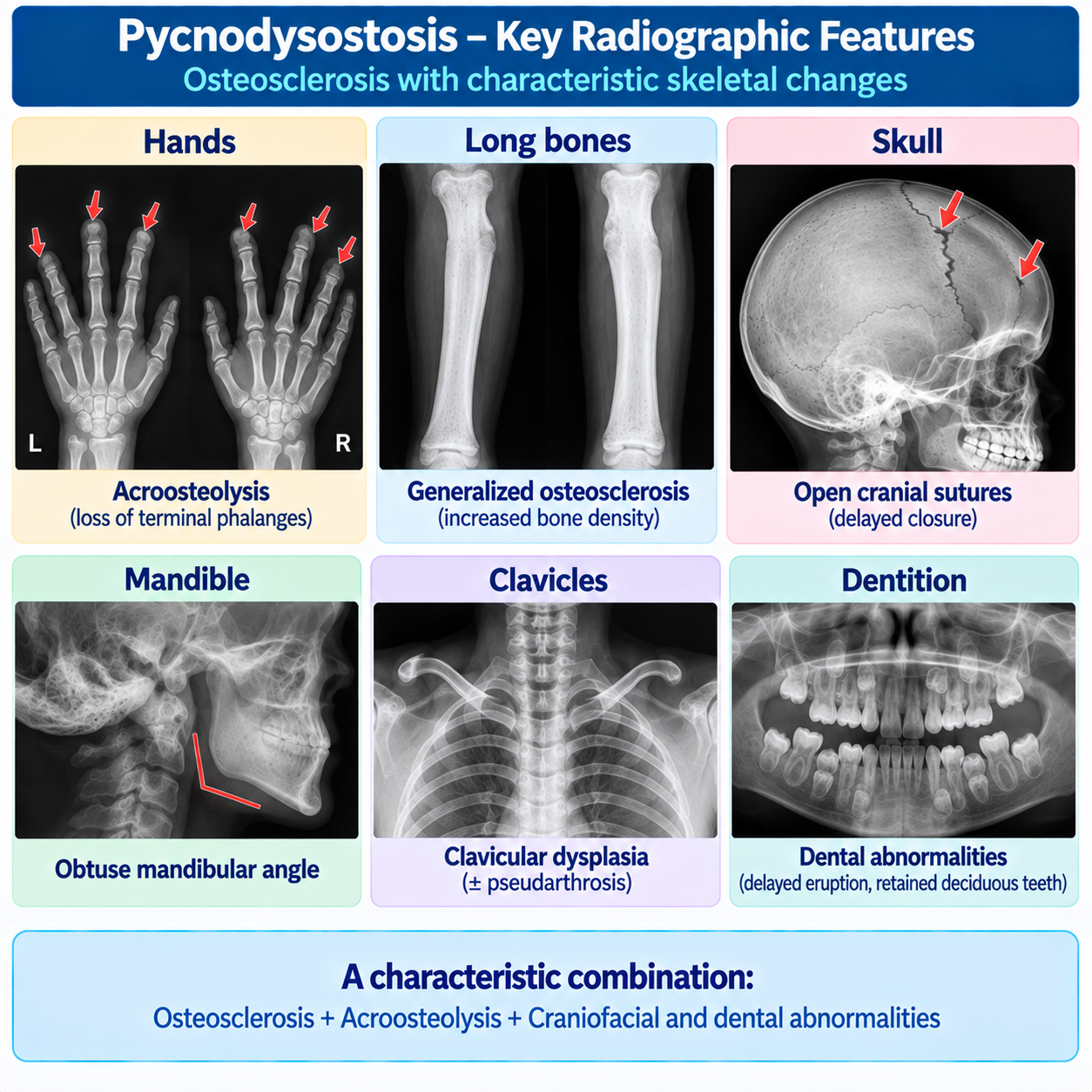
Radiology is central to diagnosis.
Characteristic findings include:
GENERALIZED OSTEOSCLEROSIS ACROOSTEOLYSIS OF TERMINAL PHALANGES DELAYED CRANIAL-SUTURE FUSION OBTUSE MANDIBULAR ANGLEOther findings can include:
- clavicular dysplasia;
- congenital clavicular pseudarthrosis;
- fractures;
- non-pneumatized mastoids. (NCBI)
Hand Radiograph
The hand radiograph is particularly educational.
Look for:
ACROOSTEOLYSISat the terminal phalanges.
Also note:
- generalized increased bone density;
- short distal digits.
This image can provide one of the strongest clues to the diagnosis.
Skull Radiograph / Imaging
Potential findings include:
- delayed closure of sutures;
- open fontanelle;
- cranial sclerosis;
- abnormal jaw morphology;
- non-pneumatized mastoids.
CT is not required simply to prove the diagnosis in every patient.
GeneReviews suggests considering skull CT when there is clinical concern regarding craniosynostosis. (NCBI)
Skeletal Survey
Once the diagnosis is established, GeneReviews recommends a complete radiographic skeletal survey including lateral spine radiographs as part of the initial assessment of disease extent. (NCBI)
Diagnosis and Genetic Testing
Diagnosis
There are:
NO FORMALLY ESTABLISHED DIAGNOSTIC CRITERIAfor pycnodysostosis.
Diagnosis can be established using:
CHARACTERISTIC CLINICAL FEATURES CHARACTERISTIC RADIOGRAPHIC FEATURESand/or:
BIALLELIC PATHOGENIC CTSK VARIANTS(NCBI)
High-Yield Diagnostic Pattern
SHORT STATURE OSTEOSCLEROSIS FRACTURES ACROOSTEOLYSIS DELAYED CRANIAL-SUTURE CLOSURE OBTUSE MANDIBULAR ANGLE THINK PYCNODYSOSTOSISGenetic Testing
When the phenotype is strongly suggestive, molecular testing can include:
CTSK SEQUENCE ANALYSISor a suitable:
MULTIGENE PANELWhen the phenotype overlaps broadly with other skeletal dysplasias, exome/genome approaches may be considered.
GeneReviews reports that sequence analysis identifies the great majority of known CTSK pathogenic variants, while rare structural variants may require additional methods. (NCBI)
Clinical assessment is not 100% sensitive.
Variant Of Uncertain Significance
A:
VUSdoes not by itself establish the diagnosis.
Similarly, one pathogenic CTSK variant plus a VUS does not automatically prove an autosomal-recessive molecular diagnosis.
Interpret molecular findings in:
CLINICAL + RADIOGRAPHIC + GENETIC CONTEXT(NCBI)
Inheritance
Pycnodysostosis is:
AUTOSOMAL RECESSIVEFor a classic family in which both parents are confirmed carriers:
each pregnancy has:
25% affected 50% carrier 25% unaffected non-carrierrisk.
This is per conception, not something that changes according to previous children's outcomes. (NCBI)
Consanguinity
Because the disease is autosomal recessive, consanguinity may increase the likelihood that both parents carry the same rare pathogenic variant.
However:
ABSENCE OF CONSANGUINITY DOES NOT EXCLUDE PYCNODYSOSTOSISand:
ABSENCE OF FAMILY HISTORY DOES NOT EXCLUDE IT(NCBI)
Genetic Counseling
Once familial CTSK pathogenic variants are identified:
- carrier testing for at-risk relatives may be possible;
- prenatal testing may be possible;
- preimplantation genetic testing may be possible.
These require appropriate genetic counseling. (NCBI)
Differential Diagnosis
Differential Diagnosis
The major differentials should include:
- osteopetrosis;
- cleidocranial dysplasia;
- hypophosphatasia;
- osteogenesis imperfecta;
- other sclerosing bone dysplasias.
The most important comparison is:
PYCNODYSOSTOSIS VS OSTEOPETROSISPycnodysostosis Versus Osteopetrosis
| Feature | Pycnodysostosis | Osteopetrosis |
|---|---|---|
| Core defect | Cathepsin K matrix degradation | Various osteoclast-resorption defects |
| Major gene | CTSK | TCIRG1, CLCN7 and others |
| Inheritance | Autosomal recessive | Depends on subtype |
| Osteosclerosis | Yes | Yes |
| Bone fragility | Yes | Yes |
| Acroosteolysis | Characteristic | Not typical |
| Short stature | Characteristic | Variable |
| Open cranial sutures | Characteristic | Not defining |
| Obtuse mandibular angle | Characteristic | Not defining |
| Marrow failure | Rare/not typical | Major feature of severe forms |
| Cranial-nerve compression | Less defining | Important in severe disease |
| HSCT | No established role | Can be definitive in selected severe forms |
This final row is extremely important.
GeneReviews specifically emphasizes differentiating pycnodysostosis from severe osteopetrosis because early HSCT can benefit selected osteopetrosis forms but:
HSCT WOULD NOT BENEFIT PYCNODYSOSTOSIS(NCBI)
Why HSCT Does Not Solve Pycnodysostosis
Shared osteoclast involvement does not mean both disorders respond to bone-marrow transplantation.
The biology differs.
In selected severe osteopetrosis, replacing hematopoietic osteoclast precursors can restore functional osteoclast activity.
Pycnodysostosis is a distinct CTSK-related disorder and:
HSCT IS NOT ESTABLISHED AS A TREATMENTThis distinction can prevent a major conceptual error.
Pycnodysostosis Versus Cleidocranial Dysplasia
Use:
| Feature | Pycnodysostosis | Cleidocranial dysplasia |
|---|---|---|
| Gene | CTSK | RUNX2 |
| Inheritance | AR | Usually AD |
| Short stature | Yes | Often |
| Open fontanelle/sutures | Yes | Yes |
| Clavicular abnormalities | Yes | Classic |
| Dental abnormalities | Yes | Classic |
| Osteosclerosis | Characteristic | Not defining |
| Acroosteolysis | Characteristic | Not typical |
| Fragility fractures | Important | Not defining |
| Obtuse mandibular angle | Characteristic | Different craniofacial pattern |
Memory:
OPEN SUTURES + DENTAL/CLAVICLE FEATURES CAN LOOK LIKE CCDbut:
OSTEOSCLEROSIS + ACROOSTEOLYSIS POINT TOWARD PYCNODYSOSTOSISPycnodysostosis Versus Hypophosphatasia
| Feature | Pycnodysostosis | Hypophosphatasia |
|---|---|---|
| Gene | CTSK | ALPL |
| Main mechanism | Impaired osteoclast matrix degradation | Defective mineralization |
| ALP | Usually normal | Persistently low |
| Bone density | Increased | Variable |
| Acroosteolysis | Characteristic | Not defining |
| Premature tooth loss | Not classic mechanism | Important clue |
| Fractures | Yes | Yes |
| Targeted enzyme replacement | No established CTSK replacement | Asfotase alfa for appropriate HPP |
Pycnodysostosis Versus Osteogenesis Imperfecta
| Feature | Pycnodysostosis | OI |
|---|---|---|
| Main mechanism | Osteoclast matrix-degradation defect | Collagen matrix disorder |
| Major gene(s) | CTSK | Often COL1A1/COL1A2 |
| Bone density | Increased | Often reduced/variable |
| Fractures | Yes | Yes |
| Acroosteolysis | Characteristic | No |
| Open fontanelle | Can persist | May occur in severe phenotypes but not defining |
| Blue sclerae | May occasionally be noted but not defining | Classic in some OI types |
| Dentinogenesis imperfecta | Not defining | Important in some OI |
Treatment Principles
Treatment Philosophy
There is no established treatment that:
CORRECTS THE CTSK MUTATIONor:
NORMALIZES SKELETAL REMODELING THROUGHOUT THE BODYManagement is therefore:
MULTIDISCIPLINARY + COMPLICATION-DIRECTEDKey domains:
- growth;
- fractures;
- scoliosis;
- craniofacial disease;
- airway/sleep;
- dental disease;
- vision/hearing;
- perioperative planning;
- genetic counseling.
GeneReviews states that there are no published standard treatment/surveillance guidelines specific to pycnodysostosis and recommends multidisciplinary management. (NCBI)
Fracture Management
Fractures require:
SPECIALIST ORTHOPEDIC MANAGEMENTTreatment may involve:
- immobilization;
- osteosynthesis;
- other individualized orthopedic strategies.
But abnormal dense bone can make intervention challenging.
Potential complications include:
NON-UNIONBisphosphonates
DO NOT TREAT PYCNODYSOSTOSIS LIKE OSTEOPOROSISBecause the disease already involves:
IMPAIRED OSTEOCLAST FUNCTIONfurther antiresorptive suppression is biologically inappropriate as routine therapy.
GeneReviews specifically states:
BISPHOSPHONATE THERAPY IS CONTRAINDICATEDbecause of the underlying osteoclast dysfunction. (NCBI)
Growth Management
Monitor:
- height;
- growth velocity;
- nutritional status.
Consider endocrinology evaluation, particularly where:
- growth failure is marked;
- GH/IGF-1 deficiency is suspected.
Growth-hormone therapy may be considered in appropriate patients under specialist care. (NCBI)
Dental Management
Dental/orthodontic follow-up is important because of:
- delayed eruption;
- retained deciduous teeth;
- malocclusion;
- hypodontia;
- jaw abnormalities.
Management should involve clinicians familiar with the craniofacial/skeletal context where possible.
Craniofacial Management
Selected patients may require specialist assessment for:
- craniosynostosis;
- maxillary hypoplasia;
- mandibular hypoplasia;
- cleft/high-arched palate;
- functional craniofacial problems.
Surgical decisions are individualized.
Sleep/Airway Management
Patients with suspected OSA or upper-airway obstruction require:
RESPIRATORY / SLEEP SPECIALIST ASSESSMENTGeneReviews recommends polysomnography early in evaluation. (NCBI)
Treatment depends on the individual anatomy and severity.
Initial Evaluation
After diagnosis, assessment should cover:
Growth
- height/growth;
- GH/IGF-1 where appropriate.
Skeleton
- disease extent;
- fractures;
- scoliosis;
- skeletal survey;
- orthopedic assessment.
Craniofacial/ENT
- palate;
- nasal airway;
- hearing.
Respiratory
- sleep-disordered breathing.
Dental
- baseline dental evaluation.
Neurological
- targeted assessment/imaging if symptoms suggest structural neurological complications.
Eyes
- baseline ophthalmology.
Genetics
- pedigree and counseling.
These domains align with GeneReviews' recommended initial evaluation. (NCBI)
Surveillance
GeneReviews suggests ongoing assessment particularly for:
- scoliosis;
- asymmetry;
- fracture frequency;
- growth/weight/nutrition;
- dental issues;
- vision;
- sleep apnea. (NCBI)
Pregnancy
Women with pycnodysostosis may have skeletal/pelvic considerations relevant to pregnancy and delivery.
Management should involve individualized obstetric and anesthetic assessment.
GeneReviews notes that cesarean delivery may be considered in patients with a small pelvis but emphasizes individual assessment. (NCBI)
Cesarean delivery is not required for every affected woman.
Master Pathophysiology Algorithm
BIALLELIC CTSK VARIANTS CATHEPSIN K ↓ ORGANIC BONE-MATRIX DEGRADATION ↓ OSTEOCLAST RESORPTION IMPAIRED BONE REMODELING ↓Two important consequences:
General skeleton
OSTEOSCLEROSIS ABNORMAL BONE QUALITY FRACTURESDistal phalanges
ACROOSTEOLYSISAlso:
CRANIOFACIAL + DENTAL + GROWTH PHENOTYPEBottom memory:
DENSE BONE ≠ STRONG BONEMaster Diagnostic Algorithm
SHORT STATURE + FRACTURES + DENSE BONES LOOK AT THE HANDSAcroosteolysis?
If yes:
LOOK FOR PYCNODYSOSTOSIS CLUES- open fontanelle / delayed sutures;
- small jaw;
- obtuse mandibular angle;
- convex nasal ridge;
- dental abnormalities;
- clavicular dysplasia.
Often normal.
RADIOGRAPHIC PATTERNOsteosclerosis + acroosteolysis + craniofacial findings.
CTSK MOLECULAR TESTING CONFIRM / SUPPORT DIAGNOSIS ASSESS FRACTURE + GROWTH + DENTAL + AIRWAY + CRANIOFACIAL NEEDSBottom:
OSTEOSCLEROSIS + ACROOSTEOLYSIS = A MAJOR PYCNODYSOSTOSIS CLUEDense-Bone Diagnostic Algorithm
GENERALIZED OSTEOSCLEROSISBone-marrow failure / cranial-nerve compression prominent?
Think:
OSTEOPETROSISAcroosteolysis + short stature + open sutures + obtuse jaw?
Think:
PYCNODYSOSTOSISRenal tubular acidosis / cerebral calcification?
Consider:
CARBONIC ANHYDRASE II–RELATED OSTEOPETROSISOther distinctive sclerosing phenotype?
Evaluate for other skeletal dysplasia.
Bottom:
NOT ALL DENSE-BONE DISORDERS ARE THE SAME OSTEOCLAST DISEASEWorked Clinical Cases
Case 1 — Dense but fragile
A short child has recurrent fractures.
Radiographs show generalized increased bone density.
Wrong conclusion
“Dense bones mean fractures should not occur.”
Correct principle
DENSE ≠ STRONGConsider an osteoclast/remodeling disorder.
Case 2 — Acroosteolysis
Hand radiograph demonstrates osteosclerosis with loss of the terminal phalanges.
Key clue
ACROOSTEOLYSISWhen combined with short stature and dense bones:
THINK PYCNODYSOSTOSISCase 3 — Open fontanelle
An older child has persistent opening of the anterior fontanelle, frontal bossing, short stature and dense bones.
Diagnostic direction
PYCNODYSOSTOSISespecially if acroosteolysis and jaw abnormalities are present.
Case 4 — Jaw radiograph
A child has a small jaw and loss of the normal gonial angle.
Radiographic clue
OBTUSE MANDIBULAR ANGLEThis is characteristic of pycnodysostosis.
Case 5 — Normal biochemical tests
Child has multiple skeletal abnormalities.
Calcium, phosphate and ALP are normal.
Wrong conclusion
“Normal bone profile means there is no bone disease.”
Correct principle
PYCNODYSOSTOSIS CAN HAVE NORMAL ROUTINE MINERAL BIOCHEMISTRYCase 6 — Pycnodysostosis versus osteopetrosis
A patient has osteosclerosis and fractures but no marrow failure.
Hand films show striking acroosteolysis and the patient has short stature and an open fontanelle.
Most likely
PYCNODYSOSTOSISrather than classic severe osteopetrosis.
Case 7 — HSCT question
Family asks whether bone-marrow transplantation used for severe osteopetrosis should be performed.
Answer
NO ESTABLISHED ROLE IN PYCNODYSOSTOSISThe two disorders must not be therapeutically equated. (NCBI)
Case 8 — Cleidocranial dysplasia differential
Child has delayed cranial-suture closure, dental abnormalities and clavicular dysplasia.
But radiographs also show:
- generalized osteosclerosis;
- terminal-phalanx acroosteolysis.
Diagnosis favored
PYCNODYSOSTOSISThe last two findings strongly separate it from typical cleidocranial dysplasia.
Case 9 — Recurrent fracture
Adult with known pycnodysostosis sustains another long-bone fracture.
Principle
Fracture treatment requires specialist orthopedic care because:
ABNORMAL DENSE BONE CAN BE TECHNICALLY DIFFICULT TO TREATand non-union has been reported.
Case 10 — Sleep apnea
Child with pycnodysostosis snores loudly and has witnessed apneas.
Correct response
ASSESS FOR OBSTRUCTIVE SLEEP APNEAThis presentation warrants assessment rather than dismissal as ordinary childhood snoring.
Case 11 — Surgery planned
Patient with craniofacial abnormalities is scheduled for general anesthesia.
Important communication
POTENTIAL DIFFICULT AIRWAYmust be recognized during preoperative planning. (NCBI)
Case 12 — Two carrier parents
Both parents carry the familial pathogenic CTSK variant.
They ask about the next pregnancy.
Per-conception probabilities
25% affected 50% carrier 25% unaffected non-carrier(NCBI)
Common Mistakes
Mistake 1
Dense bones mean strong bones. Wrong.
Mistake 2
Pycnodysostosis is simply another name for osteopetrosis. Wrong.
Mistake 3
Pycnodysostosis occurs because osteoclasts are absent. Wrong.
Mistake 4
CTSK encodes a collagen protein. Wrong.
Mistake 5
Cathepsin K mainly creates bone mineral. Wrong.
Mistake 6
Acroosteolysis contradicts the diagnosis because the disease causes sclerosis. Wrong.
Mistake 7
Acroosteolysis is typical of every osteopetrosis subtype. Wrong.
Mistake 8
Short stature proves GH deficiency. Wrong.
Mistake 9
An open fontanelle alone diagnoses pycnodysostosis. Wrong.
Mistake 10
Clavicular abnormalities mean the patient must have cleidocranial dysplasia. Wrong.
Mistake 11
Normal calcium and phosphate exclude skeletal dysplasia. Wrong.
Mistake 12
Normal ALP excludes pycnodysostosis. Wrong.
Mistake 13
Persistently low ALP is characteristic of pycnodysostosis. Wrong — think HPP.
Mistake 14
All dense-bone disorders cause marrow failure. Wrong.
Mistake 15
HSCT used for severe osteopetrosis also treats pycnodysostosis. Wrong.
Mistake 16
Bisphosphonates should be used because the patient fractures. Wrong.
Mistake 17
Dental abnormalities are only cosmetic. Wrong.
Mistake 18
Airway anatomy is irrelevant to anesthesia. Wrong.
Mistake 19
Absence of consanguinity excludes an autosomal-recessive disorder. Wrong.
Mistake 20
One CTSK VUS automatically establishes the diagnosis. Wrong.
Pycnodysostosis in One Minute
PYCNODYSOSTOSIS IN ONE MINUTE CTSK LOSS OF FUNCTION CATHEPSIN K ↓ COLLAGEN / ORGANIC MATRIX DEGRADATION ↓ OSTEOCLAST RESORPTION ↓ OSTEOSCLEROSISbut:
BONE REMAINS FRAGILEClassic clues:
SHORT STATURE ACROOSTEOLYSIS OPEN CRANIAL SUTURES SMALL JAW OBTUSE MANDIBULAR ANGLE DENTAL ABNORMALITIESLabs:
Ca / PO₄ / ALP OFTEN NORMALInheritance:
AUTOSOMAL RECESSIVETreatment:
COMPLICATION-DIRECTED MULTIDISCIPLINARY CARENot:
HSCTNot:
ROUTINE BISPHOSPHONATESFinal:
DENSE BONE + ACROOSTEOLYSIS = THINK PYCNODYSOSTOSISFrequently Asked Questions
What is pycnodysostosis?
Pycnodysostosis is a rare autosomal-recessive skeletal dysplasia characterized by osteosclerosis, bone fragility, short stature, acroosteolysis and characteristic craniofacial and dental abnormalities.
What gene causes pycnodysostosis?
It is caused by biallelic pathogenic variants in CTSK, which encodes cathepsin K.
What does cathepsin K do?
Cathepsin K is an osteoclast lysosomal protease that helps degrade organic bone-matrix proteins, especially collagen, during bone resorption.
Why are bones dense in pycnodysostosis?
Defective cathepsin K reduces normal osteoclast degradation of bone matrix, impairing resorption and remodeling and producing generalized osteosclerosis.
Why do fractures occur if the bones are dense?
Radiographic density does not guarantee normal bone quality. Abnormal remodeling produces structurally fragile bone despite osteosclerosis.
What is acroosteolysis?
Acroosteolysis is loss/resorption of bone from the distal phalanges. It is one of the characteristic radiographic features of pycnodysostosis.
What are the classic craniofacial features?
They include frontal bossing, a convex nasal ridge, midface retrusion, a small jaw, delayed cranial-suture closure and an obtuse mandibular angle.
What dental abnormalities occur?
Delayed tooth eruption, retained deciduous teeth, double rows of teeth, hypodontia and other dental/orthodontic abnormalities may occur.
Are calcium and phosphate abnormal?
Routine serum calcium, phosphate, vitamin D and alkaline phosphatase are typically normal.
How is pycnodysostosis diagnosed?
Diagnosis is based on characteristic clinical/radiographic findings and/or identification of biallelic pathogenic CTSK variants. Formal diagnostic criteria have not been established.
How is it different from osteopetrosis?
Both can cause osteosclerosis and fractures, but acroosteolysis, short stature, delayed cranial-suture closure and the characteristic jaw findings strongly favor pycnodysostosis. Severe marrow failure is much more characteristic of certain osteopetrosis forms.
Can bone-marrow transplantation treat pycnodysostosis?
It is not an established treatment and would not be expected to provide the benefit seen in selected hematopoietic forms of severe osteopetrosis.
Are bisphosphonates used?
GeneReviews lists bisphosphonate therapy as contraindicated because pycnodysostosis already involves underlying osteoclast dysfunction.
Can pycnodysostosis cause sleep apnea?
Yes. Craniofacial and upper-airway abnormalities can predispose to obstructive sleep apnea.
Is pycnodysostosis inherited?
Yes. It is autosomal recessive. When both parents are confirmed carriers, each pregnancy has a 25% chance of an affected child.
Key Take-Home Messages
Pycnodysostosis is caused by:
BIALLELIC CTSK PATHOGENIC VARIANTSleading to:
CATHEPSIN K DEFICIENCYCathepsin K is required for effective osteoclast degradation of:
ORGANIC BONE MATRIXTherefore:
MATRIX DEGRADATION ↓ BONE RESORPTION / REMODELING ↓ OSTEOSCLEROSISBut:
OSTEOSCLEROSIS DOES NOT MEAN NORMAL BONE QUALITYTherefore patients can develop:
RECURRENT FRACTURESThe most characteristic diagnostic combination is:
SHORT STATURE DENSE BONES ACROOSTEOLYSIS DELAYED CRANIAL-SUTURE CLOSURE OBTUSE MANDIBULAR ANGLERoutine:
CALCIUM + PHOSPHATE + ALP MAY BE NORMALTherefore normal bone biochemistry does not exclude the disorder.
Distinguish it carefully from osteopetrosis because:
SELECTED SEVERE OSTEOPETROSIS → HSCT MAY BE DEFINITIVEbut:
PYCNODYSOSTOSIS → HSCT IS NOT AN ESTABLISHED TREATMENTAnd do not treat the radiographic sclerosis as osteoporosis:
BISPHOSPHONATES ARE NOT ROUTINE THERAPY AND GENEReviews LISTS THEM AS CONTRAINDICATEDThe final memory statement:
PYCNODYSOSTOSIS = CTSK DEFICIENCY → DENSE BUT FRAGILE BONE + ACROOSTEOLYSIS + SHORT STATURE + CRANIOFACIAL/DENTAL CLUES.