CKD stage, bone turnover and drug safety shape treatment
Early CKD: osteoporosis treatment may be conventional.
Advanced CKD: treatment must integrate CKD-MBD, turnover and drug safety.
Osteoporosis Treatment in CKD
Opening — Use This Content
Treating osteoporosis in chronic kidney disease becomes progressively more complicated as kidney function declines.
In early CKD, a patient with osteoporosis may often be treated similarly to a patient without CKD.
But in advanced CKD, the same low bone-mineral density may coexist with:
- secondary hyperparathyroidism;
- high-turnover renal bone disease;
- adynamic low-turnover bone disease;
- defective mineralization;
- calcium and phosphate abnormalities;
- vitamin-D disturbances.
At the same time, the safety and evidence base of osteoporosis medications also changes.
Therefore the central question is not simply:
“WHICH OSTEOPOROSIS DRUG IS BEST?”The better sequence is:
DOES THE PATIENT NEED FRACTURE-PREVENTION THERAPY? WHAT IS THE CKD STAGE? IS IMPORTANT CKD-MBD PRESENT? COULD ABNORMAL BONE TURNOVER CHANGE THE DRUG DECISION? WHAT ARE THE BENEFITS AND CKD-SPECIFIC RISKS OF EACH TREATMENT?This distinction becomes increasingly important in CKD G4, CKD G5 and dialysis.
Central Memory Box
EARLY CKD → OFTEN STANDARD OSTEOPOROSIS THINKING ADVANCED CKD → FRACTURE RISK + CKD-MBD + TURNOVER + DRUG SAFETYThen:
DO NOT CHOOSE THE DRUG FROM THE DXA RESULT ALONEFirst Question — Does The Patient Need Treatment?
This article assumes that fracture risk has already been assessed.
Relevant information may include:
- previous fragility fracture;
- DXA;
- age;
- clinical osteoporosis risk factors;
- falls;
- other established fracture-risk assessment.
Instead use:
DXA and clinical fracture-risk assessment help determine whether fracture-prevention treatment may be appropriate. They do not, by themselves, determine which osteoporosis medication is most appropriate in advanced CKD.
Why CKD Stage Changes Treatment
CKD STAGE CHANGES THE TREATMENT PROBLEMKDIGO separates osteoporosis treatment decisions according to CKD stage and CKD-MBD context. (KDIGO)
CKD G1–G2
For patients with:
CKD G1–G2and:
OSTEOPOROSIS AND/OR HIGH FRACTURE RISKKDIGO recommends:
MANAGEMENT AS FOR THE GENERAL POPULATIONThis is a strong recommendation in the KDIGO CKD-MBD guideline. (KDIGO)
Teaching point
Mild CKD alone does not mean that standard osteoporosis treatment principles must be abandoned.
However, normal medication-specific contraindications and precautions still apply.
CKD G3a–G3b
For:
CKD G3a–G3bwith:
PTH IN THE NORMAL RANGEand:
OSTEOPOROSIS / HIGH FRACTURE RISKKDIGO suggests:
TREATMENT AS FOR THE GENERAL POPULATION(KDIGO)
Memory
G3a–G3b + NORMAL PTH → OFTEN STANDARD OSTEOPOROSIS FRAMEWORKAdvanced CKD and CKD-MBD
The Difficult Group
CKD G3a–G5D with biochemical CKD-MBD
If the patient has:
- CKD G3a–G5D;
- biochemical abnormalities of CKD-MBD;
- low BMD and/or fragility fracture;
the treatment problem changes.
KDIGO recommends considering:
- the magnitude of the biochemical abnormalities;
- whether those abnormalities are reversible;
- progression of CKD;
- and, where useful, bone biopsy.
(KDIGO)
Therefore:
ADVANCED CKD + CKD-MBD ≠ AUTOMATIC GENERAL-POPULATION TREATMENTWhy CKD-MBD Changes The Decision
The same low BMD can occur in patients with very different skeletal biology.
Examples include:
HIGH-TURNOVER BONEor:
VERY LOW-TURNOVER BONEor:
DEFECTIVE MINERALIZATIONA drug that suppresses remodeling may have a different biological context in a patient whose bone turnover is already extremely low than in a patient with conventional postmenopausal osteoporosis.
Therefore:
LOW BMD TELLS YOU THERE IS A BONE-MASS PROBLEMbut it does not automatically tell you:
WHICH DRUG TO USEMinimum Pre-Treatment CKD-MBD Assessment
Before selecting pharmacological osteoporosis treatment in a patient with significant CKD, consider the clinical context and relevant biochemical information, including:
- serum calcium;
- phosphate;
- PTH;
- alkaline phosphatase;
- bone-specific alkaline phosphatase where useful and available;
- 25-hydroxyvitamin D where appropriate;
- renal function.
The purpose is:
IDENTIFY IMPORTANT CKD-MBD BEFORE MODIFYING BONE TURNOVERDoes Bone Turnover Matter?
Does turnover matter?
Markedly high PTH and/or BSAP
May make:
HIGH TURNOVER MORE LIKELYMarkedly low PTH and/or BSAP
May make:
LOW TURNOVER MORE LIKELYBut:
PTH / BSAP ARE CLUES — NOT HISTOLOGYIf the turnover phenotype is uncertain and knowing it would materially alter treatment:
CONSIDER WHETHER BONE BIOPSY WOULD HELPThen immediately link:
Treat the CKD-MBD Driver
Treat The CKD-MBD Driver
Before asking which osteoporosis drug to use, ask:
IS AN ACTIVE CKD-MBD PROCESS CONTRIBUTING TO THE SKELETAL PROBLEM?Examples include:
- severe secondary hyperparathyroidism;
- significant calcium disturbance;
- phosphate disturbance;
- vitamin-D deficiency;
- suspected defective mineralization;
- excessive suppression of PTH.
The goal is not to normalize every laboratory value before fracture prevention can ever begin.
The principle is:
DO NOT IGNORE THE METABOLIC BONE ENVIRONMENTHigh-Turnover Disease
If the patient has evidence strongly suggesting excessive PTH-driven turnover:
THE CKD-MBD DRIVER REQUIRES ATTENTIONThe treatment plan may involve management of secondary hyperparathyroidism according to CKD stage and clinical context.
KDIGO recommends evaluating persistently/progressively elevated PTH in non-dialysis CKD for modifiable factors such as hyperphosphatemia, hypocalcemia, high phosphate intake and vitamin-D deficiency. In dialysis patients requiring PTH-lowering therapy, available strategies include calcimimetics, calcitriol/vitamin-D analogues or combinations; severe refractory hyperparathyroidism may lead to consideration of parathyroidectomy. (KDIGO)
See secondary hyperparathyroidism.
Low-Turnover Disease
If the patient has:
- markedly suppressed PTH;
- low BSAP;
- or other evidence suggesting very low turnover;
additional potent suppression of bone remodeling deserves particular consideration.
The correct statement is:
SUSPECTED LOW TURNOVER CHANGES THE RISK–BENEFIT DISCUSSIONThe following statement is too absolute:
“All antiresorptives are contraindicated.”
That is too absolute.
See adynamic low-turnover bone disease.
Osteomalacia
If a mineralization defect is suspected:
TREAT THE MINERALIZATION DISORDERA low DXA result does not convert osteomalacia into conventional osteoporosis.
Potential causes require specific evaluation.
See osteomalacia.
Treatment Classes: Overview
Create a clean overview table.
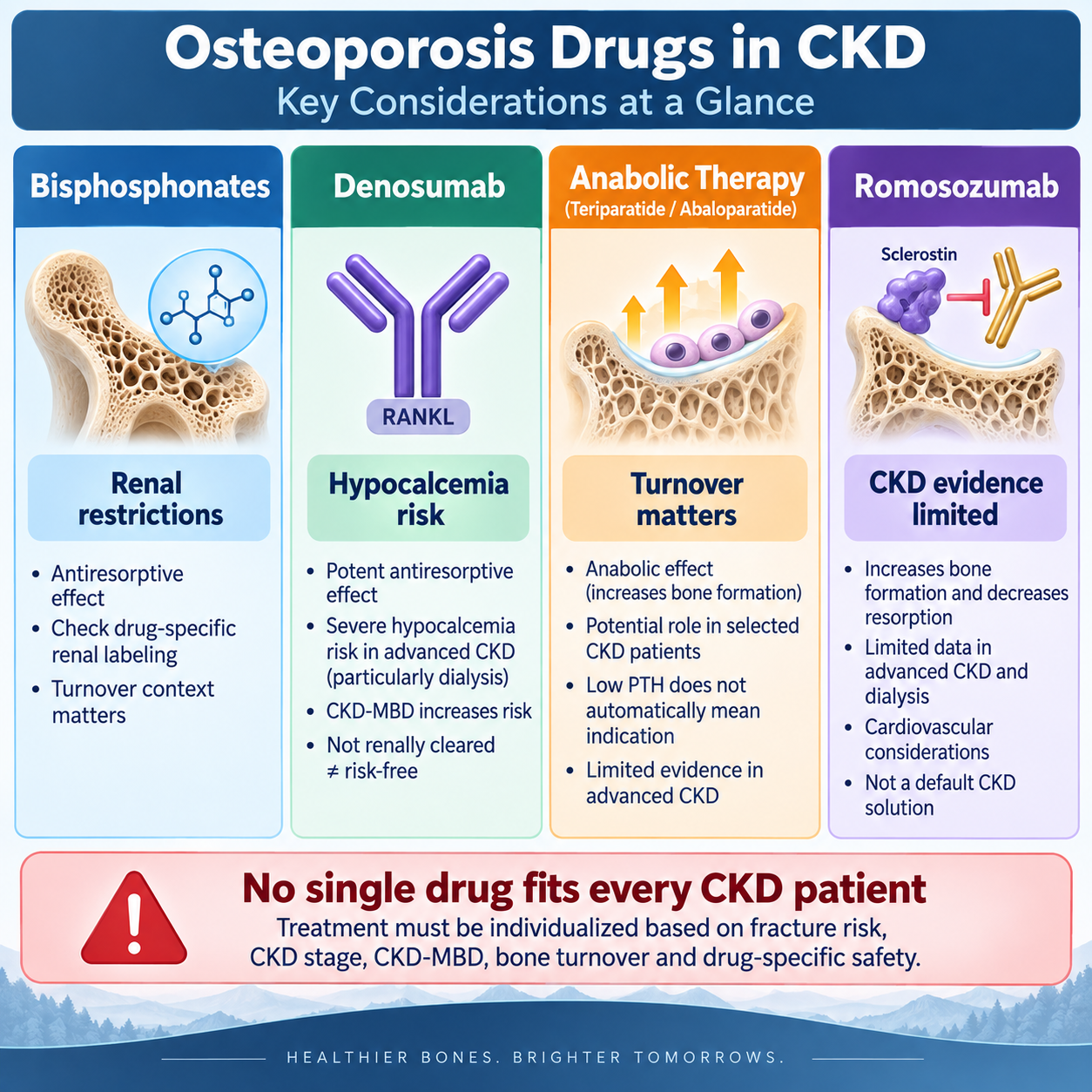
| Treatment approach | Main skeletal effect | Main CKD question |
|---|---|---|
| Bisphosphonates | Antiresorptive | Renal restrictions and turnover context |
| Denosumab | Potent antiresorptive via RANKL | Severe hypocalcemia risk in advanced CKD |
| PTH/PTHrP analogues | Anabolic | Is low formation truly the relevant problem? |
| Romosozumab | Sclerostin inhibition; anabolic + antiresorptive effects | Limited advanced-CKD evidence and cardiovascular context |
| CKD-MBD therapy | Corrects metabolic driver | Is renal bone disease driving skeletal fragility? |
| Non-drug measures | Falls, muscle, lifestyle | Fracture prevention is broader than medication |
Bisphosphonates in CKD
Bisphosphonates — Mechanism
Bisphosphonates are:
ANTIRESORPTIVE DRUGSThey bind to bone mineral and suppress osteoclast-mediated bone resorption.
The result is:
BONE RESORPTION ↓ BONE TURNOVER ↓ FRACTURE RISK ↓ IN APPROPRIATE OSTEOPOROSIS POPULATIONSTheir established evidence base is strongest in conventional osteoporosis populations.
Bisphosphonates In Earlier CKD
When CKD is mild or moderate and the patient does not have important biochemical CKD-MBD, treatment may often follow general osteoporosis principles, consistent with the KDIGO framework for G1–G2 and G3a–G3b with normal PTH. (KDIGO)
However:
CHECK THE SPECIFIC DRUGIndividual bisphosphonates differ in:
- renal labeling;
- approved indications;
- route of administration;
- precautions;
- contraindications.
Therefore:
DO NOT CREATE ONE eGFR CUTOFF FOR THE ENTIRE CLASSBisphosphonates In Advanced CKD
As CKD progresses, several problems become more important:
- evidence from large osteoporosis trials becomes less directly applicable;
- CKD-MBD becomes more common;
- renal drug considerations increase;
- very-low-turnover bone becomes more relevant.
A contemporary review emphasizes that medical fracture prevention in advanced CKD remains an area with substantial evidence gaps and requires individualized clinical judgment. (PubMed Central (PMC))
Therefore:
ADVANCED CKD REQUIRES MORE THAN A T-SCORE BEFORE BISPHOSPHONATE SELECTIONBisphosphonates And Low Turnover
Bisphosphonates suppress bone resorption and remodeling.
If bone turnover is already very low:
FURTHER TURNOVER SUPPRESSION IS A RELEVANT CONCERNThis does not establish a universal prohibition.
Instead ask:
- How strong is the fracture-prevention indication?
- How advanced is CKD?
- Is significant CKD-MBD present?
- Is low turnover strongly suspected?
- Would more definitive turnover information change treatment?
Memory:
LOW BMD ≠ AUTOMATIC BISPHOSPHONATEBisphosphonate Safety Principle
DRUG-SPECIFIC RENAL LABELING MATTERSDenosumab in CKD
Denosumab — Mechanism
Denosumab is a monoclonal antibody targeting:
RANKLThis suppresses:
OSTEOCLAST FORMATION AND ACTIVITY BONE RESORPTION ↓Denosumab is a potent antiresorptive treatment.
But its CKD safety problem is fundamentally different from simply asking whether a drug is renally cleared.
The Most Important Denosumab Memory
Display prominently:
NOT RENALLY CLEARED ≠ RENALLY RISK-FREEThis should be one of the major teaching messages of the article.
Denosumab And Advanced CKD
In January 2024, the FDA added a Boxed Warning to Prolia (denosumab) because of an increased risk of severe hypocalcemia in patients with advanced CKD.
Risk is particularly important in:
DIALYSISand:
CKD-MBDThe FDA reported serious consequences including:
- hospitalization;
- life-threatening events;
- death.
(U.S. Food and Drug Administration)
This safety warning must be visually prominent.
Why Denosumab Can Produce Hypocalcemia
Conceptual pathway:
RANKL BLOCKED OSTEOCLAST ACTIVITY ↓ CALCIUM RELEASE FROM BONE ↓Combined with:
ADVANCED CKD / CKD-MBD SERUM CALCIUM MAY FALL MARKEDLYThe risk is particularly important when mineral metabolism is already abnormal.
Before Denosumab In Advanced CKD
The FDA advises clinicians to assess:
- kidney function;
- calcium;
- evidence of CKD-MBD;
before Prolia treatment in advanced CKD, with involvement of clinicians experienced in CKD-MBD particularly for dialysis patients. (U.S. Food and Drug Administration)
The treatment context should include:
CORRECT IMPORTANT PRE-EXISTING HYPOCALCEMIAand:
ADDRESS CKD-MBDbefore proceeding when denosumab is considered.
Monitoring After Denosumab
For advanced CKD, the FDA specifically recommends frequent calcium monitoring after Prolia administration, particularly during the period of greatest observed risk. Severe events in the FDA analysis typically occurred 2–10 weeks after injection, with greatest risk during weeks 2–5. (U.S. Food and Drug Administration)
This numerical interval may be included because it comes directly from the FDA safety communication.
However:
Denosumab And Dialysis
Dialysis represents a particularly high-risk context.
Therefore:
DENOSUMAB IN DIALYSIS IS A SPECIALIST CKD-MBD DECISIONnot:
A ROUTINE EXTENSION OF GENERAL OSTEOPOROSIS PRESCRIBINGThe FDA explicitly recommends that treatment in advanced CKD, including dialysis, particularly when CKD-MBD is present, involve expertise in CKD-MBD diagnosis and management. (U.S. Food and Drug Administration)
Denosumab Discontinuation
Denosumab treatment also requires an exit strategy.
Stopping, skipping or substantially delaying treatment can be followed by:
REBOUND BONE TURNOVERand:
INCREASED VERTEBRAL-FRACTURE RISKThe FDA specifically warns patients not to stop Prolia without discussing fracture-prevention planning with their clinician. (U.S. Food and Drug Administration)
Therefore:
DO NOT START DENOSUMAB WITHOUT THINKING ABOUT HOW TREATMENT WILL EVENTUALLY BE CONTINUED OR TRANSITIONEDAnabolic Therapy in CKD
Anabolic Therapy — Concept
Antiresorptive treatment mainly suppresses bone breakdown.
Anabolic treatment aims to:
INCREASE BONE FORMATIONThis distinction becomes conceptually important in CKD because some patients may already have:
VERY LOW BONE FORMATIONHowever:
LOW SERUM PTH DOES NOT AUTOMATICALLY MEAN “USE AN ANABOLIC DRUG”Teriparatide And Abaloparatide
Teriparatide and abaloparatide are PTH-receptor pathway anabolic therapies used in appropriate osteoporosis populations.
In CKD, treatment decisions become more complicated because the patient may have:
- secondary hyperparathyroidism;
- altered endogenous PTH physiology;
- low-turnover bone;
- CKD-MBD;
- limited advanced-CKD trial evidence.
Contemporary reviews describe anabolic therapy as potentially useful in selected CKD patients but emphasize the limited evidence base in advanced CKD and dialysis. (PubMed Central (PMC))
Therefore:
ANABOLIC THERAPY REQUIRES PHENOTYPE-AWARE SELECTIONHigh PTH And Anabolic Therapy
If a patient already has severe PTH-driven high-turnover disease:
THE PROBLEM IS NOT A LACK OF PTH SIGNALTherefore the first question should be whether uncontrolled CKD-MBD requires treatment.
Avoid this incorrect conclusion:
“Fracture + CKD = teriparatide.”
Low-Turnover Bone And Anabolic Therapy
A treatment that stimulates formation may be biologically attractive in a true low-turnover state.
However:
- biochemical markers are imperfect;
- low PTH does not prove histology;
- advanced CKD evidence is limited.
Therefore:
BIOLOGICAL PLAUSIBILITY ≠ UNIVERSAL STANDARD OF CAREThis distinction is essential.
Romosozumab in CKD
Romosozumab
Romosozumab targets:
SCLEROSTINIts skeletal effect includes:
BONE FORMATION ↑and:
BONE RESORPTION ↓It is an important osteoporosis therapy in selected general-population patients.
However, advanced CKD and dialysis data remain limited compared with conventional osteoporosis populations. (PubMed Central (PMC))
Treatment decisions also need to account for the drug's established cardiovascular safety considerations.
Therefore:
ROMOSOZUMAB IS NOT THE AUTOMATIC “CKD-SAFE” SOLUTIONShould One Drug Be Called “Best” For CKD?
NOThere is no single osteoporosis drug that can be called:
THE BEST DRUG FOR ALL CKDSelection depends on:
- CKD stage;
- fracture risk;
- CKD-MBD;
- likely turnover;
- calcium status;
- renal drug restrictions;
- previous therapy;
- drug-specific adverse effects;
- ability to monitor;
- future treatment strategy.
Non-Drug Fracture Prevention
Non-Drug Fracture Prevention
Medication is only one part of fracture prevention.
Assess:
- falls;
- muscle weakness;
- gait;
- frailty;
- vision;
- sedating medications;
- postural hypotension;
- nutrition;
- smoking;
- excessive alcohol;
- physical inactivity.
Therefore:
TREAT THE BONE + REDUCE THE FALLExercise
Appropriate exercise can support:
- muscle strength;
- balance;
- mobility;
- skeletal loading;
- fall reduction.
But the program should account for:
- frailty;
- dialysis;
- cardiovascular disease;
- neuropathy;
- previous fracture;
- mobility limitations.
Calcium
Adequate calcium availability matters for skeletal health and becomes particularly relevant with treatments capable of causing hypocalcemia.
However CKD also creates concern about:
- positive calcium balance;
- hypercalcemia;
- vascular calcification;
- excessive PTH suppression in susceptible patients.
Therefore:
MORE CALCIUM IS NOT AUTOMATICALLY BETTER IN CKDVitamin D
Vitamin-D deficiency should be recognized and appropriately managed.
But distinguish:
NUTRITIONAL VITAMIN-D DEFICIENCYfrom:
ACTIVE VITAMIN-D THERAPY USED FOR CKD-MBDThese are not interchangeable concepts.
See vitamin D deficiency.
See vitamin D metabolism.
Phosphate
Phosphate management is part of CKD-MBD management where clinically indicated.
But osteoporosis medication should not be selected simply according to phosphate alone.
See hyperphosphatemia.
Dialysis Patients
A dialysis patient may simultaneously have:
- very high fracture risk;
- severe CKD-MBD;
- high turnover;
- low turnover;
- previous parathyroidectomy;
- calcium/phosphate abnormalities;
- multiple comorbidities;
- high fall risk.
Therefore:
DIALYSIS IS NOT SIMPLY “OSTEOPOROSIS + LOWER eGFR”It is a distinct metabolic context.
Treatment decisions should integrate:
FRACTURE RISK + CKD-MBD + TURNOVER + DRUG SAFETYDenosumab-associated hypocalcemia is particularly important in this population. (U.S. Food and Drug Administration)
Kidney Transplantation
Kidney transplantation creates another special context.
Bone disease may reflect:
- pre-existing renal osteodystrophy;
- persistent hyperparathyroidism;
- glucocorticoid exposure;
- osteoporosis;
- changing mineral metabolism.
KDIGO suggests BMD testing in transplant recipients with osteoporosis risk factors when results will alter therapy and gives specific guidance for the first post-transplant year. (KDIGO)
Monitoring Treatment
Monitoring — General Principle
Monitoring should match:
- CKD stage;
- selected drug;
- baseline CKD-MBD;
- calcium/phosphate status;
- turnover concerns;
- adverse-effect profile.
Potential domains include:
- calcium;
- phosphate;
- renal function;
- PTH;
- ALP/BSAP where clinically useful;
- vitamin-D status where relevant;
- interval BMD assessment where appropriate;
- incident fractures;
- falls;
- adverse effects;
- adherence.
Treatment Success
Do not define success only as:
BMD ↑The clinically important goal is:
FRACTURES ↓while maintaining:
- acceptable treatment safety;
- appropriate CKD-MBD control;
- functional independence;
- fall prevention.
Therefore:
THE ENDPOINT IS THE PATIENT — NOT THE DXA NUMBERTreatment Algorithm
Implement this as the major article algorithm.
OSTEOPOROSIS / HIGH FRACTURE RISK + CKD WHAT CKD STAGE?CKD G1–G2
GENERALLY TREAT AS GENERAL POPULATIONCKD G3a–G3b + NORMAL PTH
GENERALLY TREAT AS GENERAL POPULATIONCKD G3a–G5D + BIOCHEMICAL CKD-MBD
ASSESS CKD-MBD SEVERITY AND REVERSIBILITY COULD ABNORMAL TURNOVER CHANGE THE DRUG DECISION?High turnover likely
ADDRESS CKD-MBD DRIVERLow turnover likely
CAUTION WITH FURTHER TURNOVER SUPPRESSIONMineralization defect suspected
TREAT THE MINERALIZATION PROBLEMPhenotype uncertain and treatment depends on it
CONSIDER BONE BIOPSYThen:
CHOOSE TREATMENT CLASSBisphosphonate?
Denosumab?
Anabolic therapy?
Romosozumab?
CHECK DRUG-SPECIFIC CKD SAFETY PLAN MONITORING AND LONG-TERM STRATEGYFinal:
FRACTURE RISK + CKD STAGE + CKD-MBD + TURNOVER + DRUG SAFETY
Drug Comparison
Implement responsively.
| Question | Bisphosphonates | Denosumab | PTH/PTHrP anabolic therapy | Romosozumab |
|---|---|---|---|---|
| Main action | Antiresorptive | Potent antiresorptive | Anabolic | Anabolic + antiresorptive |
| Renal issue | Drug-specific renal restrictions | Severe hypocalcemia in advanced CKD | Limited advanced-CKD evidence/phenotype matters | Limited advanced-CKD evidence |
| Low-turnover concern | Further suppression | Further suppression | Potential biological rationale in selected cases | Complex |
| High-turnover CKD-MBD | Address driver | Address driver + Ca risk | Not a simple solution | Not a simple solution |
| Dialysis evidence | Limited | Major hypocalcemia concern | Limited | Limited |
| Key memory | Check drug + turnover | Not renally cleared ≠ risk-free | Low PTH ≠ automatic indication | Not default CKD solution |
Worked Clinical Cases
Case 1 — CKD G2
Patient has osteoporosis and CKD G2 without important CKD-MBD.
Principle
GENERAL-POPULATION OSTEOPOROSIS FRAMEWORKKDIGO recommends this approach. (KDIGO)
Case 2 — CKD G3b with normal PTH
Patient has CKD G3b, normal PTH and high fracture risk.
Principle
GENERAL-POPULATION TREATMENT IS GENERALLY APPROPRIATEaccording to KDIGO's CKD-MBD framework. (KDIGO)
Case 3 — CKD G4 with severe SHPT
Patient has:
- fragility fracture;
- low BMD;
- markedly elevated PTH;
- elevated BSAP.
Wrong approach
“Choose an osteoporosis drug from the T-score.”
Better approach
HIGH-TURNOVER CKD-MBD MAY BE A MAJOR DRIVERAddress the metabolic bone process as part of the treatment plan.
Case 4 — CKD G4 with suspected low turnover
Patient has:
- low BMD;
- markedly suppressed PTH;
- low BSAP;
- diabetes.
Question
Should a potent antiresorptive automatically be started?
Answer
NOThe possibility of already-low turnover should influence the decision.
Case 5 — Bisphosphonate in early CKD
Patient has conventional osteoporosis with mild CKD.
Lesson
CKD DOES NOT AUTOMATICALLY PROHIBIT BISPHOSPHONATESUse the specific drug's renal prescribing information and the patient's clinical context.
Case 6 — Bisphosphonate in advanced CKD
Patient has CKD G5, low BMD and uncertain turnover.
Lesson
ADVANCED CKD REQUIRES PHENOTYPE-AWARE DECISION-MAKINGDo not prescribe solely because the T-score is low.
Case 7 — Denosumab and dialysis
Dialysis patient is being considered for denosumab.
Major concern
SEVERE HYPOCALCEMIALesson
THIS REQUIRES CKD-MBD EXPERTISE AND CAREFUL CALCIUM/MINERAL MANAGEMENTThe FDA specifically identifies dialysis as a particularly high-risk setting. (U.S. Food and Drug Administration)
Case 8 — Denosumab with CKD-MBD
Advanced CKD patient has biochemical CKD-MBD and pre-existing hypocalcemia.
Wrong approach
“Denosumab is not renally cleared, so kidney disease is not relevant.”
Correct principle
NOT RENALLY CLEARED ≠ RENALLY RISK-FREEAddress hypocalcemia and CKD-MBD before treatment is considered. (U.S. Food and Drug Administration)
Case 9 — Denosumab discontinuation
Patient receiving long-term denosumab wants simply to stop treatment.
Lesson
DENOSUMAB REQUIRES AN EXIT STRATEGYStopping or delaying treatment can increase vertebral-fracture risk. (U.S. Food and Drug Administration)
Case 10 — Low PTH and teriparatide
Advanced CKD patient has low PTH.
Wrong conclusion
“Low PTH means teriparatide is indicated.”
Correct conclusion
LOW SERUM PTH DOES NOT DEFINE THE BONE PHENOTYPEThe whole CKD-MBD and turnover context matters.
Case 11 — Osteomalacia
Patient has low BMD but biochemical evidence suggests defective mineralization.
Lesson
TREAT THE MINERALIZATION DISORDERDo not automatically treat the DXA result as conventional osteoporosis.
Case 12 — Falls
Older CKD patient has osteoporosis plus recurrent falls and muscle weakness.
Lesson
OSTEOPOROSIS DRUG + NO FALL STRATEGY = INCOMPLETE FRACTURE PREVENTIONCommon Mistakes
Mistake 1
Every CKD patient needs a special osteoporosis drug.
Wrong.
Mistake 2
Standard osteoporosis treatment can never be used in CKD.
Wrong.
Mistake 3
A low T-score automatically determines the drug.
Wrong.
Mistake 4
CKD G2 osteoporosis should always be treated differently from the general population.
Wrong.
Mistake 5
CKD G3b automatically prohibits standard osteoporosis treatment.
Wrong.
Mistake 6
PTH does not matter when choosing therapy in advanced CKD.
Wrong.
Mistake 7
Low PTH proves adynamic bone.
Wrong.
Mistake 8
High PTH proves osteitis fibrosa.
Wrong.
Mistake 9
Bone biopsy is required before every osteoporosis treatment in CKD.
Wrong.
Mistake 10
Bisphosphonates are prohibited in every patient with CKD.
Wrong.
Mistake 11
All bisphosphonates have one universal renal cutoff.
Wrong.
Mistake 12
Low BMD automatically means a bisphosphonate should be prescribed.
Wrong.
Mistake 13
Denosumab is automatically safe because it is not handled like renally cleared bisphosphonates.
Wrong.
Mistake 14
Denosumab cannot cause dangerous hypocalcemia in dialysis.
Wrong. The FDA has issued a boxed warning. (U.S. Food and Drug Administration)
Mistake 15
CKD-MBD does not affect denosumab risk.
Wrong. The FDA identifies CKD-MBD as an important risk enhancer. (U.S. Food and Drug Administration)
Mistake 16
Denosumab can simply be stopped when no longer wanted.
Wrong.
Mistake 17
Low PTH automatically means teriparatide should be given.
Wrong.
Mistake 18
Romosozumab is proven to be the preferred treatment in dialysis.
Wrong.
Mistake 19
Osteomalacia is treated exactly like conventional osteoporosis.
Wrong.
Mistake 20
Fracture prevention is only about medication.
Wrong.
Osteoporosis Treatment in CKD in One Minute
OSTEOPOROSIS TREATMENT IN CKD — ONE MINUTEG1–G2
GENERALLY STANDARD OSTEOPOROSIS TREATMENTG3a–G3b + normal PTH
GENERALLY STANDARD OSTEOPOROSIS TREATMENTG3a–G5D + CKD-MBD
STOP AND ASSESS THE BONE CONTEXTHigh turnover?
→ address CKD-MBD driver.
Low turnover?
→ caution with further suppression.
Mineralization defect?
→ treat the defect.
Uncertain + phenotype changes therapy?
→ consider biopsy.
Then:
Bisphosphonate
CHECK RENAL RESTRICTIONS + TURNOVERDenosumab
CHECK Ca + CKD-MBD + SEVERE HYPOCALCEMIA RISKAnabolic therapy
PHENOTYPE MATTERSRomosozumab
LIMITED ADVANCED-CKD EVIDENCE + CV CONTEXTFinal:
DO NOT TREAT THE T-SCORE — TREAT THE PATIENTFrequently Asked Questions
Can osteoporosis be treated in patients with CKD?
Yes. The appropriate approach depends on CKD stage, fracture risk, CKD-MBD, likely bone turnover and the specific medication.
How is osteoporosis treated in CKD G1–G2?
KDIGO recommends treating osteoporosis/high fracture risk as in the general population.
What about CKD G3a–G3b?
When PTH is normal and osteoporosis/high fracture risk is present, KDIGO suggests treatment as for the general population.
Why is treatment harder in CKD G4–G5?
Advanced CKD is more likely to involve CKD-MBD, abnormal turnover, mineralization abnormalities and medication-specific safety problems.
Does low BMD tell which osteoporosis drug to use?
No. BMD helps assess skeletal fragility but does not directly identify bone turnover or mineralization.
Can bisphosphonates be used in CKD?
They can be appropriate in selected CKD patients. The decision depends on CKD stage, the individual drug's renal labeling, CKD-MBD and bone-turnover context.
Are bisphosphonates contraindicated in every CKD patient?
No.
Why is low-turnover bone relevant to antiresorptive treatment?
Antiresorptive drugs suppress remodeling, so already-severely-suppressed turnover may change the treatment risk-benefit assessment.
Can denosumab be used in CKD?
It may be considered in selected patients, but advanced CKD creates a major severe-hypocalcemia risk that requires careful assessment and monitoring.
What is the FDA warning about denosumab in CKD?
The FDA added a boxed warning because Prolia increases severe-hypocalcemia risk in advanced CKD, particularly dialysis, with greater risk when CKD-MBD is present.
Is denosumab safe just because it is not renally cleared like a bisphosphonate?
No. Its severe-hypocalcemia risk in advanced CKD demonstrates why renal safety cannot be judged from clearance alone.
Can denosumab simply be stopped?
No. Stopping, skipping or delaying denosumab can increase fracture risk, particularly vertebral fractures, so discontinuation requires a planned strategy.
Is teriparatide automatically appropriate when PTH is low?
No. Serum PTH alone does not establish the bone-turnover phenotype or determine anabolic-treatment suitability.
Is bone biopsy required before osteoporosis treatment in advanced CKD?
Not routinely. KDIGO suggests considering biopsy when knowledge of the underlying ROD phenotype would meaningfully influence treatment.
What is the main principle for osteoporosis treatment in CKD?
Integrate fracture risk, CKD stage, CKD-MBD, likely bone turnover and drug-specific safety rather than selecting treatment from BMD alone.
Key Take-Home Messages
Osteoporosis treatment in CKD should become progressively more individualized as kidney disease advances.
In:
CKD G1–G2and often:
CKD G3a–G3b WITH NORMAL PTHthe general osteoporosis treatment framework usually remains applicable according to KDIGO. (KDIGO)
But when the patient has:
ADVANCED CKD + BIOCHEMICAL CKD-MBDthe treatment question changes.
Before selecting a drug, consider:
IS TURNOVER HIGH? IS TURNOVER LOW? IS MINERALIZATION ABNORMAL? WOULD KNOWING THE EXACT PHENOTYPE CHANGE THERAPY?Bisphosphonates are not universally prohibited in CKD, but renal restrictions and turnover context matter.
Denosumab requires particular caution.
NOT RENALLY CLEARED ≠ RENALLY RISK-FREEIn advanced CKD, particularly dialysis and CKD-MBD, denosumab can cause severe hypocalcemia and carries an FDA boxed warning. (U.S. Food and Drug Administration)
Anabolic treatments may be useful in selected patients, but:
LOW PTH ≠ AUTOMATIC ANABOLIC INDICATIONand evidence in advanced CKD remains limited. (PubMed Central (PMC))
Finally, medication is only one part of fracture prevention.
TREAT THE BONE CONTROL CKD-MBD REDUCE FALLSThe final decision should follow:
FRACTURE RISK CKD STAGE CKD-MBD TURNOVER CONTEXT DRUG-SPECIFIC BENEFIT / RISK INDIVIDUALIZED TREATMENTFinal memory:
DO NOT TREAT THE T-SCORE — TREAT THE PATIENT'S FRACTURE RISK, BONE BIOLOGY AND CKD CONTEXT