Potassium replacement is one of the most common electrolyte interventions in clinical medicine, but it is not a routine prescription to normalise a number. Safe replacement requires assessment of symptoms, ECG findings, kidney function, ongoing losses, magnesium status and the underlying cause of hypokalemia.
This article builds on Electrolytes Explained, Potassium Homeostasis Explained, Hypokalemia Explained and Hyperkalemia Explained.
Specific doses, maximum infusion rates and monitoring intervals vary by institution. This page explains the clinical principles that help medical students and junior doctors understand why local potassium replacement protocols are written the way they are.
The goal is safe restoration of potassium balance while avoiding rebound hyperkalemia, arrhythmias and recurrent losses.

Learning Objectives
- Decide when potassium replacement is indicated
- Assess urgency using symptoms, potassium level, ECG and kidney function
- Distinguish oral and intravenous replacement strategies
- Understand why magnesium deficiency causes refractory hypokalemia
- Recognise situations needing closer monitoring
- Avoid common prescribing and monitoring errors
Why Potassium Replacement Matters
Potassium is essential for normal nerve, skeletal muscle and cardiac electrical activity. Clinically significant hypokalemia can cause weakness, paralysis, respiratory muscle dysfunction, ileus, arrhythmias, increased digoxin toxicity and sudden cardiac death.
Replacement itself can also be hazardous. Excessive or rapid potassium administration may produce hyperkalemia, particularly in patients with acute kidney injury, chronic kidney disease, low urine output or medications that impair potassium excretion.
Assessment Before Replacement
The decision to replace potassium depends on more than the serum potassium concentration alone. Clinicians should assess the laboratory value, symptoms, ECG findings, speed of decline, kidney function, medication history and whether losses are ongoing.
| Assessment Area | Why It Matters |
|---|---|
| Severity | Severe hypokalemia increases risk of weakness, paralysis and arrhythmias |
| Symptoms | Weakness, palpitations, syncope or respiratory involvement increase urgency |
| ECG | Flattened T waves, U waves, ST depression or ventricular ectopy suggest cardiac risk |
| Kidney function | Impaired excretion increases the risk of overcorrection |
| Magnesium | Low magnesium can make potassium correction ineffective |
| Ongoing losses | Vomiting, diarrhoea, stomas or diuretics may cause recurrent hypokalemia |
Severity of Hypokalemia
| Severity | Serum Potassium | Typical Approach |
|---|---|---|
| Mild | 3.0-3.4 mmol/L | Often oral replacement and cause correction if clinically stable |
| Moderate | 2.5-2.9 mmol/L | Assess symptoms, ECG and ongoing losses; oral often possible if stable |
| Severe | <2.5 mmol/L | Urgent assessment; IV replacement and monitoring may be required |
General Principles
Potassium replacement is safest when it follows a structured sequence.
- Confirm the diagnosis if the result is unexpected or inconsistent with the clinical picture.
- Identify the mechanism: gastrointestinal loss, renal loss, redistribution or reduced intake.
- Correct ongoing losses such as diarrhoea, vomiting, high-output stoma or unnecessary diuretic effect.
- Check and correct magnesium, especially in persistent, moderate or severe hypokalemia.
- Assess renal function and urine output before and during replacement.
- Avoid overcorrection by repeating blood tests and adjusting therapy to response.
Potassium prescriptions should follow local policy for formulation, concentration, diluent, route, infusion pump use, maximum rate and monitoring frequency.
Oral Potassium Replacement
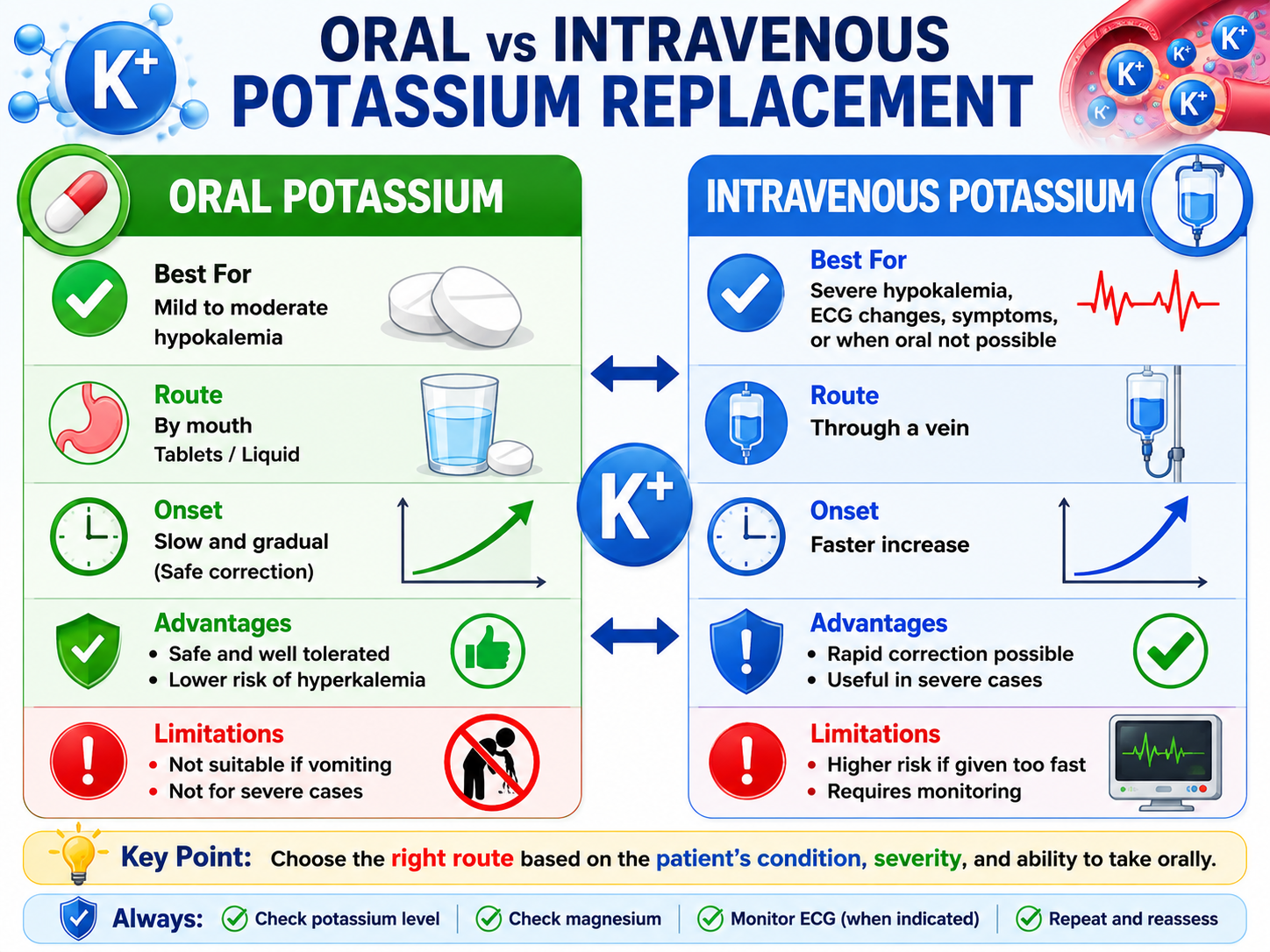
Oral potassium is preferred whenever the patient is stable and able to tolerate enteral medication. It produces a slower and more physiological correction than intravenous therapy and has a lower risk of sudden hyperkalemia.
Typical Indications
- Mild hypokalemia
- Most clinically stable moderate hypokalemia
- No significant ECG abnormalities
- Functioning gastrointestinal tract
- Ability to swallow or receive enteral medication
Common Preparations
Preparations vary by country and hospital formulary. Common options include potassium chloride tablets, sustained-release potassium chloride, potassium chloride liquid and effervescent preparations.
Potassium chloride is commonly used because many patients with hypokalemia also have chloride depletion, especially after vomiting or diuretic therapy. Other potassium salts may be considered in selected situations, such as coexisting phosphate depletion or metabolic acidosis, but this should follow local guidance.
Intravenous Potassium Replacement
Intravenous potassium should be reserved for patients who need urgent correction or cannot safely receive oral therapy. It can raise serum potassium more rapidly, so it requires careful monitoring and administration through an appropriate line using an infusion pump.
Common Indications
- Severe hypokalemia
- Significant ECG abnormalities
- Cardiac arrhythmias or concerning cardiac symptoms
- Severe weakness, paralysis or respiratory muscle involvement
- Inability to tolerate oral therapy
- Severe ongoing potassium losses
Administration Principles
Intravenous potassium should be diluted appropriately, given with an infusion pump and monitored according to the patient's risk. Peripheral lines may be suitable for many patients but can cause pain and phlebitis. Central access may be required for higher concentrations or repeated replacement, depending on local policy.
Potassium should not be given as a rapid intravenous bolus outside specialised resuscitation protocols. Rapid administration can provoke fatal arrhythmias.
Monitoring
Monitoring is part of treatment, not an optional extra. The intensity of monitoring depends on severity, route, symptoms, ECG findings, kidney function and whether potassium losses are ongoing.

Repeat Potassium Measurement
Serum potassium should be rechecked after replacement according to clinical urgency and local protocol. Patients receiving intravenous replacement usually need more frequent blood testing than those receiving oral therapy.
ECG Monitoring
Continuous ECG monitoring should be considered in severe hypokalemia, significant ECG changes, intravenous replacement, cardiac disease or rapid potassium shifts. For ECG morphology and interpretation pitfalls, see ECG Changes in Potassium Disorders.
Kidney Function and Urine Output
Creatinine, estimated GFR and urine output help estimate the risk of potassium accumulation. Low urine output or worsening kidney function should prompt cautious replacement and closer monitoring.
The Role of Magnesium
Magnesium deficiency is one of the most important reasons for persistent hypokalemia. Low magnesium increases potassium secretion in the distal nephron, so potassium replacement may fail until magnesium is corrected.
Magnesium should be checked in moderate or severe hypokalemia, persistent hypokalemia, diuretic therapy, chronic diarrhoea, alcohol dependence, malnutrition and suspected refeeding syndrome.
If potassium remains low despite apparently adequate replacement, think magnesium before simply giving more potassium.
Special Clinical Situations
Diabetic Ketoacidosis
DKA is a classic situation where serum potassium can be normal or elevated even though total body potassium is depleted. Insulin treatment and correction of acidosis drive potassium back into cells, so potassium may fall rapidly during therapy. DKA protocols therefore require repeated potassium assessment and protocol-guided replacement.
Chronic Kidney Disease
Patients with CKD are at increased risk of overcorrection because renal potassium excretion is impaired. Replacement decisions should consider baseline potassium, kidney function, urine output and medications such as ACE inhibitors, ARBs and mineralocorticoid receptor antagonists.
Ongoing Gastrointestinal Losses
Persistent diarrhoea, vomiting, high-output stoma and enterocutaneous fistula may cause continued potassium depletion. Replacement alone is insufficient unless the underlying loss is treated and volume status is corrected.
Diuretic Therapy
Loop and thiazide diuretics are common causes of hypokalemia. Review whether the diuretic remains necessary, whether the dose can be adjusted and whether potassium-sparing strategies are appropriate for the broader clinical context.
Heart Failure
Heart failure patients may receive medications with opposing potassium effects. Loop diuretics can lower potassium, while ACE inhibitors, ARBs and mineralocorticoid receptor antagonists can raise it. Replacement decisions should account for the whole medication regimen and renal function.
Complications
Potassium replacement is generally safe when performed carefully, but complications can occur when treatment is excessive, too rapid or poorly monitored.
- Hyperkalemia, especially in impaired renal function or excessive replacement
- Cardiac arrhythmias from rapid intravenous administration or overcorrection
- Phlebitis and pain with peripheral intravenous potassium
- Extravasation injury if intravenous potassium leaks into tissues
- Gastrointestinal upset with oral preparations
- Recurrent hypokalemia if ongoing losses are not corrected
Common Mistakes
- Treating the laboratory value without assessing the patient
- Using intravenous potassium when oral replacement is safe and feasible
- Ignoring magnesium deficiency
- Failing to identify vomiting, diarrhoea, diuretics or endocrine causes
- Not reassessing potassium after replacement
- Overcorrecting in patients with AKI or CKD
- Ignoring ECG abnormalities in moderate or severe hypokalemia
Practical Bedside Approach
This simple sequence helps prevent two opposite errors: under-treating dangerous hypokalemia and over-treating stable patients in a way that causes hyperkalemia.
One Minute Revision
- The goal is safe potassium restoration, not rapid normalisation of a number.
- Oral potassium is preferred for stable mild and many moderate cases.
- Intravenous potassium is reserved for severe, symptomatic, ECG-abnormal or oral-intolerant patients.
- Always assess kidney function, urine output, ECG risk and ongoing potassium losses.
- Magnesium deficiency commonly causes refractory hypokalemia.
- Repeat potassium measurement and clinical reassessment are essential.
Frequently Asked Questions
Conclusion
Potassium replacement is a common but potentially hazardous intervention. Safe practice depends on confirming hypokalemia, understanding the underlying mechanism, choosing the correct route, correcting magnesium deficiency, monitoring the response and treating ongoing losses. A structured approach allows clinicians to restore potassium while minimising the risks of arrhythmia, overcorrection and recurrent hypokalemia.
This article is intended for educational purposes. Potassium replacement should always follow local institutional protocols, taking into account the patient's clinical condition, kidney function and cardiac status. This article does not replace clinical judgement or specialist advice.