Fluids first → calcitonin = fast → antiresorptive = slower but durable → treat the mechanism
Severe hypercalcemia is treated by restoring euvolemia, rapidly lowering calcium when necessary with calcitonin, adding longer-acting antiresorptive therapy such as an IV bisphosphonate or denosumab when appropriate, and treating the underlying cause.
This article follows the hypercalcemia diagnostic approach: Ca ↑ → confirm → PTH → mechanism. Assessment of the cause and urgent stabilization proceed together.
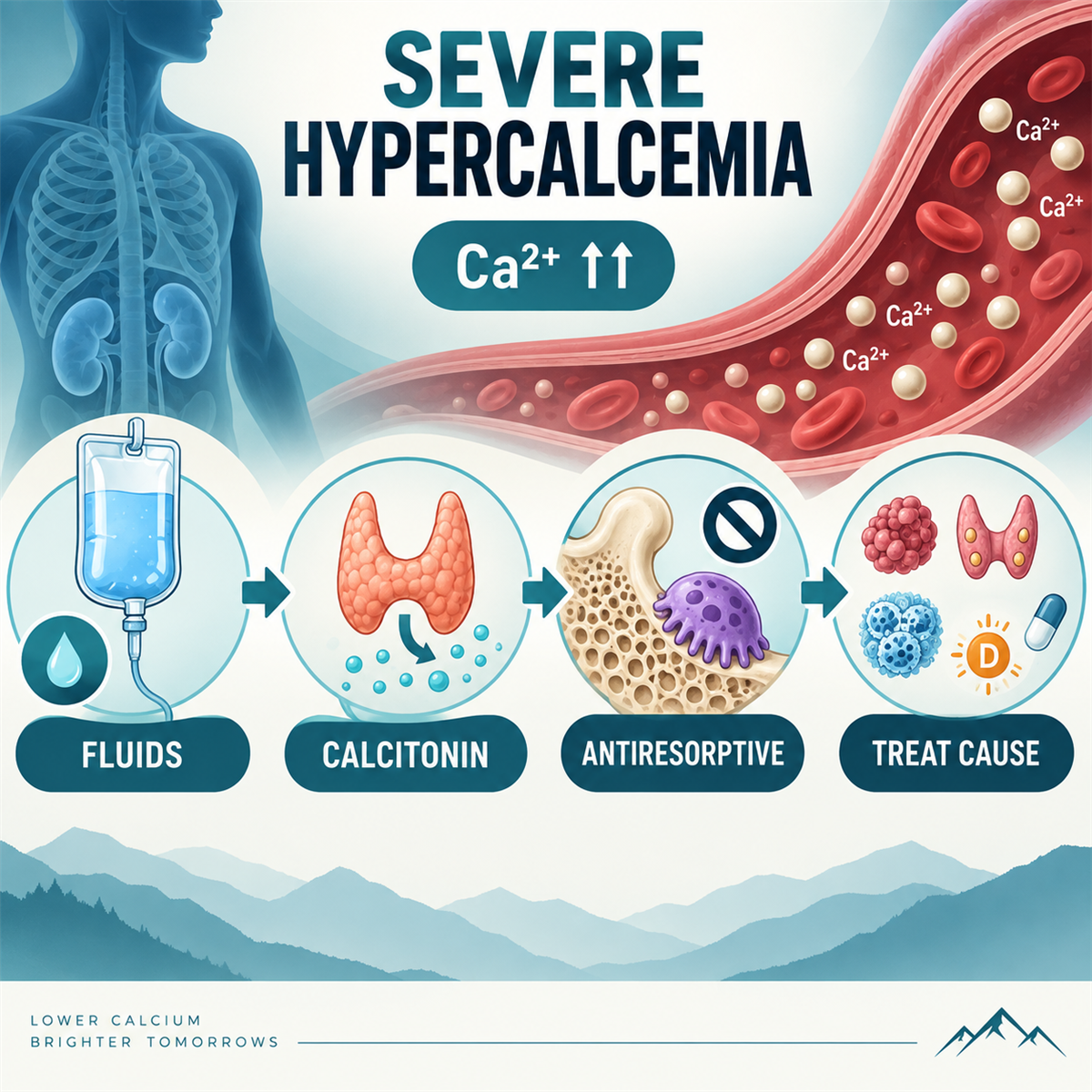
What Is Severe Hypercalcemia?
Hypercalcemia ranges from an incidental mild biochemical abnormality to a life-threatening metabolic emergency.
The urgency of treatment depends not only on the absolute serum calcium concentration but also on:
- the speed at which calcium increased;
- the patient's symptoms;
- volume status;
- renal function;
- cardiac status;
- neurological involvement;
- the underlying mechanism.
A patient with longstanding mild primary hyperparathyroidism may tolerate a calcium concentration that would produce major symptoms if reached rapidly in a patient with malignancy-associated hypercalcemia.
Therefore:
THE NUMBER ALONE DOES NOT DEFINE THE EMERGENCYManagement should answer three questions simultaneously:
1. DOES THE PATIENT NEED URGENT STABILIZATION? 2. HOW CAN CALCIUM BE LOWERED SAFELY? 3. WHAT IS DRIVING THE HYPERCALCEMIA?Definitive control depends on treating the underlying mechanism.
When Does Hypercalcemia Require Emergency Treatment?
When does hypercalcemia require urgent treatment?
Endotext provides a useful general framework:
Calcium <12 mg/dL
If the patient is asymptomatic:
treat the underlying causerather than automatically initiating emergency calcium-lowering treatment.
Calcium >12 mg/dL
If acute symptoms are present:
urgent treatment is generally appropriateCalcium >14 mg/dL
urgent treatment is almost always requiredThese are general clinical orientation points, not substitutes for clinical judgment. (NCBI)
Do not define severity by calcium alone
Urgency increases with:
RAPID RISE NEUROLOGICAL SYMPTOMS DEHYDRATION RENAL IMPAIRMENT CARDIAC EFFECTS MALIGNANCY-ASSOCIATED DISEASETherefore a symptomatic patient with a rapidly rising calcium may need urgent treatment even if the number is lower than a traditional “crisis” threshold.
Red-flag features
Urgent assessment is particularly important with:
CONFUSION STUPOR / REDUCED CONSCIOUSNESS SEVERE WEAKNESS PERSISTENT VOMITING SIGNIFICANT DEHYDRATION OLIGURIA / AKI ARRHYTHMIA OR IMPORTANT ECG CHANGE RAPIDLY INCREASING CALCIUM Ca >14 mg/dLin most clinical contexts.
For orientation, 12 mg/dL is approximately 3.0 mmol/L and 14 mg/dL is approximately 3.5 mmol/L. These values do not replace assessment of symptoms and rate of rise.
Why Hypercalcemia Causes Dehydration
Hypercalcemia impairs renal concentrating ability.
Therefore:
Ca ↑ NEPHROGENIC DIURESIS POLYURIA VOLUME DEPLETION GFR ↓ RENAL Ca CLEARANCE ↓ Ca RISES FURTHERThis is a:
VICIOUS CYCLEIV Fluids and Rehydration
First major treatment principle: restore euvolemia
For acute severe hypercalcemia, extracellular fluid depletion should usually be corrected.
Endotext identifies hydration with:
0.9% salineas foundational acute therapy. (NCBI)
The purpose is not simply “diluting calcium.”
Hydration:
- restores circulating volume;
- improves GFR;
- increases filtered calcium;
- improves renal calcium excretion;
- corrects hypercalcemia-related dehydration.
Fluids are physiological treatment
VOLUME RESTORED GFR ↑ FILTERED Ca ↑ RENAL Ca CLEARANCE ↑ SERUM Ca ↓Hydration alone may substantially help when the cause is rapidly reversible, particularly in calcium-alkali syndrome, but is often insufficient in malignancy-associated or severe resorptive hypercalcemia. Endotext explicitly notes this distinction. (NCBI)
Individualize fluid administration
There is no universal fluid rate suitable for every patient.
Fluid administration must consider:
- age;
- body size;
- blood pressure;
- degree of dehydration;
- urine output;
- heart failure;
- renal impairment;
- pulmonary status.
IV isotonic saline should be titrated to restore euvolemia while avoiding fluid overload.
Endotext specifically advises caution in patients with compromised cardiovascular or renal function. (NCBI)
What should be monitored during rehydration?
Depending on severity and setting:
- clinical volume status;
- blood pressure;
- heart rate;
- urine output;
- serum calcium;
- creatinine/eGFR;
- sodium;
- potassium;
- magnesium;
- phosphate;
- fluid balance;
- oxygenation/pulmonary signs when relevant.
Stop contributing agents
Early management should review and stop or reduce, when medically appropriate:
- calcium supplements;
- vitamin D excess;
- calcium-containing antacids;
- thiazides;
- vitamin A excess;
- other implicated medications.
Do not stop essential medications without clinical judgment.
Calcitonin: Rapid Bridge Therapy
Calcitonin
Calcitonin is valuable because it can lower calcium:
RAPIDLYIt acts mainly by:
reducing osteoclast-mediated bone resorptionand can also increase renal calcium excretion.
Endotext notes that calcium reduction can begin within approximately 2–6 hours. (NCBI)
Calcitonin's main role
CALCITONIN = RAPID BRIDGE THERAPYIt is particularly useful when:
- hypercalcemia is severe;
- symptoms are significant;
- a slower antiresorptive drug has also been started;
- rapid initial lowering is desirable.
Why calcitonin is not enough
Its major limitation is:
TACHYPHYLAXISThe calcium-lowering response diminishes rapidly.
Endotext notes tachyphylaxis often after approximately 24–48 hours, while the Endocrine Society advises limiting calcitonin therapy to 48–72 hours in severe hypercalcemia of malignancy. (Endocrine Society)
Memory rule:
CALCITONIN = FAST BUT SHORTCalcitonin + antiresorptive therapy
This combination makes physiological sense because:
Calcitonin
works quicklywhile:
Bisphosphonate / denosumab
takes longer but lasts longerThe Endocrine Society specifically suggests calcitonin together with an IV bisphosphonate or denosumab for severe hypercalcemia of malignancy, defined in that guideline as serum calcium >14 mg/dL. (Endocrine Society)
IV Bisphosphonates: Zoledronic Acid and Pamidronate
Antiresorptive therapy
In many severe cases, especially malignancy-associated hypercalcemia, excessive:
OSTEOCLAST-MEDIATED BONE RESORPTIONis a major contributor.
Therefore longer-acting treatment targets osteoclasts.
Main options:
IV BISPHOSPHONATESand:
DENOSUMABIV bisphosphonates
Important agents include:
ZOLEDRONIC ACIDand:
PAMIDRONATEThese drugs bind bone mineral and inhibit osteoclast function.
Result:
BONE RESORPTION ↓ Ca RELEASE FROM BONE ↓ SERUM Ca ↓Bisphosphonates are not rapid like calcitonin
Their onset is:
SLOWERthan calcitonin.
Endotext notes that peak calcium reduction after IV bisphosphonate therapy may take several days. (NCBI)
Therefore:
CALCITONIN BRIDGES THE GAPin severe symptomatic disease.
Bisphosphonates last longer
Once effective, antiresorptive action can persist much longer than calcitonin.
This makes them useful for:
SUSTAINED CONTROLespecially when bone resorption is driving the hypercalcemia.
Renal function and bisphosphonates
IV bisphosphonates require attention to:
RENAL FUNCTIONbecause:
- they are renally cleared;
- nephrotoxicity can occur;
- administration may need modification or avoidance depending on renal impairment.
Denosumab and Renal Impairment
Denosumab
Denosumab is a monoclonal antibody against:
RANKLIt prevents activation and maturation of osteoclasts.
Therefore:
RANKL BLOCKADE OSTEOCLAST ACTIVITY ↓ BONE RESORPTION ↓ SERUM Ca ↓Denosumab in hypercalcemia of malignancy
The Endocrine Society recommends either:
DENOSUMABor:
IV BISPHOSPHONATEfor adults with hypercalcemia of malignancy.
It conditionally suggests:
DENOSUMAB OVER IV BISPHOSPHONATEbased on available evidence. (Endocrine Society)
This preference applies to malignancy-associated disease and should not be generalized to every nonmalignant hypercalcemia.
Denosumab in refractory hypercalcemia
For:
recurrent or refractory hypercalcemia of malignancydespite an IV bisphosphonate, the Endocrine Society suggests:
DENOSUMABas additional therapy. (Endocrine Society)
Denosumab and renal impairment
Unlike bisphosphonates, denosumab is not cleared by the kidney in the same way.
Therefore it may be useful when:
renal impairment limits bisphosphonate useHowever:
HYPOCALCEMIA RISK CAN BE GREATERparticularly in:
- CKD;
- vitamin D deficiency;
- low calcium states.
Endotext specifically notes correcting low 25-OH vitamin D before denosumab when possible to reduce subsequent hypocalcemia risk. (NCBI)
Denosumab safety principle
DENOSUMAB CAN OVERSHOOT HYPOCALCEMIATherefore monitor:
- calcium;
- vitamin D status;
- renal context;
- magnesium/phosphate when appropriate.
Calcitonin vs Bisphosphonate vs Denosumab
Calcitonin vs bisphosphonate vs denosumab
| Feature | Calcitonin | IV Bisphosphonate | Denosumab |
|---|---|---|---|
| Onset | Fast | Slower | Slower |
| Duration | Short | Long | Long |
| Main action | Rapid antiresorptive/calciuretic | Osteoclast inhibition | RANKL inhibition |
| Tachyphylaxis | Yes | No | No |
| Main role | Bridge | Sustained antiresorptive | Sustained antiresorptive |
| Renal concern | Relatively less | Important | Less dependent on renal clearance |
| Hypocalcemia risk | Usually limited | Possible | Important, especially CKD/Vit D deficiency |
Memory rule
CALCITONIN = HOURS ANTIRESORPTIVE = DAYS AND LONGERDo not interpret this as an exact pharmacokinetic rule.
It is a teaching framework.
Glucocorticoids and Calcitriol-Mediated Hypercalcemia
Glucocorticoids
Glucocorticoids are not universal hypercalcemia drugs.
They are particularly useful when the mechanism is:
CALCITRIOL-MEDIATEDExamples include:
- granulomatous disease;
- sarcoidosis;
- selected lymphomas;
- vitamin D-related mechanisms.
Why steroids work in calcitriol-mediated hypercalcemia
Granulomatous macrophages or malignant cells may produce:
extra-renal 1α-hydroxylase 1,25-(OH)₂D ↑ intestinal Ca absorption ↑ hypercalcemiaGlucocorticoids suppress this abnormal vitamin D activation pathway.
Therefore:
CALCITRIOL ↑ → THINK GLUCOCORTICOID RESPONSIVENESSwhen the clinical context supports it.
Hypercalcemia of malignancy from calcitriol
The Endocrine Society identifies glucocorticoids as first-line treatment for:
calcitriol-mediated hypercalcemia of malignancysuch as lymphoma-related disease.
If severe or symptomatic hypercalcemia persists despite glucocorticoid therapy:
IV bisphosphonate or denosumabmay be added. (Endocrine Society)
Vitamin D intoxication
When hypercalcemia results from excess vitamin D:
- stop vitamin D exposure;
- stop unnecessary calcium;
- restore volume;
- consider glucocorticoid therapy in appropriate cases;
- treat severe hypercalcemia according to clinical severity.
Endotext specifically lists glucocorticoids among therapies for vitamin D intoxication. (NCBI)
Cinacalcet: PTH-Directed Treatment
Cinacalcet
Cinacalcet is a:
CALCIMIMETICIt increases sensitivity of the:
CaSRto extracellular calcium.
This reduces:
PTH SECRETIONand can lower calcium in selected:
PTH-MEDIATED HYPERCALCEMIAWhen cinacalcet is relevant
Potential contexts include:
- severe PHPT when surgery is delayed or unavailable;
- parathyroid carcinoma;
- selected tertiary hyperparathyroidism.
Endotext lists cinacalcet as an option in severe primary hyperparathyroidism, particularly parathyroid carcinoma. (NCBI)
Cinacalcet is not universal emergency therapy
Cinacalcet is not a universal response to severe hypercalcemia.
It is mechanism-specific.
If severe acute hypercalcemia requires rapid stabilization:
fluids + rapid/antiresorptive measuresmay still be required while definitive PTH-directed management is planned.
Primary Hyperparathyroid Crisis and Parathyroid Carcinoma
Primary hyperparathyroidism crisis
A patient with severe symptomatic PHPT may require:
acute stabilization firstfollowed by:
DEFINITIVE PARATHYROIDECTOMYonce sufficiently optimized.
Do not rush an unstable, profoundly dehydrated patient directly to surgery without stabilization.
See the related reading on primary hyperparathyroidism.
Parathyroid carcinoma
Parathyroid carcinoma can produce extreme:
PTH-MEDIATED HYPERCALCEMIAThe Endocrine Society guideline addressing malignancy-related hypercalcemia states that:
- calcimimetic therapy;
- IV bisphosphonate;
- denosumab
may be used depending on severity and context, while surgery should be considered when feasible after severe hypercalcemia has been controlled. (Endocrine Society)
Why Routine Furosemide Is Not Recommended
Loop diuretics: important modern correction
A common older teaching was:
“Give saline and furosemide routinely to wash out calcium.”
This is not routine modern management.
The core rule is:
DO NOT GIVE LOOP DIURETICS BEFORE ADEQUATE REHYDRATIONEndotext specifically states that loop diuretics should be administered only after rehydration when calciuresis is needed. (NCBI)
Why routine furosemide can be harmful
Loop diuretics can:
increase volume loss worsen dehydration reduce GFRpotentially:
WORSEN HYPERCALCEMIAif used indiscriminately.
Therefore:
FLUID STATUS FIRSTWhen loop diuretics may be useful
Selected circumstances include:
- fluid overload after rehydration;
- a need for enhanced calciuresis in a carefully monitored patient;
- heart failure/pulmonary congestion during treatment.
They should not be automatic components of every hypercalcemia protocol.
Dialysis for Severe Hypercalcemia
Dialysis
Dialysis is a rescue option rather than routine first-line therapy.
Consider in selected patients with:
SEVERE REFRACTORY HYPERCALCEMIAor:
SIGNIFICANT RENAL FAILUREor:
INABILITY TO TOLERATE ADEQUATE FLUID THERAPYor:
LIFE-THREATENING CLINICAL MANIFESTATIONSEndotext specifically lists dialysis for patients refractory to other therapies and those with renal insufficiency. (NCBI)
Why dialysis works
Dialysis can:
REMOVE CALCIUM FROM THE CIRCULATIONusing an appropriately designed dialysate strategy.
These are nephrology-level treatment decisions.
Hypercalcemia of Malignancy
Malignancy-associated hypercalcemia
Main mechanisms include:
- PTHrP;
- osteolytic bone resorption;
- calcitriol;
- mixed mechanisms.
Treatment often requires:
ACUTE Ca CONTROLplus:
CANCER-DIRECTED THERAPYWithout treatment of the underlying malignancy, hypercalcemia can recur.
Endocrine Society HCM algorithm
For adult hypercalcemia of malignancy:
IV bisphosphonate OR denosumabis recommended.
For:
SEVERE HCM >14 mg/dLthe guideline suggests:
CALCITONIN + IV bisphosphonate or denosumabas initial therapy.
For:
refractory/recurrent HCM after bisphosphonateconsider:
DENOSUMABFor:
calcitriol-mediated HCMstart:
GLUCOCORTICOIDand add antiresorptive therapy if severe/symptomatic hypercalcemia persists. (Endocrine Society)
PTHrP-mediated hypercalcemia
Treatment principles:
- restore volume;
- antiresorptive therapy;
- calcitonin when rapid lowering is needed;
- treat malignancy.
Osteolytic hypercalcemia
Examples:
- multiple myeloma;
- extensive skeletal metastases.
Because the mechanism is heavily dependent on:
OSTEOCLAST ACTIVATIONantiresorptive therapy is particularly logical.
Again:
control of the underlying malignancy is essentialCause-Specific Treatment
Calcitriol-mediated disease
Examples:
- sarcoidosis;
- TB-associated granulomatous disease in selected patients;
- lymphoma;
- other granulomatous disorders.
Treatment principles:
STOP EXCESS Ca/Vit D EXPOSURE HYDRATE GLUCOCORTICOID WHEN APPROPRIATE ANTIRESORPTIVE IF SEVERE/PERSISTENTdepending on mechanism and clinical context.
Calcium-alkali syndrome
Core treatment:
STOP EXCESS CALCIUM / ALKALI RESTORE VOLUME RENAL FUNCTION IMPROVES CALCIUM CLEARANCE IMPROVESEndotext notes that hydration alone may sometimes be sufficient when the cause is readily reversible, such as calcium-alkali syndrome. (NCBI)
Immobilization-related hypercalcemia
Core principles:
- restore volume if needed;
- mobilize as soon as clinically possible;
- consider antiresorptive therapy when clinically appropriate.
Endotext includes mobilization after the acute episode as part of acute hypercalcemia management. (NCBI)
FHH
Typical FHH:
DOES NOT REQUIRE ACUTE CALCIUM-LOWERING TREATMENTbecause hypercalcemia is usually mild and stable.
If an FHH patient has severe symptomatic hypercalcemia:
DO NOT AUTOMATICALLY ASSUME FHH IS THE ONLY CAUSELook for:
- dehydration;
- medications;
- PHPT coexistence;
- another acute hypercalcemic process.
See the related reading on FHH.
Treat the cause, not just the number
PHPT
Parathyroidectomyis definitive when appropriate.
Malignancy
Cancer-directed treatmentis essential.
Vitamin D intoxication
Stop vitamin DCalcium-alkali
Stop calcium/alkaliGranulomatous/calcitriol
Mechanism-directed glucocorticoid therapyImmobilization
MobilizeDrug-induced
Remove contributing medication when feasible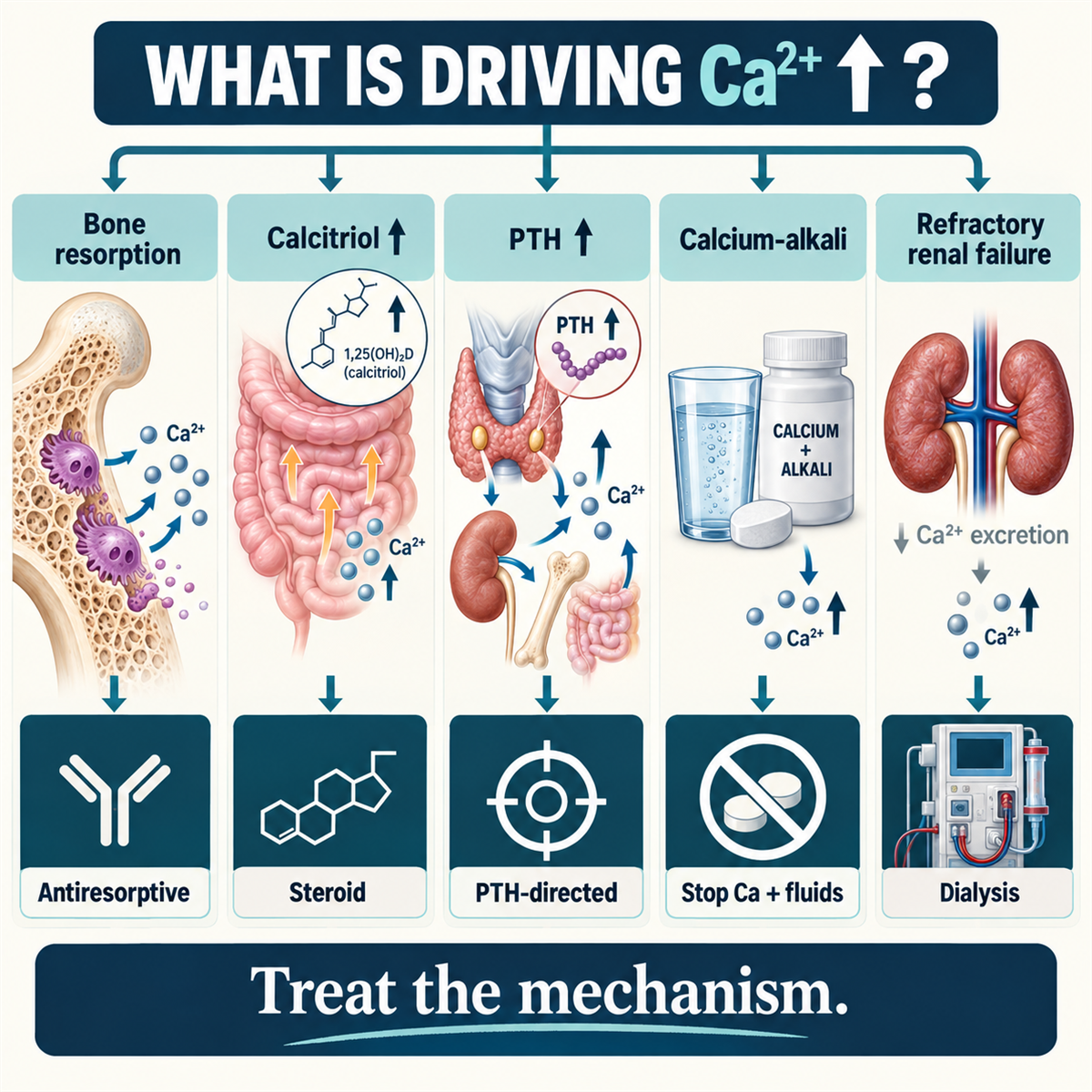
Complete Acute Management Algorithm
- Confirm severe or symptomatic hypercalcemia; assess mental state, cardiac status, renal function, volume status, cause and medications.
- Stop contributing agents when medically appropriate.
- Restore euvolemia with isotonic IV fluid when appropriate, individualized to cardiac and renal status.
- Need rapid calcium reduction? Use calcitonin as a short-term bridge when appropriate.
- Antiresorptive needed? Select an IV bisphosphonate or denosumab according to cause and renal context.
- Target the mechanism: glucocorticoids for appropriate calcitriol-mediated disease; cinacalcet or definitive parathyroid management for PTH-mediated disease; stop calcium/alkali and hydrate; treat malignancy.
- Consider dialysis with nephrology for selected refractory severe disease, significant renal failure or inability to tolerate adequate fluids.
- Monitor for recurrence, hypocalcemia and other treatment complications.
Treatment Timeline
Timeline concept
Minutes to hours
Fluids
start correcting volume.
Calcitonin
rapid calcium lowering.
Days
Bisphosphonate
major antiresorptive effect develops.
Denosumab
sustained antiresorptive effect develops.
Days and beyond
Cause-specific treatment
controls recurrence.
Do not treat these as rigid pharmacokinetic timings.
Why one drug often is not enough
In severe hypercalcemia:
CALCITONINmay act before:
ANTIRESORPTIVE THERAPYbut then loses effectiveness.
Therefore combination treatment can provide:
FAST CONTROL + DURABLE CONTROLparticularly in severe malignancy-associated disease.

Monitoring, Recurrence and Treatment Complications
Rebound / recurrence
Serum calcium can rise again if:
THE UNDERLYING MECHANISM REMAINS ACTIVEExamples:
- progressive cancer;
- unresected PHPT;
- continued vitamin D excess;
- persistent granulomatous disease.
Therefore treatment success should not be judged solely by the first calcium reduction.
Monitoring after treatment
Depending on severity and therapy, monitor:
- calcium;
- renal function;
- volume status;
- phosphate;
- magnesium;
- potassium;
- vitamin D status where relevant;
- ECG when clinically indicated;
- symptoms.
Monitor for:
HYPOCALCEMIAafter potent antiresorptive treatment.
Hypophosphatemia and hypomagnesemia
Severe illness, malignancy, renal losses and treatment can coexist with:
- hypophosphatemia;
- hypomagnesemia.
Both may affect:
- muscle function;
- cardiac stability;
- PTH physiology.
Therefore assess and correct when clinically indicated.
Calcium response is not the only outcome
Assess:
MENTAL STATUS URINE OUTPUT RENAL FUNCTION VOLUME STATUS GI SYMPTOMS CARDIAC STATUSas well as serum calcium.
Worked Clinical Cases
Worked case 1: dehydrated patient
Patient:
- Ca 13.1 mg/dL;
- vomiting;
- polyuria;
- clinically dehydrated;
- creatinine increased.
First principle
RESTORE EUVOLEMIAThe dehydration itself worsens renal calcium clearance.
Lesson
FLUIDS ARE PATHOPHYSIOLOGIC TREATMENTCase 2: severe hypercalcemia of malignancy
Patient:
- Ca 15.3 mg/dL;
- confusion;
- known squamous-cell carcinoma;
- PTH suppressed.
Management concept
URGENT REHYDRATION CALCITONINfor rapid lowering
DENOSUMAB OR IV BISPHOSPHONATEfor sustained control
CANCER-DIRECTED THERAPYThis aligns with Endocrine Society severe-HCM recommendations. (Endocrine Society)
Case 3: malignancy + CKD
Patient:
- severe malignancy-related hypercalcemia;
- significantly impaired renal function.
Key issue
IV bisphosphonate therapy requires renal consideration.
DENOSUMAB MAY BE ADVANTAGEOUSdepending on clinical context.
But monitor carefully for:
HYPOCALCEMIAespecially with CKD/vitamin D deficiency.
Case 4: calcitriol-mediated lymphoma
Patient:
- Ca ↑;
- PTH suppressed;
- 1,25-(OH)₂D ↑;
- lymphoma.
Mechanism
CALCITRIOL-MEDIATEDTreatment direction
GLUCOCORTICOIDwith antiresorptive therapy if severe/symptomatic hypercalcemia persists.
Case 5: sarcoidosis
Patient:
- hypercalcemia;
- PTH suppressed;
- calcitriol elevated;
- active sarcoidosis.
Interpretation
Macrophage-driven extra-renal calcitriol production.
Treatment principle
GLUCOCORTICOID-RESPONSIVE MECHANISMwhere clinically appropriate.
Case 6: primary hyperparathyroid crisis
Patient:
- severe Ca elevation;
- PTH markedly ↑;
- dehydration;
- vomiting;
- AKI.
Immediate approach
STABILIZE LOWER CALCIUM PLAN DEFINITIVE PARATHYROIDECTOMYonce clinically optimized.
Lesson
Definitive surgery does not eliminate the need for acute stabilization.
Case 7: calcium-alkali syndrome
Patient:
- Ca ↑;
- metabolic alkalosis;
- renal impairment;
- heavy calcium carbonate intake.
Treatment
STOP CALCIUM CARBONATE RESTORE VOLUME MONITOR RENAL RECOVERYIn many cases this may produce substantial improvement.
Case 8: heart failure
Patient:
- severe hypercalcemia;
- dehydration;
- reduced ejection fraction.
Error
“Give several litres rapidly because all hypercalcemia needs aggressive fluids.”
Correct reasoning
Volume replacement remains important but must be:
CAUTIOUS + INDIVIDUALIZEDwith close monitoring for pulmonary edema.
Case 9: refractory hypercalcemia + renal failure
Patient:
- severe hypercalcemia;
- renal failure;
- limited ability to tolerate fluids;
- inadequate response to conventional therapy.
Consider
DIALYSISwith nephrology involvement.
Case 10: routine furosemide error
Patient:
- severe hypercalcemia;
- markedly dehydrated;
- receives furosemide before adequate fluids.
Problem
Loop diuresis worsens:
VOLUME DEPLETION GFR ↓potentially worsening hypercalcemia.
Lesson
REHYDRATE FIRSTCase 11: calcitonin continued for a week
Patient receives calcitonin repeatedly for many days.
Calcium initially falls then stops responding.
Explanation
TACHYPHYLAXISLesson
Calcitonin is:
BRIDGE THERAPYnot durable control.
Case 12: denosumab + CKD + vitamin D deficiency
Patient receives denosumab.
Later:
significant hypocalcemia developsRisk factors
- CKD;
- low vitamin D;
- potent osteoclast suppression.
Lesson
ANTICIPATE THE OVERSHOOTCommon Mistakes
Mistake 1
Treat every hypercalcemia as an emergency.
Wrong.
Mistake 2
Calcium number alone defines severity.
Wrong.
Mistake 3
Fluids only dilute calcium.
Wrong.
They restore renal calcium clearance.
Mistake 4
Give the same fluid rate to every patient.
Wrong.
Mistake 5
Give furosemide before hydration.
Wrong.
Mistake 6
Routine furosemide is mandatory.
Wrong.
Mistake 7
Calcitonin is slow.
Wrong.
It is rapid.
Mistake 8
Calcitonin works indefinitely.
Wrong.
Mistake 9
Calcitonin alone is durable treatment for severe malignancy hypercalcemia.
Wrong.
Mistake 10
Bisphosphonates work immediately.
Wrong.
Mistake 11
Bisphosphonates have no renal implications.
Wrong.
Mistake 12
Denosumab cannot cause hypocalcemia.
Wrong.
Mistake 13
Denosumab is automatically best for every hypercalcemia.
Wrong.
Mistake 14
Steroids treat all hypercalcemia.
Wrong.
Mistake 15
High calcitriol has no treatment implication.
Wrong.
Mistake 16
Cinacalcet is universal acute therapy.
Wrong.
Mistake 17
Severe PHPT needs only medications.
Wrong.
Definitive therapy is often surgery.
Mistake 18
Dialysis is first-line therapy.
Wrong.
Mistake 19
Treat the calcium but ignore the malignancy.
Wrong.
Mistake 20
Normal calcium after therapy means the disease is cured.
Wrong.
Mistake 21
FHH usually requires emergency treatment.
Wrong.
Mistake 22
Calcium-alkali syndrome requires the same long-term antiresorptive strategy as malignancy.
Wrong.
Severe Hypercalcemia in One Minute
One-minute revision
SEVERE HYPERCALCEMIA IN ONE MINUTE
SEVERE / SYMPTOMATIC Ca ↑ ASSESSmental state
kidney
volume
cardiac status
cause
HYDRATEwhen appropriate
CALCITONINif rapid lowering needed
BISPHOSPHONATE / DENOSUMABfor sustained antiresorptive effect where appropriate
MECHANISM?Calcitriol ↑
Steroids
PTH ↑
Cinacalcet / surgery
Calcium-alkali
Stop calcium + hydrate
Malignancy
Cancer treatment
Refractory / severe renal failure
Dialysis
Golden rules
Severe hypercalcemia is defined by the clinical situation, not just one number.
Acute hypercalcemia is generally more symptomatic than chronic hypercalcemia at the same calcium level.
Hypercalcemia causes volume depletion, which then worsens hypercalcemia.
Restore euvolemia early when appropriate.
Fluid administration must be individualized in heart and kidney disease.
Calcitonin acts quickly.
Calcitonin loses effectiveness rapidly because of tachyphylaxis.
Limit calcitonin to short-term bridge therapy.
IV bisphosphonates act more slowly but provide longer control.
Denosumab blocks RANKL and is a major antiresorptive option.
Renal function matters when choosing antiresorptive treatment.
Denosumab can cause significant hypocalcemia, especially in CKD.
Calcitriol-mediated hypercalcemia is particularly glucocorticoid responsive.
Do not give loop diuretics before rehydration.
Routine furosemide is not mandatory.
Cinacalcet is for selected PTH-mediated disease—not all hypercalcemia.
Dialysis is rescue therapy for selected severe/refractory cases.
Definitive management requires treatment of the underlying cause.
Clinical Pearls
- The severity of symptoms depends partly on how rapidly calcium rose.
- Chronic mild PHPT and acute malignancy-associated hypercalcemia behave differently.
- Hypercalcemia causes nephrogenic diuresis.
- Polyuria worsens dehydration.
- Dehydration worsens renal calcium clearance.
- Isotonic fluid restores renal calcium handling.
- Fluids must be individualized in heart failure/CKD.
- Calcitonin works within hours.
- Calcitonin tachyphylaxis develops quickly.
- Calcitonin is bridge therapy.
- Antiresorptive therapy is slower but more durable.
- Zoledronic acid and pamidronate are common IV bisphosphonate options.
- Renal function matters with IV bisphosphonates.
- Denosumab blocks RANKL.
- Denosumab is an important HCM treatment.
- Denosumab is useful in bisphosphonate-refractory HCM.
- CKD increases post-denosumab hypocalcemia risk.
- Vitamin D deficiency increases hypocalcemia risk.
- Steroids are mechanism-specific.
- High calcitriol suggests a steroid-responsive pathway.
- Sarcoidosis can be calcitriol mediated.
- Lymphoma can be calcitriol mediated.
- Cinacalcet reduces PTH secretion through CaSR.
- PHPT crisis still requires definitive parathyroid treatment.
- Furosemide should not precede rehydration.
- Routine forced diuresis is outdated.
- Dialysis is reserved for selected cases.
- Calcium-alkali syndrome may improve dramatically with withdrawal and hydration.
- Malignancy hypercalcemia will recur if cancer remains uncontrolled.
- A normal calcium after treatment does not prove the underlying disease is cured.
Frequently Asked Questions
When is hypercalcemia considered severe?
What is the first treatment for severe hypercalcemia?
Why are fluids used?
How fast does calcitonin work?
Why can't calcitonin be continued indefinitely?
What do bisphosphonates do?
Which bisphosphonates are commonly used?
What is denosumab?
Is denosumab used for malignancy hypercalcemia?
When are steroids useful?
Should furosemide routinely be given?
When is dialysis considered?
What is the definitive treatment for PHPT-related hypercalcemia?
What is the treatment of calcium-alkali syndrome?
Key Take-Home Messages
Severe hypercalcemia should be managed by combining:
PHYSIOLOGICAL STABILIZATIONwith:
CALCIUM-LOWERING THERAPYand:
TREATMENT OF THE UNDERLYING MECHANISMFirst ask:
IS THE PATIENT VOLUME DEPLETED?Hypercalcemia commonly causes:
polyuria dehydration GFR ↓ calcium clearance ↓ hypercalcemia worsensTherefore:
RESTORING EUVOLEMIAis often the first physiological intervention.
If calcium must fall quickly:
CALCITONINcan provide rapid temporary lowering.
But:
CALCITONIN IS NOT DURABLEbecause tachyphylaxis develops.
Therefore severe resorptive hypercalcemia often also needs:
IV BISPHOSPHONATEor:
DENOSUMABfor longer-acting control.
Then identify the mechanism.
If:
CALCITRIOL ↑consider:
GLUCOCORTICOID-RESPONSIVE DISEASEIf:
PTH IS DRIVING THE HYPERCALCEMIAconsider:
PTH-DIRECTED THERAPY + DEFINITIVE PARATHYROID MANAGEMENTIf:
CALCIUM-ALKALIremove the calcium/alkali exposure and restore volume.
If:
MALIGNANCYcontrol the calcium but also:
TREAT THE CANCERIf conventional treatment cannot safely or adequately control life-threatening disease:
DIALYSISmay become necessary.
The final management rule is:
STABILIZE → HYDRATE → LOWER CALCIUM → TARGET THE MECHANISM → TREAT THE CAUSESevere hypercalcemia is not treated successfully by choosing one calcium-lowering drug. Effective management requires correction of volume depletion, rapid control when necessary, longer-acting suppression of the responsible mechanism, prevention of treatment complications and definitive therapy for the disease that caused the calcium to rise.
This article explains management principles. Individual treatment, doses, fluid rates, dialysis prescriptions and monitoring schedules require clinical assessment and local protocols.