Familial hypocalciuric hypercalcemia, abbreviated FHH, is an inherited disorder of calcium sensing in which the body establishes a higher-than-usual serum calcium set-point.
Most affected patients have lifelong mild hypercalcemia with PTH that is normal, mildly elevated, or inappropriately non-suppressed, and relatively low urinary calcium excretion. The condition is usually inherited in an autosomal-dominant pattern and is most commonly associated with variants affecting the calcium-sensing receptor, CaSR.
The greatest clinical importance of FHH is not that it usually produces severe hypercalcemic disease. Rather, it is that its biochemical pattern can resemble primary hyperparathyroidism. If FHH is mistaken for PHPT, a patient may undergo unnecessary parathyroid surgery without correction of the inherited abnormal calcium set-point.
Not simply “is the urinary calcium low?” but: does the entire pattern represent inherited altered calcium sensing, or acquired autonomous parathyroid disease? FHH is generally mild and often clinically benign, while PHPT has greater potential for classical renal and skeletal complications.
FHH at a Glance

What Is Familial Hypocalciuric Hypercalcemia?
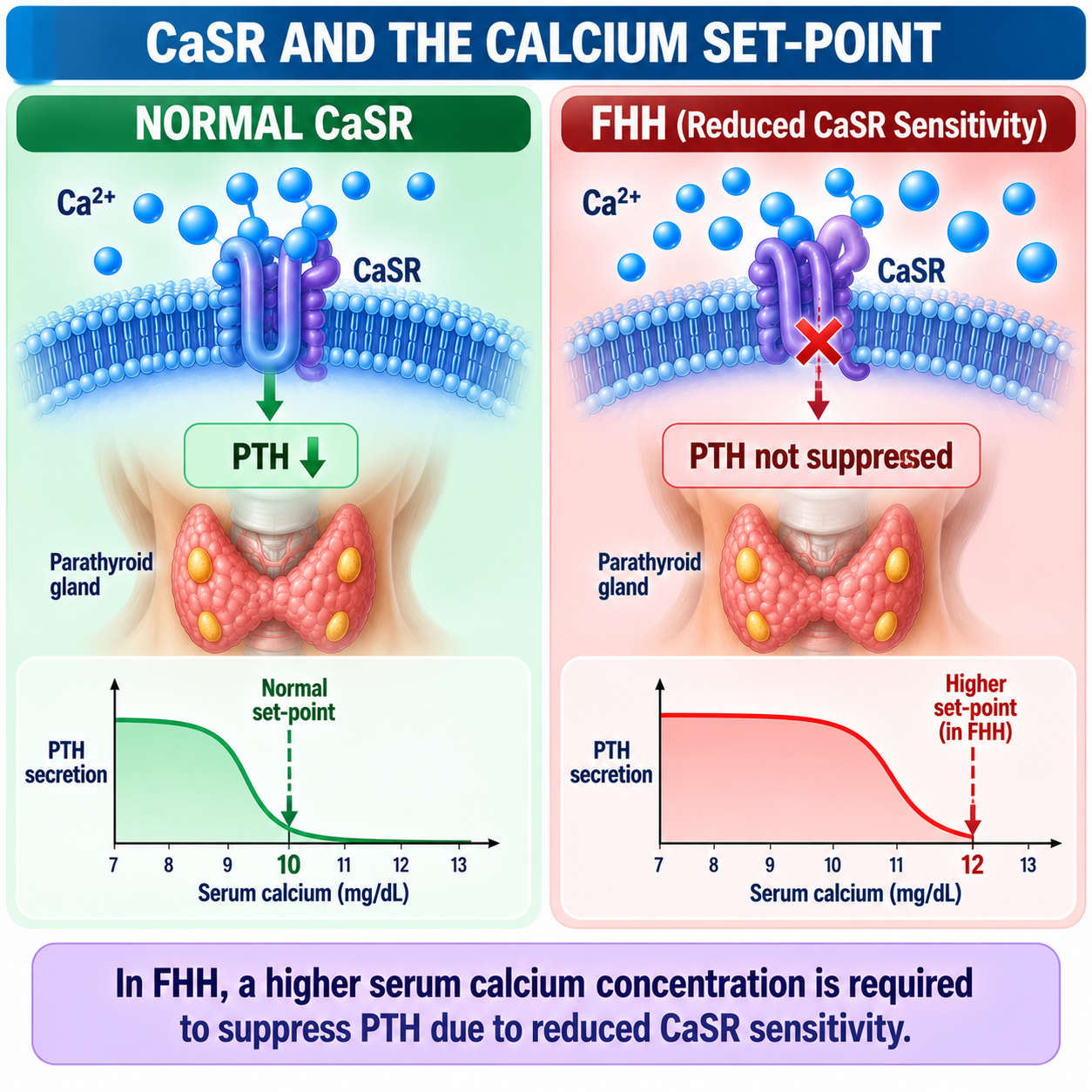
Not primarily a parathyroid adenoma disorder. The basic physiology: CaSR signalling ↓ → the parathyroid gland perceives extracellular calcium as being lower than it actually is → higher serum calcium is required to suppress PTH; in the kidney, renal calcium conservation ↑ → urinary calcium relatively ↓.
FHH1 is most commonly caused by heterozygous loss-of-function variants in CASR; rarer forms involve GNA11 and AP2S1.
What Is the Calcium-Sensing Receptor?
The calcium-sensing receptor, or CaSR, is a G-protein-coupled receptor that allows tissues — especially the parathyroid glands and kidneys — to sense extracellular calcium concentration and adjust PTH secretion and renal calcium handling accordingly. CaSR has major roles in parathyroid cells, kidney and other tissues; this article focuses on parathyroid + kidney.
Normal CaSR Physiology
At the kidney, CaSR signalling also participates in regulation of calcium handling. Normal physiology helps maintain serum calcium within a relatively narrow range. See Calcium Homeostasis Explained for the complete normal calcium–PTH feedback loop.
What Happens to CaSR Signalling in FHH?
In classic FHH1, a CASR loss-of-function variant reduces CaSR sensitivity/signalling. The body now requires a higher extracellular calcium concentration before it generates the same suppressive response. Therefore the calcium set-point shifts upward, creating stable hypercalcemia.
Parathyroid Effect
In a person without FHH, Ca²⁺ ↑ should suppress PTH ↓. In FHH, the altered calcium-sensing system interprets a higher calcium level as relatively more acceptable. Therefore PTH may remain normal or mildly elevated despite hypercalcemia — inappropriately non-suppressed PTH.
Renal Effect
The renal calcium-sensing abnormality promotes relative renal calcium conservation, so urinary calcium excretion is often lower than expected for the degree of hypercalcemia. This produces the classic term hypocalciuric, but the wording must remain relatively low urinary calcium — not every genetically confirmed FHH patient has extremely low absolute urinary calcium. Significant biochemical overlap exists with PHPT.
FHH is best understood as a reset calcium-sensing system rather than simply “too much PTH.”
FHH1, FHH2 and FHH3
| Type | Gene | Mechanism |
|---|---|---|
| FHH1 | CASR | Reduced CaSR function |
| FHH2 | GNA11 | Altered CaSR downstream signalling |
| FHH3 | AP2S1 | Altered CaSR trafficking/signalling |
FHH1 is the most common form. FHH2 (GNA11) and FHH3 (AP2S1) are rare; FHH3 can sometimes have a somewhat different or more pronounced biochemical phenotype, but this is not an absolute diagnostic discriminator.
Severe disruption of CaSR function in the neonatal period can produce neonatal severe hyperparathyroidism, with marked hypercalcemia and potentially life-threatening disease. Do not confuse this with ordinary heterozygous FHH in adults.
How Is FHH Inherited?
FHH is generally autosomal dominant. Therefore an affected heterozygous parent has approximately a 50% probability of transmitting the pathogenic variant to each child. Inheritance is independent of sex.
Family History
Family history can be extremely useful. Ask about known hypercalcemia, “high calcium” discovered during routine blood tests, relatives evaluated for hyperparathyroidism, unsuccessful parathyroid surgery, relatives told they have FHH, or neonatal severe hypercalcemia in rare families.
Reasons include de novo variants, relatives never tested, mild/asymptomatic biochemical disease, or unavailable family history.
Typical Clinical Presentation
Most patients are asymptomatic or have mild nonspecific symptoms. FHH is often discovered when routine blood tests show mild hypercalcemia. The hypercalcemia may have been present for many years or essentially lifelong — this longstanding stability is an important clue.
Typical FHH is usually associated with mild hypercalcemia, relatively stable biochemical findings, few classical hypercalcemic complications, and no need for routine intervention. Do not state that “FHH never causes symptoms” — rare atypical or symptomatic presentations occur.
Typical Laboratory Findings
| Test | Typical FHH |
|---|---|
| Serum calcium | ↑, often mild |
| Ionized calcium | ↑ |
| PTH | Normal / mildly ↑ / non-suppressed |
| Urinary calcium | Relatively ↓ |
| CCCR | Often low |
| Magnesium | May be normal-high or mildly ↑ |
| Phosphate | Variable; sometimes low |
| 25-OH D | Variable |
| Renal function | Usually not primary cause |
No single value proves FHH.
Why FHH Resembles Primary Hyperparathyroidism
The biochemical overlap is fundamental: both FHH and PHPT can produce Ca²⁺ ↑ with PTH not suppressed. Therefore neither calcium nor PTH alone reliably separates them.
They produce similar blood tests for completely different physiological reasons. See Hypercalcemia Explained for the broader diagnostic approach.
FHH vs PHPT
| Feature | FHH | PHPT |
|---|---|---|
| Basic disorder | Altered calcium sensing | Autonomous/inappropriate parathyroid secretion |
| Typical onset | Lifelong/inherited | Acquired |
| Serum calcium | Mild ↑ commonly | ↑, variable |
| PTH | Normal/mild ↑ | ↑ or inappropriate normal |
| Urinary calcium | Relatively low | Variable, often higher |
| CCCR | Often low | Often higher |
| Family history | Often positive | Usually absent |
| Genetic cause | CASR/GNA11/AP2S1 | Usually sporadic adenoma/multigland disease |
| Kidney stones | Uncommon in typical FHH | Important PHPT complication |
| Bone disease | Usually not classical | Can occur |
| Parathyroid imaging | Not diagnostic | Used only after biochemical diagnosis and surgical decision |
| Parathyroidectomy | Usually not corrective | Definitive treatment when appropriate |
Do not send a patient for parathyroid surgery before seriously considering FHH when the biochemistry fits. PHPT can be cured by removing abnormal parathyroid tissue. FHH is an inherited systemic calcium-sensing abnormality — removing parathyroid tissue generally does not reset the genetically determined calcium set-point.
Typical PHPT has clinically important associations with nephrolithiasis, nephrocalcinosis, osteoporosis, fractures and renal impairment. Typical FHH generally does not reproduce this same classical target-organ phenotype. Stones + osteoporosis + progressive biochemical disease tend to support PHPT over typical FHH, although clinical features alone are not absolute. See Primary Hyperparathyroidism Explained for the PHPT-side diagnostic criteria, target-organ assessment and surgical indications.
Urinary Calcium: Useful but Not Sufficient Alone
Urinary calcium is useful because typical FHH produces relative hypocalciuria, while PHPT more often produces greater urinary calcium excretion. However, 24-hour urine calcium alone is not sufficient because values overlap.
Absolute urinary calcium depends on calcium intake, vitamin D status, renal function, sodium intake, medications, age, body size, completeness of urine collection and underlying disease. Therefore low 24-hour urine calcium ≠ automatic FHH, and normal/high urine calcium ≠ automatic exclusion of FHH.
What Is CCCR?
The most commonly used biochemical index is the calcium/creatinine clearance ratio, abbreviated CCCR.
Use measurements obtained from the same collection period with compatible units. CCCR compares renal calcium clearance with creatinine clearance, adjusting urinary calcium excretion for filtration and urine concentration. The conceptual question: is the kidney excreting as much calcium as expected for a patient who is hypercalcemic? In FHH, the answer is often no.
CCCR Interpretation
The Fifth International Workshop states that CCCR <0.01 favors FHH and should raise particular suspicion, especially in younger patients or those with family history of hypercalcemia. But do not convert this into an absolute diagnostic cutoff.
According to the Fifth Workshop: approximately 70–80% of FHH patients have CCCR <0.01; up to 20% of PHPT patients can also have CCCR <0.01; about 40% of patients with either disorder can fall between 0.01 and 0.02; some FHH patients have CCCR >0.02. CCCR is probabilistic, not binary.
Practical CCCR Interpretation
Some literature has suggested genetic testing at CCCR ≤0.02 to improve diagnostic sensitivity. However, there is no single universally accepted biochemical strategy that replaces clinical judgment. Genetic testing should be driven by the overall probability of FHH, not one ratio alone.
Factors That Can Falsely Lower Urinary Calcium
Urinary calcium and CCCR can be reduced by vitamin D deficiency, reduced calcium intake, chronic kidney disease, thiazide diuretics, lithium-related physiology, incomplete urine collection and other factors influencing calcium balance. The Fifth Workshop specifically warns that vitamin D deficiency, CKD, lithium and thiazides can impair interpretation of urinary calcium.
Vitamin D Deficiency
Vitamin D deficiency can reduce intestinal calcium absorption and therefore lower urinary calcium; it may also increase PTH. Thus a patient with PHPT plus vitamin D deficiency can appear more “FHH-like.” Low CCCR + vitamin D deficiency requires caution. See Vitamin D Deficiency Explained.
CKD
Reduced GFR can decrease filtered calcium load and alter urinary calcium excretion. CCCR becomes less reliable in significant CKD. Do not diagnose FHH from hypocalciuria alone in this setting. See CKD-MBD Explained for how impaired renal function affects calcium and PTH physiology.
Thiazides
Thiazide diuretics reduce urinary calcium excretion, so a patient taking a thiazide may have artificially lower urine calcium/CCCR that can mimic FHH. Resolve the medication context before over-interpreting the ratio.
Lithium
Lithium can alter calcium–CaSR–PTH physiology and may cause hypercalcemia with non-suppressed PTH; it can also complicate urinary calcium interpretation. Lithium-associated hypercalcemia must be considered separately from straightforward FHH or PHPT.
Dietary Calcium
Very low calcium intake may decrease urinary calcium, making CCCR look more FHH-like. This is a point of diagnostic interpretation, not an instruction to load patients with calcium.
Family Biochemistry, Old Blood Tests and Age
One of the most useful practical clues is serum calcium in first-degree relatives. If multiple first-degree relatives have similar mild hypercalcemia, FHH probability increases greatly, especially when the phenotype appears across generations.
Historical laboratory results can be extremely valuable. A current adult with mild hypercalcemia who has similar calcium levels documented 10–20 years earlier has a phenotype more compatible with stable inherited disease than newly acquired PHPT. This is not absolute but is an important clue.
FHH is present genetically from birth, so it may be discovered in childhood, adolescence, early adulthood, or much later. Late diagnosis does not mean late onset — diagnosis age ≠ disease onset. A young patient with Ca ↑ + PTH not suppressed should prompt careful consideration of FHH, hereditary PHPT syndromes and less common causes.
When Should Genetic Testing Be Considered?
Genetic testing can provide definitive evidence for an inherited FHH mechanism when an appropriate pathogenic variant is found. Testing is particularly useful when biochemistry is ambiguous, CCCR is low/intermediate, family history is supportive, the patient is young, surgery is being considered, previous surgery failed to normalize calcium, or PHPT and FHH remain difficult to distinguish.
A practical genetic approach may include CASR first or as part of a panel; if negative and suspicion remains high, GNA11 and AP2S1 may be considered depending on the testing strategy. Many laboratories use multigene panels rather than sequential single-gene testing.
Interpreting Genetic Results
Do not teach “any CASR variant = FHH.” Variants must be interpreted according to appropriate clinical genetics standards: pathogenic, likely pathogenic, variant of uncertain significance (VUS), likely benign, or benign. A VUS does not by itself establish FHH — clinical–biochemical correlation remains important.
Negative Genetic Test
A negative test does not automatically prove PHPT. Reasons include limitations of the panel, genes not tested, undetected variant types, uncertain biology, or phenocopies. Genetic testing complements, not replaces, clinical reasoning.
Why Parathyroid Imaging Does Not Diagnose FHH
A positive sestamibi or ultrasound does not automatically prove PHPT. Incidental parathyroid-appearing lesions or nonspecific imaging findings can mislead. Diagnosis remains biochemical + physiological ± genetic.
If the biochemical phenotype strongly suggests FHH, do not let a positive localization study override the physiology. Imaging should not be used to decide whether the disorder is FHH or PHPT.
Why Surgery Usually Does Not Fix FHH
The abnormality exists in the calcium-sensing system, not simply in one abnormal parathyroid gland. Therefore removing one gland does not correct the inherited set-point. Persistent hypercalcemia after parathyroid surgery is a classic clue that should trigger reconsideration of FHH in an appropriate patient.
Can FHH and PHPT Coexist?
Yes, in rare situations a person with FHH may also develop true primary hyperparathyroidism. This is an advanced concept. Clues may include calcium rising substantially above the patient's historical baseline, PTH becoming more clearly elevated, development of PHPT-type target-organ disease, or imaging/surgical evidence in the correct biochemical context. Do not use this possibility to undermine the main rule that typical FHH should not be sent automatically for surgery.

FHH Management
For typical asymptomatic FHH, reassurance + education are generally sufficient. Routine attempts to normalize serum calcium are not necessary in most patients. Typical FHH is largely benign and usually requires no specific treatment.
Do not create a standard medication regimen. Calcimimetics such as cinacalcet have been reported in selected symptomatic cases, but this is not routine standard treatment for typical FHH, and regulatory approval varies. Keep treatment specialist-directed.
Routine parathyroidectomy is generally inappropriate for typical FHH because the inherited calcium-sensing abnormality remains. This is the article's main patient-safety message.
Follow-Up
Typical FHH generally requires much less intensive disease surveillance than PHPT. Clinical follow-up should be individualized based on diagnostic certainty, degree of hypercalcemia, symptoms, renal function, family/genetic considerations and unusual complications. No universal laboratory intervals are given here.
Pregnancy
FHH can create important diagnostic and fetal/neonatal considerations during pregnancy because fetal calcium physiology depends partly on the fetal genotype relative to the maternal genotype. This is specialist territory.
TODO: Consider a separate pregnancy/mineral metabolism article if needed.
Diagnostic Algorithm
Worked Clinical Cases
Case 1: Classic FHH
A 28-year-old has serum calcium mildly elevated, PTH in upper-normal range, no symptoms, mother and grandfather also with mild hypercalcemia, CCCR 0.006. The pattern strongly suggests FHH: young age, family pattern, mild stable hypercalcemia, PTH not suppressed, very low CCCR. Next step: consider appropriate genetic confirmation, particularly if future surgery could otherwise be contemplated.
Case 2: More Typical PHPT
A 63-year-old has newly recognized hypercalcemia, PTH clearly elevated, kidney stones, reduced BMD, urine calcium not low, CCCR 0.025. This is more typical of PHPT than FHH. Lesson: clinical phenotype and target-organ disease matter.
Case 3: CCCR <0.01 + Vitamin D Deficiency
Hypercalcemia, PTH elevated, CCCR 0.008, severe vitamin D deficiency. Error: “CCCR <0.01 proves FHH.” Correct reasoning: vitamin D deficiency can reduce urinary calcium and increase PTH, so CCCR is confounded. Resolve the context before making a definitive FHH diagnosis.
Case 4: Low CCCR in CKD
Hypercalcemia, PTH non-suppressed, significantly impaired renal function, low urinary calcium. Reduced GFR can lower urinary calcium, so low urine calcium is difficult to interpret. Do not diagnose FHH from CCCR alone.
Case 5: Young Patient + Multiple Affected Relatives
A 19-year-old has mild hypercalcemia; father, paternal aunt and grandmother all have similar calcium values; PTH is non-suppressed. Autosomal-dominant FHH becomes highly likely. Genetic testing is especially informative.
Case 6: No Family History
A 25-year-old has lifelong mild hypercalcemia, low CCCR, normal PTH, no known affected relatives. Error: “no family history means FHH impossible.” Correct reasoning: family history may be absent because of de novo disease, untested relatives, or incomplete records. FHH remains possible.
Case 7: Positive Sestamibi
Mild longstanding hypercalcemia, low CCCR, several hypercalcemic relatives, and a sestamibi scan shows a possible parathyroid focus. Error: “scan proves PHPT.” Correct reasoning: imaging does not override the biochemical/genetic differential. Resolve FHH before surgery.
Case 8: Failed Parathyroid Surgery
A patient underwent parathyroidectomy for presumed PHPT; postoperatively, mild hypercalcemia persists. Old records reveal similar calcium levels for decades, and several relatives are hypercalcemic. Reconsider FHH — the original hypercalcemia may have represented inherited altered calcium sensing.
Case 9: FHH With Later Rising Calcium
A genetically confirmed FHH patient has stable mild hypercalcemia for years; later, calcium rises well above historical baseline, PTH rises substantially, and kidney stones develop. Do not assume all future hypercalcemia is “just FHH” — consider coexisting PHPT or another new process.
Case 10: “Low Urine Calcium = FHH”
Calcium mildly ↑, PTH ↑, 24-h urine calcium low, CCCR not calculated, patient on thiazide therapy. Error: “low urine calcium means FHH.” Correct reasoning: thiazides reduce urinary calcium, so the result is confounded.
Common Mistakes
FHH in One Minute
Golden Rules
- FHH is a calcium-sensing disorder, not simply a disorder of excess PTH.
- The most common cause is a pathogenic CASR variant.
- FHH is usually autosomal dominant.
- Serum calcium is usually mildly elevated and longstanding.
- PTH can be normal, mildly elevated or inappropriately non-suppressed.
- Urinary calcium is relatively low, not necessarily absolutely low in every patient.
- CCCR <0.01 favors FHH but does not prove it.
- CCCR 0.01–0.02 is an important overlap zone.
- PHPT can also produce CCCR <0.01.
- Vitamin D deficiency, CKD and thiazides can lower urinary calcium.
- Family history and historical calcium results are valuable.
- Genetic testing is especially useful when diagnosis remains uncertain before surgery.
- A positive parathyroid scan does not diagnose PHPT.
- Typical FHH generally does not require parathyroidectomy.
Clinical Pearls
- FHH is usually lifelong.
- Discovery in adulthood does not mean adult onset.
- Mild stable hypercalcemia for many years is a strong clue.
- Hypercalcemia in several generations strongly suggests inherited disease.
- PTH should be interpreted relative to calcium.
- Normal PTH during hypercalcemia is not necessarily physiologically normal.
- FHH and PHPT can therefore look similar.
- FHH commonly produces relative hypocalciuria.
- “Hypocalciuric” is not absolute.
- Use CCCR rather than urine calcium alone where appropriate.
- CCCR <0.01 increases FHH probability.
- Around one-fifth of PHPT patients may also have CCCR <0.01.
- The 0.01–0.02 range has major overlap.
- Even >0.02 does not absolutely eliminate FHH.
- Vitamin D deficiency can reduce urine calcium.
- CKD can reduce urine calcium.
- Thiazides reduce urine calcium.
- Lithium complicates calcium/PTH physiology.
- CASR causes FHH1.
- GNA11 causes FHH2.
- AP2S1 causes FHH3.
- FHH is usually autosomal dominant.
- Family screening can be useful.
- A negative family history is not absolute exclusion.
- Genetic confirmation is valuable before irreversible surgery.
- A VUS is not diagnostic.
- Parathyroid imaging should not decide FHH vs PHPT.
- Typical FHH generally does not need treatment.
- Surgery usually does not normalize genetically reset calcium physiology.
- A patient with FHH can rarely develop true PHPT later.
Frequently Asked Questions
Key Take-Home Messages
Familial hypocalciuric hypercalcemia becomes much easier to understand when it is viewed as a disorder of calcium sensing rather than simply a disorder of parathyroid hormone.
Normally, Ca²⁺ ↑ activates CaSR → PTH ↓. In FHH, CaSR signalling is reduced, so more calcium is required before PTH is fully suppressed. At the same time, altered renal calcium sensing promotes greater calcium conservation. Therefore the patient develops mild hypercalcemia with PTH not suppressed and relative hypocalciuria.
The diagnostic difficulty arises because primary hyperparathyroidism can produce the same first two findings: Ca²⁺ ↑ + PTH not suppressed. Therefore the next question is FHH or PHPT? Look at age, historical calcium values, family history, renal function, vitamin D, medications, urinary calcium and CCCR.
A CCCR <0.01 makes FHH more likely, but does not prove it. The intermediate range 0.01–0.02 contains substantial biochemical overlap. Difficult cases may require genetic testing for CASR and, when appropriate, GNA11/AP2S1.
The distinction matters because PHPT can be cured by parathyroidectomy, but typical FHH should not be sent routinely for parathyroid surgery. The final diagnostic memory rule: high Ca + PTH not suppressed → think PHPT vs FHH → check history + family + urinary calcium/CCCR → correct for confounders → use genetics when needed → avoid unnecessary surgery.
This article is intended for medical education only. It explains FHH physiology and diagnostic reasoning, not patient-specific medical advice, genetic counselling, surgical eligibility, medication dosing or monitoring intervals.