Calcium homeostasis protects extracellular ionized calcium through feedback between parathyroid glands, bone, kidneys and intestine.
Calcium homeostasis is the physiological process that maintains extracellular calcium concentration through coordinated regulation by PTH, vitamin D, bone, kidneys and intestine.
Calcium is often thought of primarily as a component of bone. That is understandable because almost all calcium in the body is stored in the skeleton. However, the small amount circulating in extracellular fluid has crucial roles in neuromuscular function, muscle contraction, cardiac function, intracellular signalling, blood coagulation and many cellular processes.
Low ionized Ca2+ raises PTH. The kidney retains calcium, excretes phosphate and increases calcitriol production. Calcitriol increases gut calcium absorption. Calcium is restored. Ionized calcium is the biologically active calcium.

Learning Objectives
- Distinguish total calcium from ionized calcium
- Explain why albumin affects total calcium
- Describe how CaSR controls PTH secretion
- Explain renal, bone and vitamin D effects of PTH
- Distinguish 25(OH)D from calcitriol
- Explain calcium-phosphate, magnesium and acid-base relationships
- Approach abnormal calcium results physiologically
Total vs Ionized Calcium
Approximately 99% of body calcium is stored in bone and teeth. Only a small fraction exists in extracellular fluid and intracellular compartments. The skeleton therefore has both a structural role and a reservoir role.
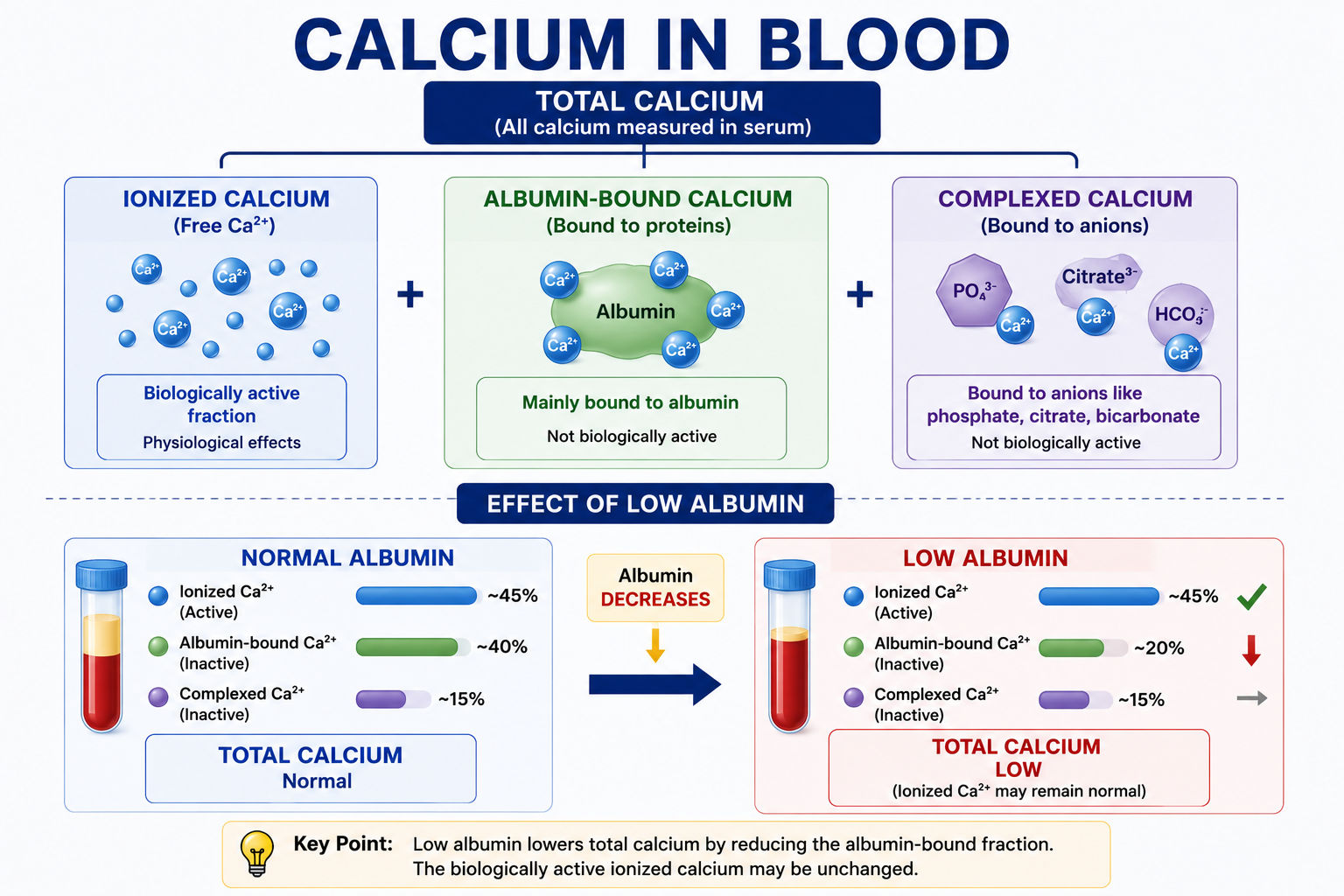
Serum calcium exists in three major forms: ionized calcium, protein-bound calcium and complexed calcium.
| Form | Meaning | Clinical Point |
|---|---|---|
| Ionized calcium | Free Ca2+ | Biologically active fraction |
| Protein-bound calcium | Mostly bound to albumin | Affected by albumin concentration |
| Complexed calcium | Bound to anions such as phosphate, citrate and bicarbonate | Part of total calcium but not free ionized calcium |
Ionized calcium is the free, biologically active fraction of circulating calcium that directly participates in neuromuscular function, cardiac physiology, intracellular signalling and coagulation. A change in total calcium does not always mean biologically active calcium has changed.
Calcium and Albumin
A significant proportion of circulating calcium is bound to albumin. If albumin concentration falls, albumin-bound calcium falls and measured total calcium falls, even though ionized calcium may remain normal.
Low total calcium does not automatically mean true physiologically important hypocalcemia.
Corrected-calcium formulas are estimates, not direct measurements of biologically active calcium. Their performance is imperfect, particularly in marked hypoalbuminemia, critical illness, significant renal disease and complex acid-base disturbances. When accurate assessment of physiologically active calcium is important, direct measurement of ionized calcium is preferable.
How the Body Senses Calcium
The parathyroid glands must detect whether extracellular calcium is too low, appropriate or too high. An important sensor is the calcium-sensing receptor, or CaSR, expressed prominently on parathyroid cells.
When extracellular ionized calcium rises, CaSR activation increases and PTH secretion is suppressed. PTH therefore participates in a classic negative-feedback system.
Parathyroid Hormone and Calcium
Parathyroid hormone is produced by the parathyroid glands. Its major physiological purpose is to help maintain extracellular ionized calcium. PTH acts particularly through kidney, bone and vitamin D activation.
PTH helps maintain extracellular calcium by increasing renal calcium conservation, promoting phosphate excretion, stimulating calcitriol production and influencing calcium mobilization from bone.
PTH Effects on the Kidney
PTH increases renal calcium conservation, decreases renal phosphate reabsorption and stimulates renal production of calcitriol through increased activity of renal 1-alpha-hydroxylase.
PTH tends to raise calcium and lower phosphate.

PTH Effects on Bone
Bone contains almost all body calcium. When extracellular calcium needs to be defended, bone can contribute calcium to the extracellular compartment.
The mechanism should not be simplified to "PTH directly activates osteoclasts." PTH receptors are expressed on cells of the osteoblast lineage. PTH signalling alters mediators including RANKL, which promote osteoclast formation and activity.
PTH has complex effects on bone depending on concentration, duration and pattern of exposure. For this article, the main homeostatic point is that PTH can facilitate mobilization of calcium from bone when extracellular calcium needs to be defended.
Vitamin D and Calcium Homeostasis
The body cannot maintain calcium balance indefinitely by conserving renal calcium and mobilizing skeletal calcium. Calcium must ultimately be absorbed from the diet, and vitamin D plays a major role in enabling efficient intestinal calcium absorption.
25-hydroxyvitamin D is the major circulating storage/status marker and is generally the test used to assess vitamin D status. Calcitriol is the hormonally active form.
The kidney converts 25(OH)D to calcitriol through 1-alpha-hydroxylase. PTH stimulates this process when calcium needs to be defended. Calcitriol increases intestinal absorption of calcium and phosphate.
PTH vs Vitamin D
| Effect | PTH | Calcitriol |
|---|---|---|
| Main trigger/context | Low ionized Ca2+ | Regulated by PTH, phosphate and other factors |
| Renal Ca2+ conservation | Increases | Supports calcium balance |
| Renal phosphate reabsorption | Decreases | Not the principal phosphaturic hormone |
| Intestinal Ca2+ absorption | Increases indirectly via calcitriol | Increases directly |
| Intestinal phosphate absorption | Increases indirectly | Increases |
| Bone | Can mobilize calcium through regulated remodelling | Supports mineral balance and interacts with bone physiology |
The high-yield distinction is that PTH tends to raise calcium and lower phosphate, while calcitriol supports intestinal absorption of both calcium and phosphate.
Role of Calcitonin
Calcitonin is produced by thyroid C cells and can inhibit osteoclast-mediated bone resorption. However, in adult human calcium homeostasis, calcitonin is usually much less central than PTH and vitamin D.
Do not teach calcitonin as the equal physiological opposite of PTH. PTH and vitamin D are the dominant framework for this foundation article.
Renal Calcium Handling
The kidney filters calcium and reabsorbs most of it along the nephron. PTH promotes calcium conservation particularly through regulated calcium reabsorption in the distal nephron. The broad effect is less calcium lost in urine and more calcium retained in the body.
Renal function also matters because the kidney activates vitamin D. Chronic kidney disease can disturb calcium, phosphate, PTH and vitamin D physiology, but detailed CKD-mineral bone disorder is beyond this foundation article.
Calcium and Phosphate
Calcium and phosphate are closely linked. If calcium and phosphate both rise substantially together, they can form calcium-phosphate complexes. PTH helps raise extracellular calcium while promoting renal phosphate excretion.
Calcitriol differs from PTH because it increases intestinal absorption of both calcium and phosphate. This difference is central when interpreting calcium-phosphate physiology. For the dedicated phosphate framework, see Phosphate Homeostasis Explained.
Magnesium and Calcium
Magnesium is included here because severe magnesium deficiency can impair both PTH secretion and PTH action. Therefore significant hypomagnesemia can cause or perpetuate hypocalcemia.
Detailed magnesium physiology is covered in Magnesium Homeostasis Explained. In calcium interpretation, magnesium should be considered whenever the calcium abnormality does not make sense or does not correct as expected.
Acid-Base Status and Ionized Calcium
Alkalosis increases calcium binding to albumin, reducing ionized calcium even when total calcium changes little. This can increase neuromuscular excitability and contribute to paresthesia, cramps, carpopedal spasm or tetany.
Acidosis has the opposite broad effect on albumin binding and can increase the ionized fraction. This is one reason total calcium and ionized calcium may not move together in complex acid-base disorders.
The acid-base foundation is covered in Acid-Base Disorders Explained. Respiratory alkalosis and hyperventilation are covered in Respiratory Alkalosis Explained.
How to Interpret an Abnormal Calcium Result
Interpreting calcium begins with deciding whether the biologically active ionized calcium is truly abnormal. Total calcium alone can mislead when albumin or pH is abnormal.
A PTH value cannot be interpreted alone. If calcium is high, PTH should normally be suppressed. A normal-range PTH may still be physiologically inappropriate in hypercalcemia.
Worked Clinical Cases
Case 1: Low Albumin
A patient has low total calcium but low albumin. Ionized calcium may be normal, so this does not automatically prove true physiologically important hypocalcemia.
Case 2: Alkalosis Symptoms
A hyperventilating patient develops perioral tingling and hand cramps. Alkalosis can increase calcium binding to albumin and reduce ionized calcium, increasing neuromuscular excitability.
Case 3: High Calcium With Non-Suppressed PTH
If calcium is high, PTH should normally be suppressed. A PTH result that appears normal by the laboratory reference interval may still be inappropriate for the calcium concentration.
Case 4: Hypocalcemia With Low Magnesium
Severe magnesium deficiency can impair both PTH secretion and PTH action, so magnesium should be considered when hypocalcemia is difficult to explain.
Common Mistakes
- Misconception: Total calcium is the active calcium. Reality: ionized calcium is biologically active.
- Misconception: Low total calcium proves hypocalcemia. Reality: low albumin can lower total calcium while ionized calcium remains normal.
- Misconception: Corrected calcium equals ionized calcium. Reality: corrected calcium is an estimate, not a direct measurement.
- Misconception: PTH directly activates osteoclasts. Reality: PTH acts through osteoblast-lineage signalling that influences osteoclast activity.
- Misconception: PTH raises phosphate. Reality: PTH promotes renal phosphate excretion, so serum phosphate tends to fall.
- Misconception: Vitamin D only increases calcium. Reality: calcitriol increases intestinal absorption of calcium and phosphate.
- Misconception: Calcitriol is the routine test for vitamin D deficiency. Reality: 25(OH)D is generally used to assess vitamin D status.
- Misconception: Alkalosis causes loss of body calcium. Reality: alkalosis changes albumin binding and lowers ionized calcium.
One Minute Revision
- Calcium homeostasis protects extracellular ionized calcium.
- About 99% of body calcium is stored in bone and teeth.
- Total calcium equals ionized plus protein-bound plus complexed calcium.
- Ionized calcium is the biologically active fraction.
- Low albumin can lower total calcium without lowering ionized calcium.
- Low ionized calcium reduces CaSR activation and raises PTH.
- PTH increases renal calcium conservation, phosphate excretion and calcitriol production.
- Calcitriol increases intestinal calcium and phosphate absorption.
- Alkalosis lowers ionized calcium by increasing albumin binding.
- PTH must be interpreted relative to calcium.
Frequently Asked Questions
Key Take-Home Messages
Calcium homeostasis is a tightly regulated feedback system designed primarily to maintain extracellular ionized calcium.
Serum calcium interpretation requires more than looking at a total calcium number. Low albumin can produce low total calcium without low ionized calcium. Alkalosis can lower ionized calcium without major acute loss of total body calcium. Once genuine calcium abnormality is established, the most useful question is whether PTH is responding appropriately to the calcium concentration. Learn how this logic is applied clinically in Hypocalcemia Explained and how elevated calcium is evaluated using the PTH response in Hypercalcemia Explained.
This article is intended for medical education only. It explains physiology and laboratory interpretation principles, not patient-specific treatment or calcium replacement protocols.