Normocalcemic primary hyperparathyroidism, abbreviated NPHPT, is a biochemical phenotype of primary hyperparathyroidism in which PTH remains persistently elevated despite repeatedly normal serum calcium.
However, this apparently simple definition can be misleading. Many conditions can increase PTH while maintaining serum calcium within the reference interval. In these situations, PTH may be performing its normal physiological role by defending extracellular calcium.
PTH ↑ + Ca normal ≠ NPHPT. The diagnosis requires persistently elevated PTH, with repeatedly normal adjusted total calcium and normal ionized calcium, after secondary causes of PTH elevation have been carefully excluded. The most important mistake is “PTH ↑ + normal calcium = NPHPT.” The correct reasoning is: PTH ↑ + normal Ca → investigate why PTH is elevated.
A high PTH concentration is frequently interpreted too quickly as “hyperparathyroidism.” But PTH is fundamentally a homeostatic hormone — it rises when the body needs to defend extracellular calcium. The central diagnostic question is therefore not “is PTH elevated?” It is “why is PTH elevated?”
NPHPT at a Glance

What Is Normocalcemic Primary Hyperparathyroidism?
For this article's diagnostic pathway, review Primary Hyperparathyroidism Explained for conventional hypercalcemic PHPT, and Familial Hypocalciuric Hypercalcemia Explained for FHH in the differential of PTH-dependent hypercalcemia. Those articles addressed Ca ↑ + PTH not suppressed. This article addresses the other difficult branch: Ca normal + PTH ↑.
Why High PTH Does Not Always Mean Primary Hyperparathyroidism
PTH secretion is strongly regulated by ionized calcium through CaSR on parathyroid cells. Normally, Ca²⁺ ↓ reduces CaSR activation, so PTH ↑ to restore extracellular calcium. See Calcium Homeostasis Explained for the normal calcium–PTH feedback loop.
How PTH Maintains Normal Calcium
PTH acts through several mechanisms: renal calcium conservation ↑, renal phosphate reabsorption ↓, renal 1α-hydroxylase activity ↑ (calcitriol ↑ when renal function and substrate permit), intestinal calcium absorption ↑ (indirectly through calcitriol), and increased bone turnover/calcium mobilization. Thus PTH can maintain serum calcium despite reduced calcium availability.
The Compensation Concept
Suppose intestinal calcium absorption falls. The body responds: calcium availability ↓ → PTH ↑ → renal calcium conservation ↑ + calcitriol pathway stimulated + skeletal calcium mobilization may increase → serum calcium remains normal.
Normal serum calcium does not mean calcium physiology is normal. The normal calcium may exist precisely because PTH is elevated.
| Feature | Secondary HPT | NPHPT |
|---|---|---|
| PTH | ↑ | ↑ |
| Total calcium | Normal commonly | Normal |
| Ionized calcium | Usually normal/low-normal | Normal |
| Physiological stimulus | Present | Not identified after evaluation |
| Vitamin D deficiency | Common cause | Must be excluded |
| CKD | Common cause | Must be excluded |
| Low Ca intake | Can cause | Must be addressed |
| Malabsorption | Can cause | Must be excluded |
| Diagnosis | Compensatory response | Diagnosis of exclusion |
See Secondary Hyperparathyroidism Explained for the full physiology of secondary PTH elevation.
Diagnostic Criteria for NPHPT
Normocalcemic primary hyperparathyroidism is characterized by normal adjusted total calcium and normal ionized calcium with elevated intact PTH on at least two occasions over 3–6 months, after alternative causes of secondary hyperparathyroidism have been excluded. This follows the Fifth International Workshop definition.
Three requirements, all necessary:
- 1. PTH persistently ↑
- 2. Total AND ionized calcium normal
- 3. Secondary causes excluded
Why Repeated Testing Matters
A single high PTH can result from biological variation, transient calcium imbalance, temporary vitamin D/calcium changes, medication effects, renal changes, assay variation, or acute illness. One high PTH does not diagnose NPHPT — the biochemical phenotype must persist.
Why Ionized Calcium Must Be Considered
Total serum calcium includes protein-bound calcium, complexed calcium and ionized calcium. The physiologically active fraction is ionized Ca²⁺. A patient may have normal total calcium but elevated ionized calcium — such a patient does not satisfy the strict definition of NPHPT.
Studies have shown that a meaningful proportion of patients initially labelled as normocalcemic PHPT based only on total calcium become reclassified as conventional hypercalcemic PHPT when ionized calcium is measured. Published cohorts have reported reclassification ranging roughly from 4% to 64%, illustrating how strongly study design and patient selection influence NPHPT diagnosis. The teaching point is not the exact percentage — it is: do not diagnose NPHPT without considering ionized calcium.
Total calcium should be interpreted with albumin where appropriate, but albumin adjustment is an estimate. Therefore when PTH ↑ + total Ca apparently normal and NPHPT is being considered, ionized calcium is particularly valuable. The Fifth Workshop specifically recommends ionized calcium when NPHPT is under consideration.
NPHPT Is a Diagnosis of Exclusion
Before NPHPT, systematically evaluate:
Vitamin D Deficiency and High PTH
Vitamin D deficiency is one of the most important causes of secondary hyperparathyroidism.
Therefore PTH ↑ + normal Ca + vitamin D deficiency does not establish NPHPT. A patient may have normal calcium, elevated PTH, osteoporosis, bone pain and low BMD purely from vitamin D-related secondary hyperparathyroidism — skeletal disease does not eliminate the need to exclude vitamin D deficiency.
The European PARAT consensus recommends aiming for 25-OH D ≥30 ng/mL (75 nmol/L) when excluding vitamin D deficiency as a cause. Importantly, PTH may remain elevated for 6–12 months after vitamin D repletion in some patients — PTH does not always normalize immediately after vitamin D correction.
A patient may initially have Ca normal + PTH ↑ + vitamin D deficiency. After vitamin D deficiency is corrected, calcium may rise, revealing conventional hypercalcemic PHPT. Vitamin D correction can clarify the phenotype rather than merely “treating the high PTH.”
See Vitamin D Deficiency Explained and Secondary Hyperparathyroidism Explained for the complete physiology.
CKD and Secondary Hyperparathyroidism
Renal impairment is another major cause of secondary hyperparathyroidism.
The European consensus and contemporary reviews generally require eGFR ≥60 mL/min/1.73 m² before diagnosing NPHPT, because stage 3–5 CKD can itself explain elevated PTH.
A patient may have normal calcium, high PTH, osteoporosis and reduced renal function. It is tempting to diagnose NPHPT because of the bone disease. But CKD itself can explain the PTH elevation. PTH ↑ + normal Ca + eGFR <60 requires careful evaluation for CKD-related secondary HPT rather than automatic NPHPT.
See CKD-MBD Explained for CKD-related secondary hyperparathyroid physiology in full.
Low Calcium Intake
Low calcium intake can produce PTH ↑ with normal Ca. Assess dietary calcium intake. The PARAT consensus recommends ensuring intake consistent with normal nutritional requirements and specifically emphasizes optimization of calcium intake before interpreting persistent PTH elevation — this is not a universal supplementation prescription. The principle: ensure adequate calcium availability before calling PTH autonomous.
Malabsorption and Bariatric Surgery
Calcium/vitamin D malabsorption can cause secondary hyperparathyroidism. Important contexts include celiac disease, inflammatory bowel disease in appropriate circumstances, bariatric surgery, extensive bowel surgery, and other clinically significant malabsorptive disorders.
After gastric bypass or other relevant bariatric procedures, calcium and/or vitamin D absorption ↓ → PTH ↑ while serum Ca may remain normal. PTH ↑ after bariatric surgery ≠ automatic NPHPT.
Hypercalciuria and PTH
Excessive renal calcium loss can create negative calcium balance → PTH stimulation. Hypercalciuria can contribute to secondary hyperparathyroidism. The European consensus uses thresholds of >250 mg/24h in women and >300 mg/24h (or >4 mg/kg/24h) in men as hypercalciuria relevant to this evaluation — useful exclusion thresholds, but interpretation must remain clinical.
FHH question: is urinary calcium inappropriately LOW during hypercalcemia? NPHPT question: could excessive renal calcium loss be stimulating PTH despite normal serum calcium? These are different diagnostic problems — see Familial Hypocalciuric Hypercalcemia Explained.
Medications That Can Raise PTH
Medication review is mandatory. Relevant classes include bisphosphonates, denosumab, lithium, diuretics, selected anticonvulsants, proton-pump inhibitors and SGLT2 inhibitors.
Bisphosphonates and Denosumab
Antiresorptive therapy reduces calcium release from bone, which can stimulate PTH ↑. High PTH in a patient receiving potent antiresorptive therapy should not immediately be labelled NPHPT. Denosumab in particular can produce a noticeable rise in PTH following treatment, persisting for months. Always ask when the last denosumab dose was given before interpreting an isolated elevated PTH.
Lithium, Diuretics, Anticonvulsants
Lithium alters CaSR–PTH physiology and can increase PTH. Diuretics can affect calcium handling, though the relationship is complex — do not teach “every thiazide causes high PTH”; instead, diuretic use must be considered during interpretation. Selected anticonvulsants can affect vitamin D metabolism, calcium balance and bone metabolism.
PPIs and SGLT2 Inhibitors
Modern literature also identifies proton-pump inhibitors and SGLT2 inhibitors as possible contributors to elevated PTH in appropriate settings. Do not exaggerate them as dominant causes — they belong in the medication review, not the core diagnostic triad.
Phosphate Disorders
Phosphate physiology can influence PTH. Disorders producing hypophosphatemia or hyperphosphatemia may alter PTH secretion. Contemporary diagnostic reviews recommend considering phosphate disorders before assigning NPHPT. See Phosphate Homeostasis Explained for how phosphate disturbances affect PTH.
| Cause | Why PTH Rises | Important Clue |
|---|---|---|
| Vitamin D deficiency | Ca absorption ↓ | 25-OH D ↓ |
| Low Ca intake | Ca availability ↓ | Dietary history |
| Malabsorption | Ca/Vit D absorption ↓ | GI/bariatric history |
| CKD | Calcitriol/mineral physiology altered | eGFR ↓ |
| Hypercalciuria | Renal Ca loss | 24-h urine Ca ↑ |
| Antiresorptives | Bone Ca release ↓ | Drug history |
| Lithium | CaSR/PTH physiology altered | Lithium use |
| Diuretics | Renal Ca handling altered | Medication history |
| Anticonvulsants | Vit D/bone effects | Medication history |
| PPI/SGLT2i | Possible mineral/PTH effects | Medication context |
| Phosphate disorders | PTH regulation altered | PO₄ abnormal |
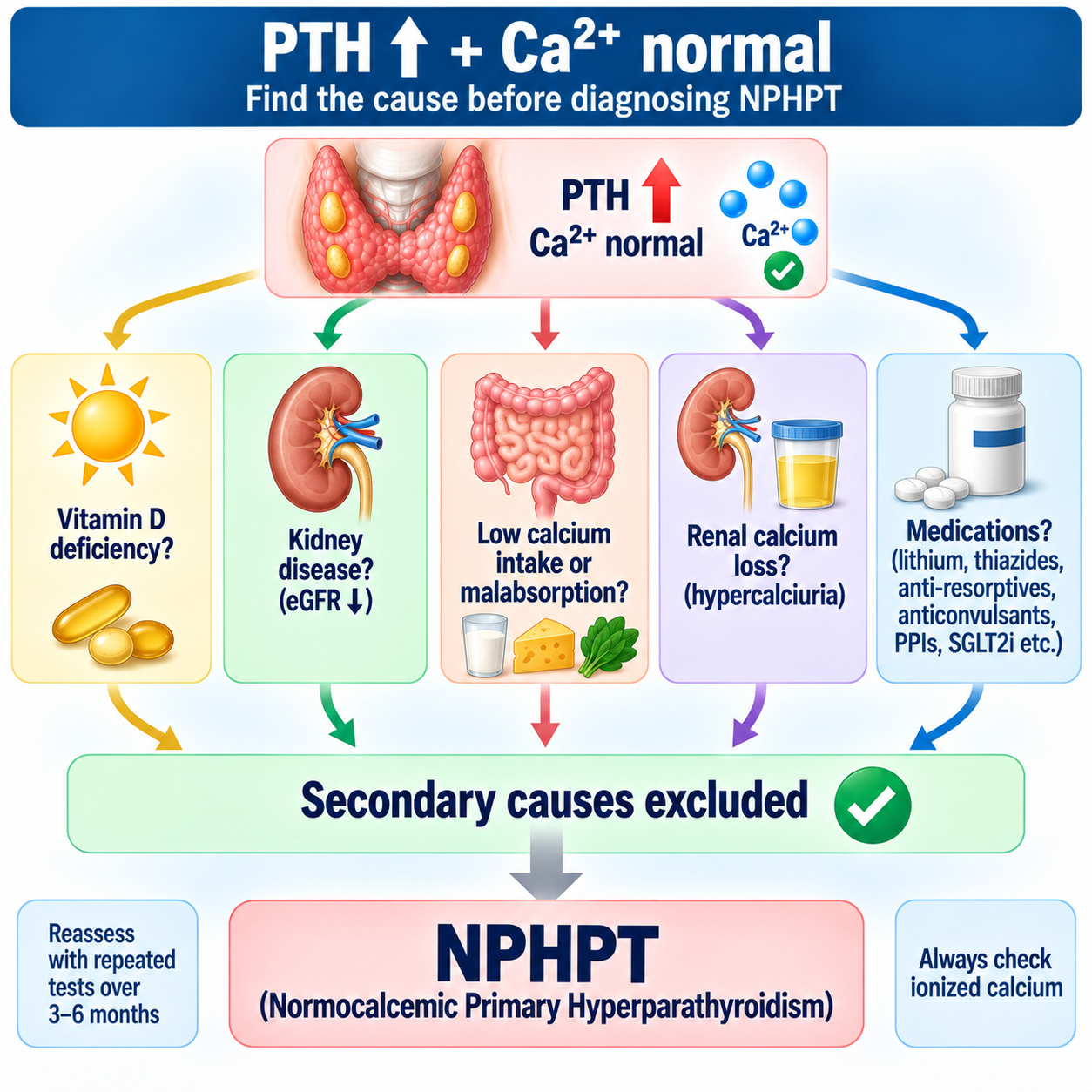
Complete Diagnostic Algorithm
Diagnostic sequence:
- Confirm PTH elevation
- Confirm total calcium is repeatedly normal
- Measure ionized calcium
- Confirm persistence over time
- Exclude vitamin D deficiency
- Assess renal function
- Assess calcium intake
- Consider malabsorption
- Assess urinary calcium
- Review medications
- Consider phosphate disorders
Only then: normocalcemic PHPT.
What Tests Should Be Considered?
Core biochemical assessment: adjusted total calcium, ionized calcium, intact PTH, 25-OH vitamin D, creatinine/eGFR, phosphate. Depending on context: magnesium, 24-hour urinary calcium, malabsorption evaluation, and additional biochemical tests guided by history. Do not order every possible test universally.
Does NPHPT Progress to Hypercalcemic PHPT?
Possibly in some patients. NPHPT may represent an early biochemical phenotype that later progresses to hypercalcemic PHPT. But not every patient progresses — the natural history remains incompletely defined.
One community-screened cohort followed for approximately eight years found that only 1 of 64 initially identified subjects developed hypercalcemia, while only 13 continued to satisfy the normocalcemic biochemical pattern. This illustrates diagnostic instability and why one-time biochemical classification can be misleading. Do not use this single cohort as a universal progression rate.
Why Selection Bias Matters
Many NPHPT cohorts come from osteoporosis clinics or kidney-stone evaluations. Therefore high reported rates of osteoporosis, fractures and nephrolithiasis may partly reflect how the patients were selected rather than the true complication rate of NPHPT in the general population. The European consensus notes large differences between population studies and tertiary referral cohorts, consistent with substantial selection bias.
Patients diagnosed with NPHPT may have low BMD, osteoporosis and fractures. However, association does not automatically establish causation, because many patients were tested for PTH precisely because they already had osteoporosis. Some NPHPT cohorts report nephrolithiasis, but patients undergoing kidney-stone evaluation are disproportionately likely to have PTH measured — stone association must be interpreted with selection bias in mind.
Evaluating Confirmed NPHPT: Skeleton and Kidney
Once the diagnosis is secure, assess the same major target-organ domains relevant to PHPT: skeleton and kidney. Potential assessment includes DXA, vertebral assessment where indicated, renal function, stone history, renal imaging when clinically indicated, and urinary calcium where appropriate. Do not assume every patient already has target-organ disease.
When skeletal assessment is appropriate, follow the established PHPT framework: lumbar spine, hip, and distal one-third radius (see Primary Hyperparathyroidism Explained for the complete DXA/renal assessment framework).
Why Parathyroid Imaging Does Not Diagnose NPHPT
Imaging should never be used to convert “high PTH + normal calcium” into “NPHPT.” The diagnosis must first be established biochemically. A patient may have elevated PTH, normal calcium, vitamin D deficiency, and a possible parathyroid lesion on imaging — that does not establish NPHPT. The secondary cause must still be resolved. Biochemistry first; localization only if surgery is appropriate.
Does NPHPT Require Surgery?
Management begins with make sure the diagnosis is real before treating the parathyroids. This is particularly important because NPHPT remains less well characterized than conventional hypercalcemic PHPT.
Before disease-specific intervention: optimize vitamin D, ensure appropriate calcium intake, address malabsorption where possible, assess renal function, address significant renal calcium loss where appropriate, review relevant medications, and evaluate phosphate abnormalities. Only persistent PTH elevation after this process supports NPHPT.
The Fifth International Workshop concluded: “There are insufficient data to provide specific guidelines for surgery in normocalcemic PHPT.” Do not simply copy the surgical criteria for hypercalcemic asymptomatic PHPT and present them as universally validated NPHPT indications.
Surgery is more difficult to standardize because of inconsistent historical diagnostic definitions, incomplete exclusion of secondary causes in older studies, referral/selection bias, uncertain natural history, limited randomized evidence, variable surgical outcomes, and higher reported rates of multigland disease in some surgical series. A surgical review reports poorer long-term cure rates than hypercalcemic PHPT and higher multigland-disease rates in some NPHPT cohorts.
In a patient with rigorously confirmed NPHPT and clinically meaningful skeletal or renal disease, specialist consideration of parathyroidectomy may be appropriate when secondary causes have been convincingly excluded, disease complications are plausibly related, an experienced endocrine/parathyroid team agrees, and operative planning is appropriate. There is no universal NPHPT surgical threshold, and surgery should never be based on “PTH is 1.5× normal” alone.
Medical Management and Follow-Up
There is no single drug that should routinely be prescribed simply because a patient has NPHPT. Management depends on skeletal disease, renal disease, vitamin D/calcium status, underlying secondary contributors, overall fracture risk, and progression of the biochemical phenotype.
Osteoporosis Treatment
If a patient with confirmed NPHPT also has osteoporosis, it should be assessed and treated according to appropriate bone-health principles; antiresorptive therapy may improve BMD in selected patients. But remember: antiresorptive therapy itself can raise PTH and can complicate subsequent biochemical interpretation. Ideally establish the baseline diagnosis before introducing major confounding therapy when clinically feasible.
Cinacalcet
Do not present cinacalcet as routine NPHPT therapy. Its major role in classical PHPT is lowering serum calcium, but in NPHPT serum calcium is already normal — routine use has no clear general rationale. No dosing regimen is provided here.
Follow-Up
Because natural history is uncertain, patients with confirmed NPHPT should receive longitudinal follow-up focused on serum calcium, PTH where clinically useful, renal function, skeletal health, kidney-stone disease, and development of hypercalcemia. No universal NPHPT-specific monitoring interval is invented here.
What If Calcium Becomes High?
If a patient with established NPHPT later develops persistent hypercalcemia with PTH not suppressed, the phenotype has changed. Reassess as hypercalcemic PHPT, including consideration of FHH and other relevant differential diagnoses where appropriate.

Worked Clinical Cases
Case 1: Vitamin D Deficiency
Calcium normal, ionized calcium normal, PTH ↑, 25-OH D markedly ↓. Error: “normocalcemic PHPT.” Correct reasoning: vitamin D-related secondary HPT must be addressed first. Lesson: NPHPT requires secondary causes to be excluded.
Case 2: CKD
Calcium normal, PTH ↑, eGFR 42 mL/min/1.73m². CKD-related secondary hyperparathyroidism is a much more appropriate initial explanation. Do not diagnose NPHPT when renal impairment itself explains the PTH elevation.
Case 3: Ionized Hypercalcemia
Total calcium normal, PTH ↑, ionized calcium ↑. Error: “normocalcemic PHPT.” Correct interpretation: the patient is not normocalcemic — evaluate as conventional hypercalcemic PHPT where appropriate.
Case 4: Low Calcium Intake
Normal calcium, PTH mildly ↑, vitamin D adequate, normal kidney function, extremely low dietary calcium intake. Calcium-deficiency-related secondary PTH elevation must be considered before NPHPT.
Case 5: Bariatric Surgery
Previous gastric bypass, calcium normal, PTH ↑, vitamin D borderline, low calcium intake. Malabsorption/calcium-vitamin D physiology provides a plausible secondary explanation. Do not immediately diagnose NPHPT.
Case 6: Hypercalciuria
Repeatedly normal total and ionized calcium, PTH ↑, vitamin D adequate, eGFR normal, marked hypercalciuria. Consider renal calcium loss as a potential stimulus for secondary PTH elevation. The NPHPT diagnosis is not yet secure.
Case 7: Denosumab
Osteoporosis, recently received denosumab, calcium normal, PTH ↑. Error: “osteoporosis + high PTH = NPHPT.” Correct reasoning: denosumab can raise PTH; medication timing must be considered.
Case 8: True NPHPT Pattern
Over several months: repeatedly normal adjusted total calcium, repeatedly normal ionized calcium, persistently elevated PTH, adequate vitamin D, preserved renal function, adequate calcium intake, no malabsorption, no significant hypercalciuria explaining PTH, no relevant medication explanation, no relevant phosphate disorder. Normocalcemic primary hyperparathyroidism is now a reasonable diagnosis. Lesson: NPHPT is the end of the work-up, not the beginning.
Case 9: Later Hypercalcemia
A patient with rigorously diagnosed NPHPT is followed longitudinally. Later: adjusted calcium ↑ repeatedly, ionized calcium ↑, PTH remains non-suppressed. The phenotype has evolved into hypercalcemic PHPT — reassess using the conventional PHPT pathway.
Case 10: Positive Sestamibi + Vitamin D Deficiency
Normal calcium, PTH ↑, 25-OH D low, sestamibi shows possible parathyroid focus. Error: “positive scan confirms NPHPT.” Correct reasoning: imaging does not establish the biochemical diagnosis. Correct/exclude secondary causes first.
Common Diagnostic Mistakes
NPHPT in One Minute
Golden Rules
- High PTH alone does not diagnose primary hyperparathyroidism.
- PTH must always be interpreted in physiological context.
- Normal serum calcium can be maintained by elevated PTH.
- NPHPT requires both normal adjusted total calcium and normal ionized calcium.
- A single elevated PTH is insufficient.
- The abnormality must persist over time.
- NPHPT is a diagnosis of exclusion.
- Vitamin D deficiency is a major mimic.
- PTH may take months to normalize after vitamin D correction.
- eGFR below 60 can explain secondary PTH elevation.
- Low calcium intake can raise PTH despite normal calcium.
- Malabsorption can produce secondary HPT without overt hypocalcemia.
- Renal calcium loss can stimulate PTH.
- Medications can substantially alter PTH physiology.
- A positive parathyroid scan does not diagnose NPHPT.
- Current evidence does not support automatic surgery for every NPHPT patient.
- NPHPT is the end of a careful exclusion process — not a label attached to the first high PTH result.
Clinical Pearls
- PTH is a homeostatic hormone.
- Ask why PTH is high before calling it autonomous.
- Repeat abnormal results.
- Confirm total calcium remains normal.
- Measure ionized calcium.
- Elevated ionized calcium reclassifies the phenotype.
- Vitamin D deficiency commonly raises PTH.
- Correct vitamin D before final classification.
- PTH normalization after vitamin D may be delayed.
- Vitamin D correction may reveal hypercalcemic PHPT.
- CKD raises PTH.
- eGFR ≥60 is generally required for a confident NPHPT diagnosis.
- Low calcium intake raises PTH.
- Normal serum calcium does not prove adequate calcium intake.
- Malabsorption can exist with normal serum calcium.
- Bariatric surgery is a major historical clue.
- Hypercalciuria may stimulate secondary PTH.
- Measure urinary calcium where appropriate.
- Antiresorptives can raise PTH.
- Denosumab timing matters.
- Lithium alters CaSR–PTH physiology.
- Diuretics can complicate interpretation.
- Anticonvulsants can affect mineral metabolism.
- Phosphate disorders can alter PTH.
- Osteoporosis does not prove NPHPT.
- Stones do not prove NPHPT.
- Referral cohorts overestimate complications.
- Natural history remains incompletely defined.
- Some patients progress to hypercalcemia.
- Many do not.
- Imaging is not diagnostic.
- Surgery requires particularly careful patient selection.
- Current evidence is insufficient for universal NPHPT-specific surgical criteria.
- Longitudinal follow-up is important.
Frequently Asked Questions
Key Take-Home Messages
When a laboratory report shows PTH ↑ with Ca normal, do not immediately diagnose primary hyperparathyroidism. Instead ask: why is PTH high? PTH exists to defend extracellular calcium. Therefore vitamin D ↓, calcium intake ↓, calcium absorption ↓, kidney function ↓, renal calcium loss ↑, or medication effects can all produce PTH ↑ while PTH successfully maintains serum Ca normal. This is secondary hyperparathyroid physiology.
Before considering NPHPT: repeat PTH → repeat adjusted total calcium → measure ionized calcium. If ionized calcium is elevated, the patient is not normocalcemic. If both forms of calcium remain normal, evaluate 25-OH D, eGFR, calcium intake, malabsorption, urinary calcium, medications and phosphate physiology. Only when the PTH elevation persists over time and these alternative explanations have been appropriately excluded should the patient be classified as normocalcemic primary hyperparathyroidism.
Even then, do not assume NPHPT = surgery. Its natural history and optimal treatment are less firmly established than conventional hypercalcemic PHPT.
The final diagnostic memory rule: PTH ↑ + Ca normal → repeat → check ionized Ca → exclude vitamin D, CKD, low Ca intake, malabsorption, hypercalciuria, drugs and phosphate disorders → only then diagnose NPHPT.
The most important sentence in this article: a normal serum calcium does not mean calcium physiology is normal — PTH may be elevated precisely because it is successfully maintaining calcium within the normal range. High PTH + normal calcium → think secondary first, NPHPT last.
This article is intended for medical education only. It explains NPHPT physiology and diagnostic reasoning, not patient-specific medical advice, surgical eligibility, medication dosing or monitoring intervals.