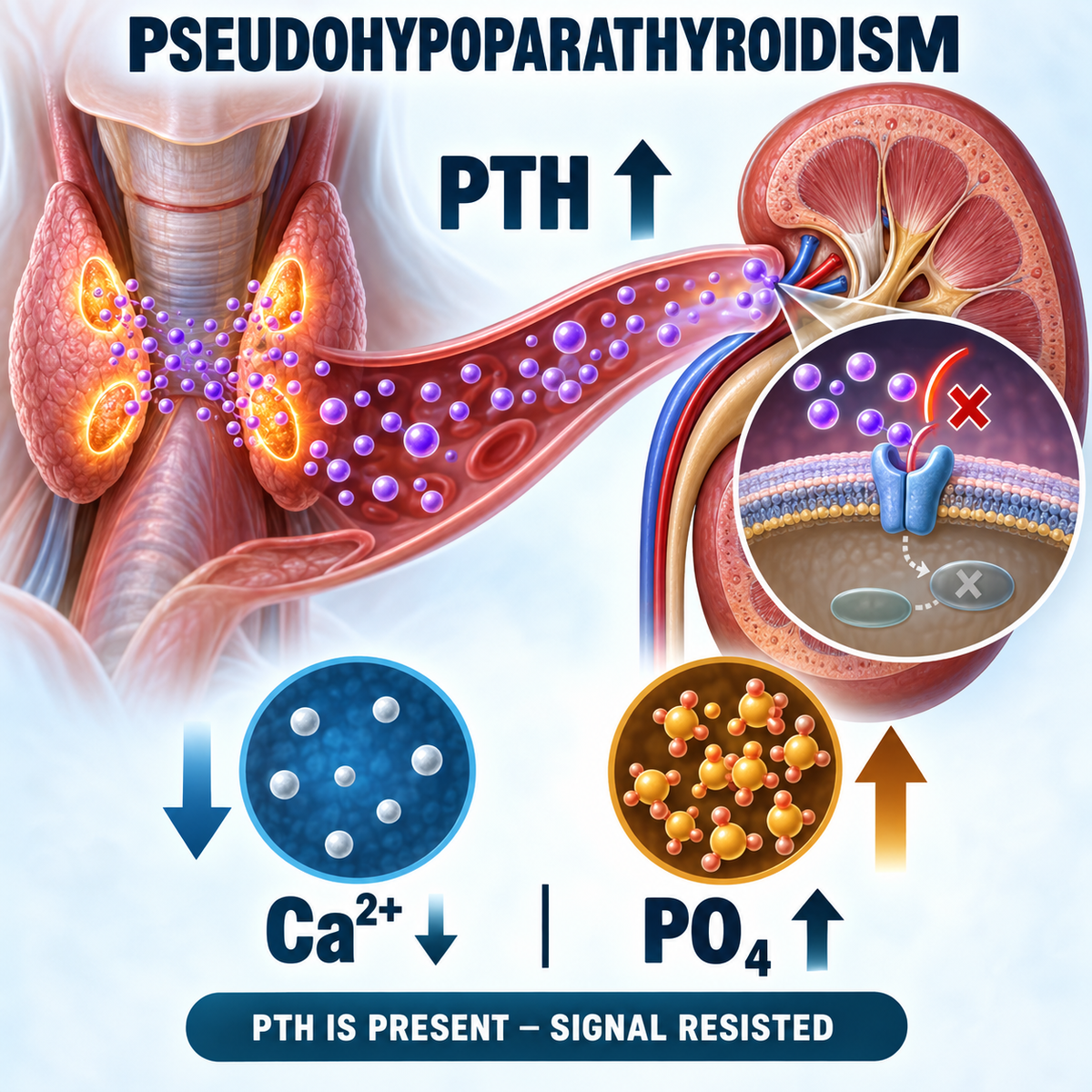
PTH is present, but its signal is resisted
Pseudohypoparathyroidism describes a group of rare disorders in which parathyroid hormone is produced, often in large amounts, but target tissues do not respond normally to its signal.
LOW Ca + HIGH PO₄ + HIGH PTH = THINK PTH RESISTANCE
Introduction
Pseudohypoparathyroidism describes a group of rare disorders in which parathyroid hormone is produced, often in large amounts, but target tissues do not respond normally to its signal.
The biochemical picture can therefore look paradoxical:
CALCIUM IS LOW PHOSPHATE IS HIGHyet:
PTH IS HIGHThe parathyroid glands are not failing.
Instead:
PTH IS PRESENT — BUT ITS SIGNAL IS RESISTEDThe kidney is a particularly important site of resistance. Failure of the normal renal response to PTH reduces phosphate excretion and contributes to impaired calcium and vitamin D physiology. (NCBI)
Some forms are associated with characteristic skeletal and developmental features historically called:
ALBRIGHT HEREDITARY OSTEODYSTROPHY — AHOand some have resistance to other hormones, especially:
TSHModern diagnosis increasingly depends on identifying the underlying molecular or epigenetic defect rather than relying only on the older clinical subtype labels. (Nature)
Why The Name “Pseudohypoparathyroidism”?
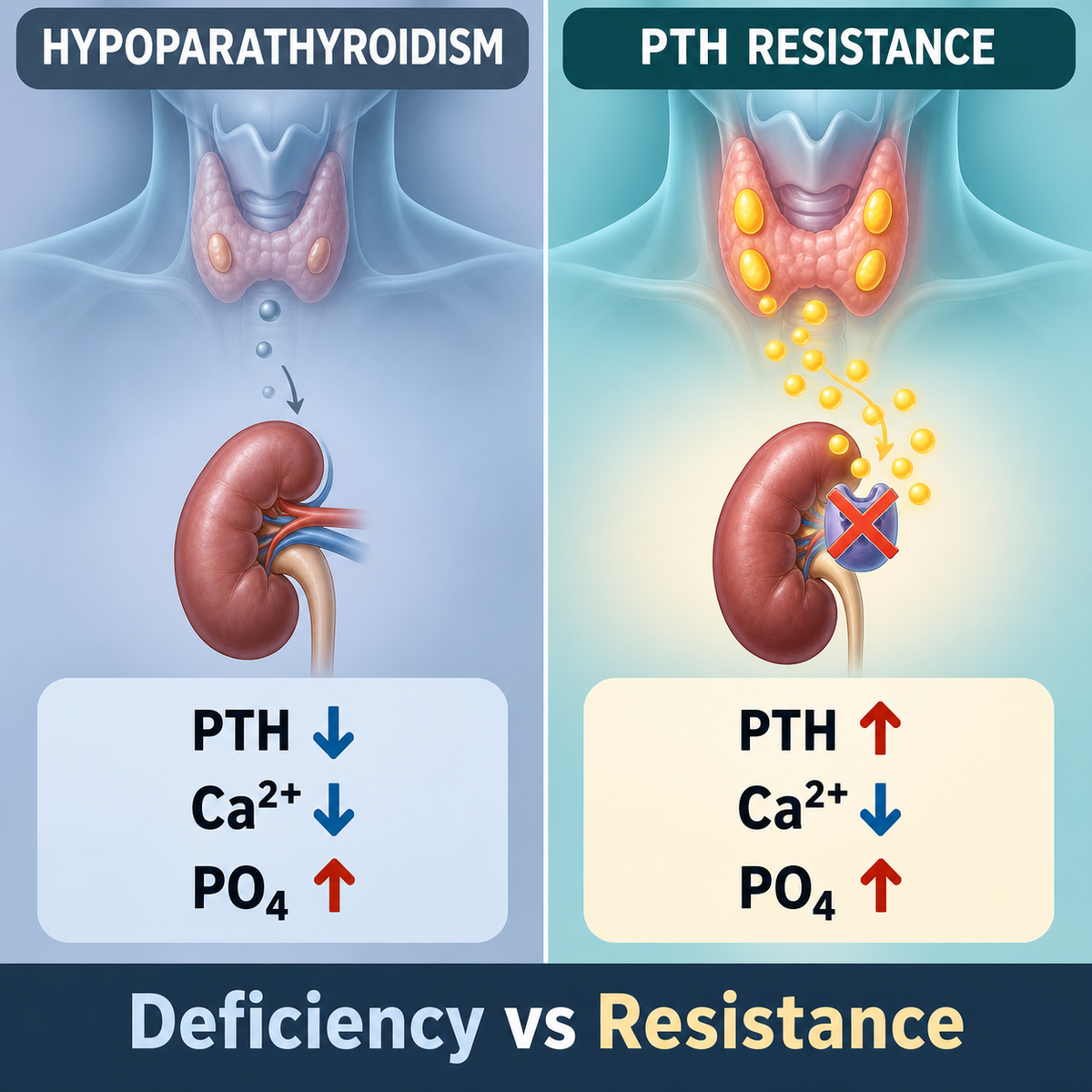
The patient resembles someone with hypoparathyroidism because both disorders can cause:
Ca ↓and:
PO₄ ↑But:
True hypoparathyroidism
The problem is:
PTH DEFICIENCYPseudohypoparathyroidism
The problem is:
PTH RESISTANCETherefore:
PTH IS HIGHrather than low.
Normal Pth Action
Normally:
Ca²⁺ ↓ PTH ↑PTH acts mainly on:
Kidney
- renal calcium reabsorption ↑;
- renal phosphate reabsorption ↓;
- phosphate excretion ↑;
- 1α-hydroxylase activity ↑;
- calcitriol production ↑.
Bone
PTH signalling contributes to mobilization of calcium and regulation of bone turnover.
Intestine
PTH acts indirectly via calcitriol to increase calcium absorption.
Normal Pth Signal Transduction
This is an important advanced section.
Use:
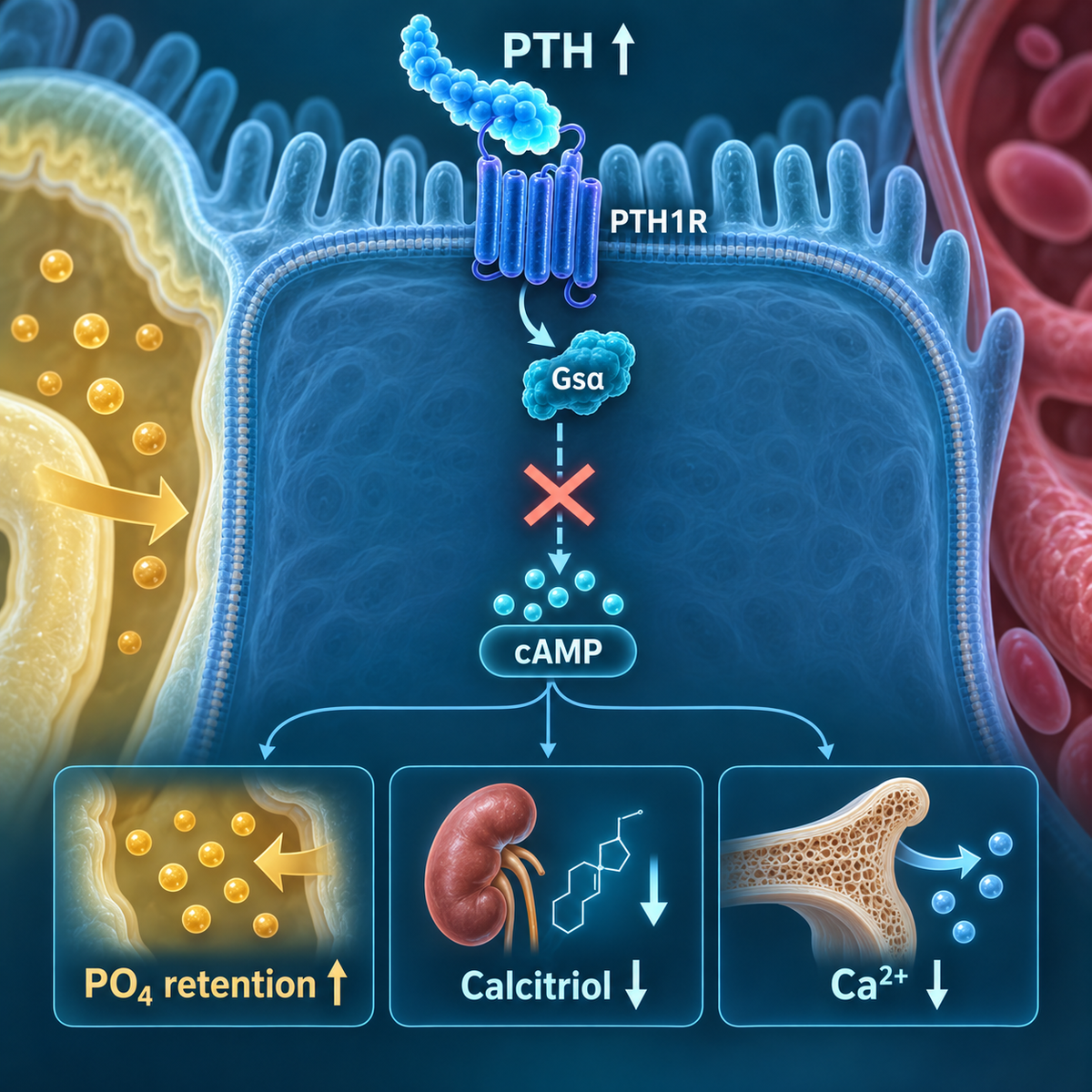
PTH PTH1R Gsα ADENYLYL CYCLASE cAMP ↑ PKA / DOWNSTREAM CELLULAR RESPONSEThis signalling pathway is central to several pseudohypoparathyroidism-related disorders. The international consensus describes molecular abnormalities affecting the PTH/PTHrP receptor–Gsα–cAMP signalling pathway as the basis for much of this disease spectrum. (Nature)
What Happens In Pth Resistance?
The parathyroids detect hypocalcemia and respond appropriately:
PTH ↑But the kidney does not respond normally.
Therefore:
PHOSPHATE EXCRETION ↓ PO₄ ↑and:
CALCITRIOL RESPONSE ↓ INTESTINAL Ca ABSORPTION ↓and overall:
Ca²⁺ ↓which stimulates even more PTH.
The Vicious Cycle
Display as:
PTH RESISTANCE PO₄ RETENTION CALCITRIOL RESPONSE ↓ Ca²⁺ ↓ PTH ↑↑But because tissues remain resistant:
PTH CONTINUES TO RISEThis explains why untreated patients can have markedly elevated PTH. (NCBI)
Classic Biochemical Pattern
Use this table:
| Test | Typical PTH resistance |
|---|---|
| Calcium | ↓ |
| Phosphate | ↑ |
| PTH | ↑ |
| 25-OH vitamin D | Usually not the primary defect |
| 1,25-(OH)₂D | May be low/inappropriately low |
| Renal phosphate response to PTH | Reduced |
| TSH | May be elevated in some molecular forms |
| Urinary calcium | Often not as high as in conventional treatment of true HypoPT |
Endotext similarly describes PTH resistance as hypocalcemia, hyperphosphatemia and increased PTH, with impaired phosphaturic responses. (NCBI)
Why Phosphate Is High
PTH normally tells the proximal renal tubule:
REABSORB LESS PHOSPHATETherefore:
PTH → PHOSPHATURIAIn PTH resistance:
KIDNEY DOES NOT RESPOND ADEQUATELY PHOSPHATE REABSORPTION REMAINS HIGH URINARY PHOSPHATE EXCRETION FALLS SERUM PO₄ ↑This is an essential mechanism.
Why Calcium Falls
PTH resistance contributes to hypocalcemia through several effects:
- impaired calcitriol generation;
- reduced intestinal calcium absorption;
- impaired PTH-mediated mineral handling;
- failure of normal compensatory physiology.
Endotext notes that PTH resistance can reduce calcium mobilization and intestinal absorption while impairing renal handling. (NCBI)
Why Pth Becomes High
Use:
Ca²⁺ ↓ PARATHYROID GLANDS SENSE LOW Ca PTH ↑The problem is therefore not failure of secretion.
It is:
FAILURE OF RESPONSEThis makes PHP fundamentally different from primary hypoparathyroidism.
Diagnostic Starting Point
When a patient has confirmed hypocalcemia, ask:
WHAT IS THE PTH?PTH low / inappropriate normal
Think:
HYPOPARATHYROIDISMPTH high
PTH secretion is intact.
Then ask:
WHAT IS THE PHOSPHATE?Phosphate As The Next Clue
PTH ↑ + PO₄ low
Commonly think:
- vitamin D deficiency;
- reduced intestinal calcium absorption;
- secondary hyperparathyroidism.
PTH ↑ + PO₄ high
Think:
- CKD;
- PTH resistance;
- severe phosphate load;
- other renal/mineral disorders.
Then use:
RENAL FUNCTIONand:
CLINICAL / DEVELOPMENTAL PHENOTYPEto narrow the diagnosis.
Ckd Must Be Excluded
CKD frequently produces:
PO₄ ↑ Ca ↓ / normal PTH ↑Therefore biochemical similarity can be considerable.
Before diagnosing pseudohypoparathyroidism:
ASSESS RENAL FUNCTIONIf substantial CKD is present, CKD-MBD becomes a much more likely explanation.
CKD-MBD Explained
Vitamin D Deficiency Must Be Considered
Vitamin D deficiency commonly causes:
PTH ↑but because elevated PTH produces phosphaturia:
PO₄ is often LOW or LOW-NORMALrather than high.
Therefore:
Ca ↓ + PTH ↑ + PO₄ ↓is much more compatible with vitamin D deficiency than classic PHP.
Vitamin D Deficiency Explained
Magnesium
Severe magnesium deficiency may alter:
- PTH secretion;
- PTH action.
But severe hypomagnesemia often produces:
LOW OR INAPPROPRIATELY NORMAL PTHrather than the classic:
MARKEDLY HIGH PTHof pseudohypoparathyroidism.
Always check magnesium in unexplained hypocalcemia.
Modern Terminology
Add an educational callout:
Traditional terminology remains important
Students will still encounter:
- PHP type 1A;
- PHP type 1B;
- PHP type 1C;
- PHP type 2;
- pseudopseudohypoparathyroidism;
- progressive osseous heteroplasia.
However, the traditional classification became problematic because:
- phenotypes overlap;
- biochemical features vary with age;
- molecular mechanisms overlap;
- old functional tests are not widely available;
- molecular diagnosis can classify disease more accurately.
The 2018 international consensus concluded that the old subtype framework should be amended toward a common pathophysiological and molecular genetic classification. (Nature)
Ippsd Terminology
A newer umbrella terminology used in the literature is:
iPPSDmeaning:
INACTIVATING PTH/PTHrP SIGNALING DISORDERSThis framework classifies disorders according to the affected signalling component rather than relying solely on historical phenotype labels.
However:
PSEUDOHYPOPARATHYROIDISMshould remain the primary article title and SEO term because it remains widely recognized clinically and educationally.
Gnas: The Central Molecular Locus
Many classic PHP disorders involve:
GNASGNAS encodes:
Gsαthe stimulatory G-protein alpha subunit.
Gsα is required for signalling from multiple G-protein-coupled hormone receptors to:
ADENYLYL CYCLASEand therefore:
cAMPDefective Gsα signalling can produce resistance not only to PTH but also to other hormones.
Why Gnas Is Complicated
GNAS is:
IMPRINTEDThis means expression of maternal and paternal alleles differs among tissues.
Therefore:
THE SAME OR RELATED GNAS DEFECTcan produce different clinical phenotypes depending on:
PARENT OF ORIGINThis is one of the most important principles in the entire article.
Maternal Vs Paternal Inheritance
In classic GNAS-related disease:
Maternal pathogenic GNAS defect
can produce:
AHO + HORMONE RESISTANCEhistorically:
PHP1APaternal pathogenic GNAS defect
can produce:
AHO WITHOUT CLASSIC HORMONE RESISTANCEhistorically:
PSEUDOPSEUDOHYPOPARATHYROIDISM — PPHPThis occurs because GNAS expression is tissue-specific and parent-of-origin dependent. (NCBI)
Why The Kidney Is Special
The proximal renal tubule has important tissue-specific GNAS imprinting.
This helps explain why a maternal GNAS defect can cause:
RENAL PTH RESISTANCEwhile a paternal defect may not produce the same biochemical abnormality.
That would be wrong.
Use:
GNAS imprinting is tissue-specific, so parent of origin changes the phenotype in selected PTH-responsive tissues.
Classic Php1A
Teach historical PHP1A as:
GNAS-RELATED Gsα DEFICIENCYtypically with:
AHO PTH RESISTANCEpossible resistance to:
- TSH;
- gonadotropins;
- GHRH;
- other Gsα-coupled endocrine signals.
The phenotype can vary substantially between patients. (Nature)
Classic Php1B
Historically:
PHP1Busually refers to disease with:
PTH RESISTANCEassociated particularly with:
GNAS METHYLATION / EPIGENETIC ABNORMALITIESAHO features are usually absent or less prominent, although overlap can occur.
TSH resistance can also occur.
The phenotype is more variable than that old simplification.
Php1C
PHP1C was historically separated from PHP1A using biochemical functional assays.
Modern molecular understanding has shown substantial overlap.
Therefore:
DO NOT TEACH PHP1C AS A COMPLETELY DISTINCT MODERN DISEASEMention it as:
a historical subtype that substantially overlaps molecularly and clinically with PHP1A.
Php Type 2
PHP2 is an older physiological classification characterized historically by:
- preserved urinary cAMP response to PTH;
- impaired phosphaturic response.
The molecular basis is heterogeneous and incompletely defined.
Teach it as:
HISTORICAL PHYSIOLOGICAL TERMINOLOGYnot as the central modern framework.
Endotext continues to describe the historical distinction but notes the heterogeneous nature of this group. (NCBI)
Albright Hereditary Osteodystrophy
AHO is a phenotype characterized by a combination of:
- brachydactyly;
- short stature;
- stocky build;
- round facial appearance;
- ectopic/subcutaneous ossification.
Not every patient has every feature.
The international consensus identifies brachydactyly type E and short adult stature relative to unaffected parents as major AHO criteria, with stocky build, round face and ectopic ossification as additional features. (Nature)
Brachydactyly
The classic hand phenotype often involves shortening of:
METACARPALSparticularly:
4th and 5thalthough other bones may be affected.
A clenched fist may show:
ABSENT / DEPRESSED KNUCKLESsometimes called the:
ARCHIBALD SIGNEndotext describes characteristic shortening particularly involving the fourth and fifth metacarpals. (NCBI)
Early-Onset Obesity
Early-onset obesity can be a feature of some GNAS-related disorders.
The consensus considers:
EARLY-ONSET OBESITY BEFORE AGE 2especially when associated with TSH resistance or other characteristic findings, as one clue to the PHP-related disease spectrum. (Nature)
Ectopic Ossification
Some patients develop:
HETEROTOPIC / SUBCUTANEOUS OSSIFICATIONThis is actual bone formation in soft tissue rather than simple calcium deposition.
Do not confuse:
ECTOPIC OSSIFICATIONwith:
METASTATIC CALCIFICATION FROM HIGH Ca × PO₄They are biologically different processes.
Pseudopseudohypoparathyroidism
Despite the confusing name, PPHP traditionally describes:
AHO PHENOTYPEwithout:
PTH RESISTANCETherefore patients may have:
NORMAL Ca NORMAL PO₄ NORMAL PTH PHYSIOLOGYwhile displaying AHO skeletal features.
Endotext describes this classical distinction. (NCBI)
Php Vs Pphp
Use this table:
| Feature | PHP with AHO | PPHP |
|---|---|---|
| AHO features | Often present | Present |
| PTH resistance | Yes | No |
| Calcium | May be ↓ | Usually normal |
| Phosphate | May be ↑ | Usually normal |
| PTH | ↑ when resistant | Usually normal |
| Parent-of-origin concept | Often maternal GNAS defect | Often paternal GNAS defect |
Add:
This is a simplified teaching comparison; molecular phenotypes can overlap.
Multiple Hormone Resistance
Because Gsα participates in multiple receptor pathways, resistance may involve:
PTHplus:
TSHand sometimes:
- gonadotropins;
- GHRH;
- calcitonin-related signalling.
This is why PHP is not simply a calcium disorder.
The international consensus recommends systematic surveillance for multiple endocrine abnormalities. (Nature)
Tsh Resistance
TSH resistance may appear as:
TSH ↑with:
normal or low thyroid hormone levelsdepending on severity.
It can precede obvious PTH resistance in some affected children.
Therefore thyroid function is an important part of evaluation and follow-up.
Growth Hormone Axis
Some patients, particularly in GNAS-related disorders, may have impaired:
GHRH signallingleading to:
GH deficiencyThis can contribute to short stature.
Gonadal Axis
Gonadotropin resistance can contribute to:
- delayed puberty;
- incomplete pubertal development;
- menstrual abnormalities;
- reproductive dysfunction.
This is variable.
Neurocognitive And Developmental Features
Some affected patients can have:
- developmental delay;
- learning difficulties;
- cognitive impairment.
Phenotypic severity varies substantially.
Other Recognized Associations
Depending on molecular diagnosis, surveillance may need to consider:
- hearing impairment;
- sleep apnea;
- obesity;
- glucose intolerance;
- hypertension;
- dental abnormalities;
- ectopic ossification;
- neurological manifestations.
The consensus supports multidisciplinary surveillance extending beyond calcium metabolism. (Nature)
When Pth Resistance Appears
PTH resistance may:
EVOLVE WITH AGEYoung children with an underlying molecular disorder may not initially have overt:
- hypocalcemia;
- hyperphosphatemia;
- markedly elevated PTH.
Therefore:
NORMAL EARLY CALCIUM DOES NOT ALWAYS EXCLUDE A GNAS-RELATED DISORDERwhen characteristic phenotype/genetics are present.
Clinical Diagnosis
The international consensus identifies major clinical/biochemical clues including:
- PTH resistance;
- ectopic ossification;
- brachydactyly;
- early-onset obesity associated with other relevant abnormalities;
- AHO phenotype.
The diagnosis should integrate:
BIOCHEMISTRY + PHENOTYPE + MOLECULAR TESTINGrather than relying on one physical feature. (Nature)
Molecular Confirmation
Modern diagnosis should seek the molecular or epigenetic cause where possible.
Testing may include evaluation for:
- GNAS sequence variants;
- GNAS methylation abnormalities;
- relevant deletions/duplications;
- other genes in the PTH/PTHrP signalling pathway when phenotype suggests them.
Use:
Testing strategy should be selected according to phenotype and specialist molecular-genetic assessment.
The consensus explicitly recommends molecular analysis to confirm the clinical diagnosis and characterize the subtype. (Nature)
Old Pth Infusion Test
Historically, exogenous PTH was administered to assess:
- urinary cAMP;
- phosphaturic response.
This helped distinguish old PHP subtypes.
However:
IT IS NOT REQUIRED FOR ROUTINE MODERN DIAGNOSISThe international consensus states that the modified Ellsworth–Howard test is unnecessary for routine diagnosis and may be more relevant to research settings. (Nature)
Complete Diagnostic Algorithm
CONFIRMED Ca²⁺ ↓ PTHLOW / INAPPROPRIATELY NORMAL
→ HYPOPARATHYROIDISM PATHWAY
Internal link.
HIGH
PO₄LOW / LOW-NORMAL
Consider:
- vitamin D deficiency;
- malabsorption;
- secondary hyperparathyroidism.
HIGH
CHECK RENAL FUNCTIONCKD present
→ evaluate CKD-MBD
Renal function does not explain pattern
THINK PTH RESISTANCEAssess:
- brachydactyly;
- short stature;
- ectopic ossification;
- early-onset obesity;
- TSH resistance;
- family history;
- developmental phenotype.
Php Vs Hypoparathyroidism
Use:
| Feature | Hypoparathyroidism | Pseudohypoparathyroidism |
|---|---|---|
| Main problem | PTH deficiency | PTH resistance |
| Calcium | ↓ | ↓ |
| Phosphate | ↑ | ↑ |
| PTH | ↓ / inappropriate normal | ↑ |
| Parathyroid secretion | Deficient | Preserved/increased |
| Renal response to PTH | Can respond | Impaired |
| AHO | No | May occur |
| GNAS abnormalities | Not typical cause | Important in classic forms |
Php Vs Vitamin D Deficiency
| Feature | PHP | Vitamin D deficiency |
|---|---|---|
| Calcium | ↓/low | ↓/normal |
| Phosphate | ↑ | Often ↓ |
| PTH | ↑ | ↑ |
| 25-OH D | Not primary defining defect | ↓ |
| Mechanism | PTH resistance | Reduced vitamin D supply |
| Renal phosphaturia | Inadequate | Enhanced by high PTH |
Php Vs Ckd-Mbd
| Feature | PHP | CKD-MBD |
|---|---|---|
| Calcium | ↓ possible | ↓/normal |
| Phosphate | ↑ | ↑ |
| PTH | ↑ | ↑ |
| Renal function | Usually not explanatory | Reduced |
| Primary mechanism | PTH resistance | CKD mineral physiology |
| Developmental/AHO phenotype | May occur | No |
Php Vs Primary Hyperparathyroidism
PHPT
PTH ↑ + Ca ↑The PTH signal is functioning.
PHP
PTH ↑ + Ca ↓The signal is being resisted.
This contrast is very useful for students.
Treatment Principle
Treatment is aimed at correcting:
HYPOCALCEMIAand:
EXCESSIVE SECONDARY PTH ELEVATIONwhile avoiding:
HYPERCALCEMIAand:
HYPERCALCIURIAThe main chronic treatment is:
ACTIVE VITAMIN Dwith:
CALCIUM SUPPLEMENTATION WHEN REQUIREDThe international consensus identifies calcitriol or alfacalcidol, with or without calcium supplementation, as the mainstay of chronic treatment of hypocalcemia due to PTH resistance. (Nature)
Active Vitamin D
Use:
CALCITRIOLor:
ALFACALCIDOLwhere available.
Why?
Because renal PTH signalling that normally supports calcitriol synthesis is impaired.
Therefore active vitamin D bypasses part of the defective pathway.
Calcium Supplements
Calcium supplementation may be required when active vitamin D alone does not maintain appropriate calcium.
Treatment should be individualized according to:
- symptoms;
- serum calcium;
- phosphate;
- PTH;
- urine calcium;
- renal status.
Treatment Target Is Different From True Hypoparathyroidism
This is important.
In conventional hypoparathyroidism, clinicians often accept:
LOW-NORMAL CALCIUMpartly because absent PTH can lead to hypercalciuria.
In PTH resistance:
DISTAL RENAL PTH ACTION MAY BE PARTLY PRESERVEDin important classic forms.
Therefore the treatment objective includes bringing:
Ca AND PO₄ INTO NORMAL RANGEwhile reducing excessive PTH without suppressing it too far.
The international consensus recommends aiming to keep serum PTH toward the upper part of the reference range rather than fully suppressing PTH. (Nature)
Why Not Suppress Pth Completely?
Persistently high PTH may contribute to:
HIGH BONE TURNOVERBut excessive treatment that suppresses PTH too strongly may increase:
HYPERCALCIURIATherefore the goal is:
CONTROL PTH — NOT ELIMINATE ITMemory rule:
PHP: CORRECT Ca/PO₄ AND BRING PTH DOWN — DO NOT DRIVE PTH TOO LOWWhen Treatment May Begin Before Frank Hypocalcemia
The consensus states that active vitamin D treatment can be considered when PTH becomes:
>2 × THE UPPER LIMIT OF NORMALeven before overt hypocalcemia, depending on the clinical context. (Nature)
Present this as:
CONSENSUS-BASED SPECIALIST MANAGEMENTnot a universal self-treatment threshold.
Phosphate
Treatment should aim to keep:
SERUM PHOSPHATE NORMALActive vitamin D and calcium treatment, by correcting hypocalcemia and reducing excessive PTH drive, are generally central.
Phosphate Binders
The international consensus states that phosphate binders other than calcium are:
RARELY, IF EVER, REQUIREDfor persistent hyperphosphatemia in PHP-related disorders. (Nature)
Pth Analogues
This is an important difference from chronic primary hypoparathyroidism.
The international consensus recommends:
DO NOT TREAT PTH RESISTANCE WITH PTH OR PTH ANALOGUESbecause the underlying problem is:
RESISTANCE TO THE SIGNALrather than lack of hormone. (Nature)
Display this clearly.
Critical Contrast With Previous Article
Hypoparathyroidism
Hormone missing.
Modern management may include:
PTH REPLACEMENTin selected inadequately controlled patients.
Pseudohypoparathyroidism
Hormone already elevated.
Problem:
PTH RESISTANCETherefore:
PTH REPLACEMENT IS NOT THE STANDARD SOLUTIONThis is a very high-value teaching contrast.
Monitoring Calcium, Phosphate And Pth
The consensus recommends monitoring:
- calcium;
- phosphate;
- PTH.
In stable asymptomatic patients:
about every 6 monthswas recommended in the international consensus, with more frequent testing when clinically indicated. (Nature)
Avoid turning this into an inflexible schedule.
Urinary Calcium
Hypercalciuria is generally less common than in true hypoparathyroidism because PTH action in the distal renal tubule can remain relatively preserved in classic PHP.
However:
HYPERCALCIURIA CAN OCCURparticularly if treatment suppresses PTH excessively.
Therefore urinary calcium remains relevant when treatment is intensive or renal complications are suspected.
Nephrocalcinosis
The consensus recommends renal imaging:
- around transition from pediatric to adult care;
- and when persistent hypercalciuria occurs or clinical circumstances warrant.
Brain Calcification
Longstanding:
HYPOCALCEMIA + HYPERPHOSPHATEMIAcan be associated with intracranial calcification.
However:
DO NOT SCREEN EVERY ASYMPTOMATIC PATIENT WITH CTThe international consensus recommends brain CT primarily when neurological manifestations are present. (Nature)
Cataracts
Chronic mineral abnormalities can be associated with cataracts.
The international consensus supports ophthalmological evaluation as part of long-term assessment. (Nature)
Dental Health
Possible manifestations include:
- enamel hypoplasia;
- delayed eruption;
- abnormal tooth development;
- dental abnormalities related to chronic mineral disturbance.
Consensus recommendations support regular dental follow-up, especially during childhood. (Nature)
Weight And Metabolic Health
Some PHP-related disorders are associated with:
- early-onset obesity;
- glucose intolerance;
- metabolic complications.
Therefore long-term care should include appropriate:
- weight assessment;
- metabolic risk assessment;
- lifestyle support.
Multidisciplinary Care
Depending on phenotype, management may involve:
- endocrinology;
- pediatric endocrinology;
- clinical genetics;
- orthopedics;
- neurology;
- developmental services;
- nutrition;
- dentistry;
- ophthalmology;
- reproductive/endocrine care.
The consensus explicitly recommends multidisciplinary management. (Nature)
Complete Management Algorithm
PTH RESISTANCE CONFIRMED / STRONGLY SUSPECTEDAssess:
Ca PO₄ PTH 25-OH D RENAL FUNCTION HYPOCALCEMIA / SIGNIFICANT PTH ELEVATION? ACTIVE VITAMIN D±
CALCIUMTarget:
Ca NORMAL PO₄ NORMAL PTH CONTROLLED, NOT OVER-SUPPRESSEDMonitor:
- Ca;
- PO₄;
- PTH;
- urinary calcium when appropriate;
- kidney;
- thyroid;
- growth/development;
- other hormone resistance.
Acute Symptomatic Hypocalcemia
If a patient develops:
- tetany;
- seizure;
- laryngospasm;
- significant arrhythmia;
- severe symptomatic hypocalcemia;
management follows emergency hypocalcemia principles:
URGENT CALCIUM CORRECTIONplus:
ECG + ELECTROLYTE MONITORINGand correction of contributing abnormalities such as magnesium disturbance.
Hypocalcemia
Molecular Diagnosis Algorithm
Create a separate educational algorithm:
PTH RESISTANCE / AHO / ECTOPIC OSSIFICATION / EARLY-ONSET PHENOTYPE CLINICAL GENETICS ASSESSMENT MOLECULAR / EPIGENETIC TESTINGPossible categories:
GNAS coding defect
GNAS methylation defect
Other PTH/PTHrP signalling disorder
MOLECULAR DIAGNOSIS GUIDES PHENOTYPE SURVEILLANCEWorked Case 1: Classic Pth Resistance
Patient:
- Ca 7.4 mg/dL;
- phosphate high;
- PTH markedly elevated;
- renal function normal.
First interpretation
PTH secretion is intact.
But high phosphate despite high PTH suggests:
RENAL PTH RESISTANCELesson
LOW Ca + HIGH PO₄ + HIGH PTHis the central biochemical clue.
Case 2: True Hypoparathyroidism
Patient:
- Ca low;
- phosphate high;
- PTH very low;
- previous total thyroidectomy.
Diagnosis
POSTSURGICAL HYPOPARATHYROIDISMnot pseudohypoparathyroidism.
Lesson
Same Ca/PO₄ pattern.
Different:
PTHCase 3: Vitamin D Deficiency
Patient:
- Ca low-normal;
- PTH high;
- phosphate low;
- 25-OH D very low.
Interpretation
SECONDARY HYPERPARATHYROIDISM DUE TO VITAMIN D DEFICIENCYnot PHP.
Key clue
PHOSPHATE LOWrather than retained.
Case 4: Ckd
Patient:
- Ca low;
- phosphate high;
- PTH high;
- eGFR 18 mL/min/1.73 m².
Interpretation
CKD-MBDprovides a much more likely explanation.
Lesson
Always evaluate renal function before diagnosing PHP.
Case 5: Aho + Pth Resistance
Young patient:
- short stature;
- brachydactyly;
- round facial appearance;
- Ca low;
- PO₄ high;
- PTH high;
- mildly elevated TSH.
Interpretation
Classic phenotype suggesting a:
GNAS-RELATED PHP SPECTRUM DISORDERNext step
MOLECULAR CONFIRMATIONCase 6: Aho Without Pth Resistance
Patient:
- brachydactyly;
- short stature;
- ectopic ossification;
- normal Ca;
- normal phosphate;
- no evidence of hormone resistance.
Historical phenotype
PSEUDOPSEUDOHYPOPARATHYROIDISMLesson
AHO does not automatically mean PTH resistance.
Case 7: Pth High Before Calcium Falls
Child with known molecular disease:
- calcium normal;
- phosphate upper-normal/high;
- PTH progressively rising.
Lesson
Biochemical PTH resistance can evolve before overt hypocalcemia.
Management and follow-up should be specialist guided.
Case 8: Tsh Resistance
Patient with established PHP:
- TSH elevated;
- free T4 low-normal.
Interpretation
Consider:
TSH RESISTANCELesson
PHP can involve multiple endocrine pathways.
Case 9: Short Stature
Patient with AHO phenotype has marked short stature.
Error
“All short stature is due to skeletal phenotype.”
Correct reasoning
Consider:
- skeletal phenotype;
- growth pattern;
- thyroid status;
- possible GH-axis abnormalities.
Case 10: Excessive Pth Suppression
Patient treated aggressively with active vitamin D and calcium:
- calcium high-normal;
- PTH suppressed;
- urinary calcium elevated.
Problem
Treatment has overshot.
Lesson
DO NOT AIM TO SUPPRESS PTH COMPLETELYbecause some PTH activity can protect renal calcium handling.
Case 11: Pth Replacement Request
Patient asks why PTH replacement is used in true chronic hypoparathyroidism but not routinely in PHP.
Explanation
Hypoparathyroidism:
PTH MISSINGPHP:
PTH ALREADY HIGH — SIGNAL RESISTEDLesson
REPLACE A DEFICIENCY, NOT A RESISTED SIGNALCase 12: Old Ellsworth–Howard Test
Student proposes an exogenous PTH challenge with urinary cAMP before diagnosis.
Modern approach
Routine diagnosis now relies on:
PHENOTYPE + BIOCHEMISTRY + MOLECULAR TESTINGThe old infusion test is generally unnecessary outside selected/research settings. (Nature)
Common Mistakes
Mistake 1
Pseudohypoparathyroidism means low PTH.
Wrong.
PTH is high.
Mistake 2
Hypoparathyroidism and PHP have identical PTH levels.
Wrong.
Mistake 3
High PTH always causes low phosphate.
Wrong if renal tissue is resistant to PTH.
Mistake 4
Low calcium + high PTH automatically means vitamin D deficiency.
Wrong.
Look at phosphate and renal function.
Mistake 5
High phosphate + high PTH automatically means PHP.
Wrong.
Exclude CKD.
Mistake 6
All PHP patients have AHO.
Wrong.
Mistake 7
All people with AHO have PTH resistance.
Wrong.
Mistake 8
PPHP means severe PTH resistance.
Wrong.
Historically it means AHO without classic hormone resistance.
Mistake 9
GNAS inheritance behaves like an ordinary autosomal dominant disorder with the same phenotype from either parent.
Wrong.
Parent-of-origin matters.
Mistake 10
Paternal GNAS expression is switched off in every tissue.
Wrong.
Imprinting is tissue-specific.
Mistake 11
PHP1A, 1B and 1C are perfectly distinct modern diseases.
Wrong.
There is substantial overlap.
Mistake 12
Old PTH infusion testing is mandatory.
Wrong.
Mistake 13
PHP affects only calcium.
Wrong.
Other hormone resistance can occur.
Mistake 14
TSH resistance is irrelevant.
Wrong.
Mistake 15
Brachydactyly alone diagnoses PHP.
Wrong.
Mistake 16
Ectopic ossification is simply calcium precipitation.
Wrong.
Mistake 17
PTH replacement should be given because the patient is hypocalcemic.
Wrong in PHP.
Mistake 18
Suppress PTH to zero with high-dose therapy.
Wrong.
Mistake 19
Renal monitoring is unnecessary.
Wrong.
Mistake 20
Normal calcium in early childhood excludes the disorder.
Wrong.
PTH resistance can evolve with age.
One-Minute Revision
PSEUDOHYPOPARATHYROIDISM IN ONE MINUTE Ca ↓ PO₄ ↑ PTH ↑ PTH IS PRESENTbut:
THE KIDNEY RESISTS IT PHOSPHATE RETENTION CALCITRIOL RESPONSE ↓ HYPOCALCEMIALook for:
AHO GNAS TSH RESISTANCEConfirm with:
MOLECULAR / EPIGENETIC TESTINGTreat with:
ACTIVE VITAMIN D ± CALCIUMTarget:
NORMAL Ca + NORMAL PO₄with:
PTH CONTROLLED, NOT SUPPRESSED NO ROUTINE PTH REPLACEMENTGolden Rules
Pseudohypoparathyroidism is a disorder of PTH resistance, not PTH deficiency.
Low calcium should increase PTH, so high PTH in hypocalcemia indicates that the parathyroid glands are responding.
Low calcium + high phosphate + high PTH is the classic biochemical clue to PTH resistance.
Always consider CKD before diagnosing pseudohypoparathyroidism.
Vitamin D deficiency generally produces high PTH with low or low-normal phosphate.
The kidney is a major site of PTH resistance.
Many classic forms involve the GNAS signalling pathway.
GNAS is imprinted, so parent of origin matters.
AHO can include brachydactyly, short stature, stocky build, round facies and ectopic ossification.
AHO does not automatically prove PTH resistance.
PHP can involve resistance to hormones other than PTH, particularly TSH.
Traditional PHP subtype names remain useful, but molecular classification is increasingly preferred.
Molecular testing is central to confirming the diagnosis.
The old exogenous-PTH challenge is not routinely required.
Treatment uses active vitamin D with calcium when required.
PTH should be controlled but not completely suppressed.
PTH analogues are not routine treatment because the underlying problem is resistance to PTH.
Final Take-Home Section
Use this complete content:
Pseudohypoparathyroidism becomes much easier to understand when the question is changed from:
“Is PTH high or low?”
to:
IS PTH DOING WHAT IT SHOULD?When serum calcium falls:
PTH SHOULD RISEIn pseudohypoparathyroidism, it does.
But despite:
PTH ↑the kidney fails to produce an adequate response.
Therefore:
PHOSPHATE EXCRETION ↓ PO₄ ↑and:
CALCITRIOL RESPONSE ↓ Ca²⁺ REMAINS LOWThe biochemical pattern becomes:
Ca²⁺ ↓ + PO₄ ↑ + PTH ↑This differs from true hypoparathyroidism:
Ca²⁺ ↓ + PO₄ ↑ + PTH ↓The next step is not simply to label the patient from the laboratory pattern.
First exclude important alternatives, especially:
CKDThen assess the broader phenotype:
- brachydactyly;
- short stature;
- ectopic ossification;
- early-onset obesity;
- thyroid abnormalities;
- developmental features;
- family history.
Many classic disorders involve:
GNASand because GNAS undergoes tissue-specific:
GENOMIC IMPRINTINGthe parent from whom a pathogenic variant is inherited can substantially alter the phenotype.
Historical terms such as:
PHP1A PHP1Band:
PPHPremain useful for understanding older literature, but modern diagnosis should increasingly be based on:
CLINICAL PHENOTYPE + BIOCHEMISTRY + MOLECULAR MECHANISMTreatment aims to bypass the impaired PTH-dependent calcium/vitamin D pathway using:
ACTIVE VITAMIN Dwith:
CALCIUM WHEN REQUIREDwhile keeping:
CALCIUM NORMAL PHOSPHATE NORMALand:
PTH CONTROLLED BUT NOT OVER-SUPPRESSEDBecause PTH is already present and elevated:
ROUTINE PTH REPLACEMENT IS NOT THE ANSWERThe strongest final memory rule is:
LOW Ca + HIGH PO₄ + HIGH PTH = PTH IS PRESENT, BUT ITS SIGNAL IS NOT WORKINGPseudohypoparathyroidism is best understood as a signalling disorder rather than a parathyroid-gland failure. The parathyroids recognize hypocalcemia and release PTH, but target tissues—particularly the kidney—do not respond normally. Recognizing that distinction explains the characteristic low-calcium, high-phosphate, high-PTH pattern and provides the basis for molecular diagnosis, treatment and lifelong surveillance.
Frequently Asked Questions
What is pseudohypoparathyroidism?
Pseudohypoparathyroidism is a group of disorders in which target tissues are resistant to PTH, resulting classically in hypocalcemia, hyperphosphatemia and elevated PTH.
Why is PTH high?
Because the parathyroid glands correctly detect hypocalcemia and increase PTH secretion, but target tissues do not respond adequately.
Why is phosphate high?
Renal resistance to PTH prevents the normal phosphaturic response, so phosphate is retained.
How is PHP different from hypoparathyroidism?
Hypoparathyroidism has: LOW PTH PHP has: HIGH PTH Both can have low calcium and high phosphate.
What does low calcium, high phosphate and high PTH mean?
It suggests: PTH RESISTANCE once CKD and other causes have been appropriately considered.
What is Albright hereditary osteodystrophy?
AHO is a phenotype that can include brachydactyly, short stature, stocky build, round facial appearance and ectopic ossification.
Does every patient with PHP have AHO?
No. Some forms, particularly those historically called PHP1B, may have little or no classical AHO phenotype.
Does everyone with AHO have PTH resistance?
No. The historical PPHP phenotype has AHO features without classic PTH resistance.
What gene is associated with pseudohypoparathyroidism?
Many classic forms involve: GNAS which encodes the stimulatory G-protein alpha subunit, Gsα.
Why does the parent of origin matter?
GNAS is subject to tissue-specific genomic imprinting, so maternal and paternal defects can produce different endocrine phenotypes.
Can thyroid function be abnormal?
Yes. TSH resistance is an important associated endocrine abnormality in some PHP-related disorders.
Is the PTH infusion test required?
No. Modern routine diagnosis generally relies on clinical, biochemical and molecular evaluation rather than the historical PTH challenge test.
How is pseudohypoparathyroidism treated?
Chronic PTH resistance is generally treated with active vitamin D such as calcitriol or alfacalcidol, with calcium supplementation when required, while monitoring calcium, phosphate and PTH.
Should PTH be completely suppressed?
No. The goal is to reduce excessive secondary PTH elevation while avoiding excessive treatment and hypercalciuria. The consensus favors maintaining PTH toward the upper reference range when feasible.
Are PTH injections used?
Routine PTH or PTH-analogue therapy is not recommended for PTH resistance because the underlying problem is target-tissue resistance.