The skeleton becomes the mineral sink
Hungry bone syndrome (HBS) is a metabolic complication most strongly associated with parathyroidectomy in patients who have had substantial preoperative hyperparathyroidism and high bone turnover.
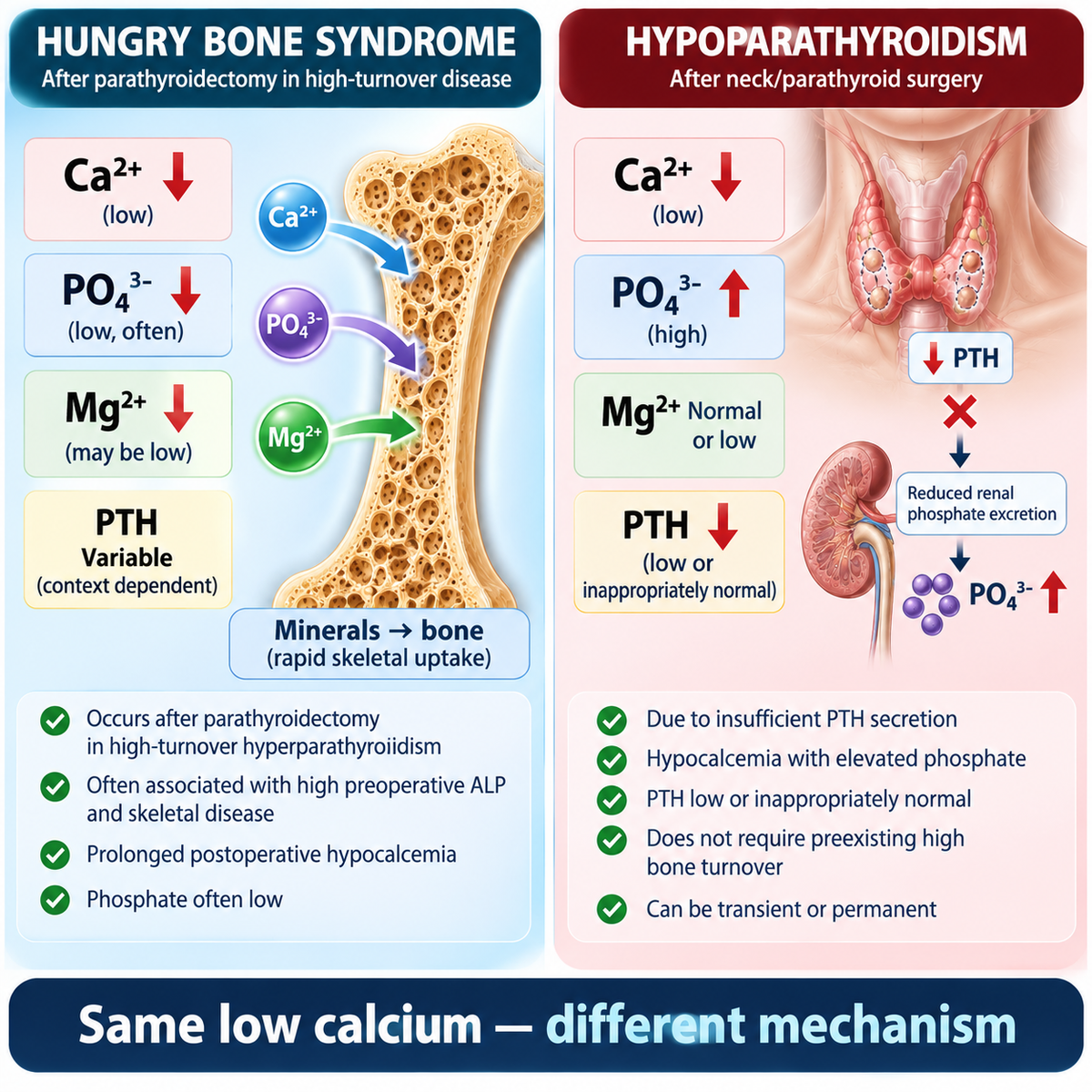
LOW Ca AFTER PARATHYROIDECTOMY IS NOT AUTOMATICALLY HYPOPARATHYROIDISM
What Is Hungry Bone Syndrome?
Central Teaching Pathway
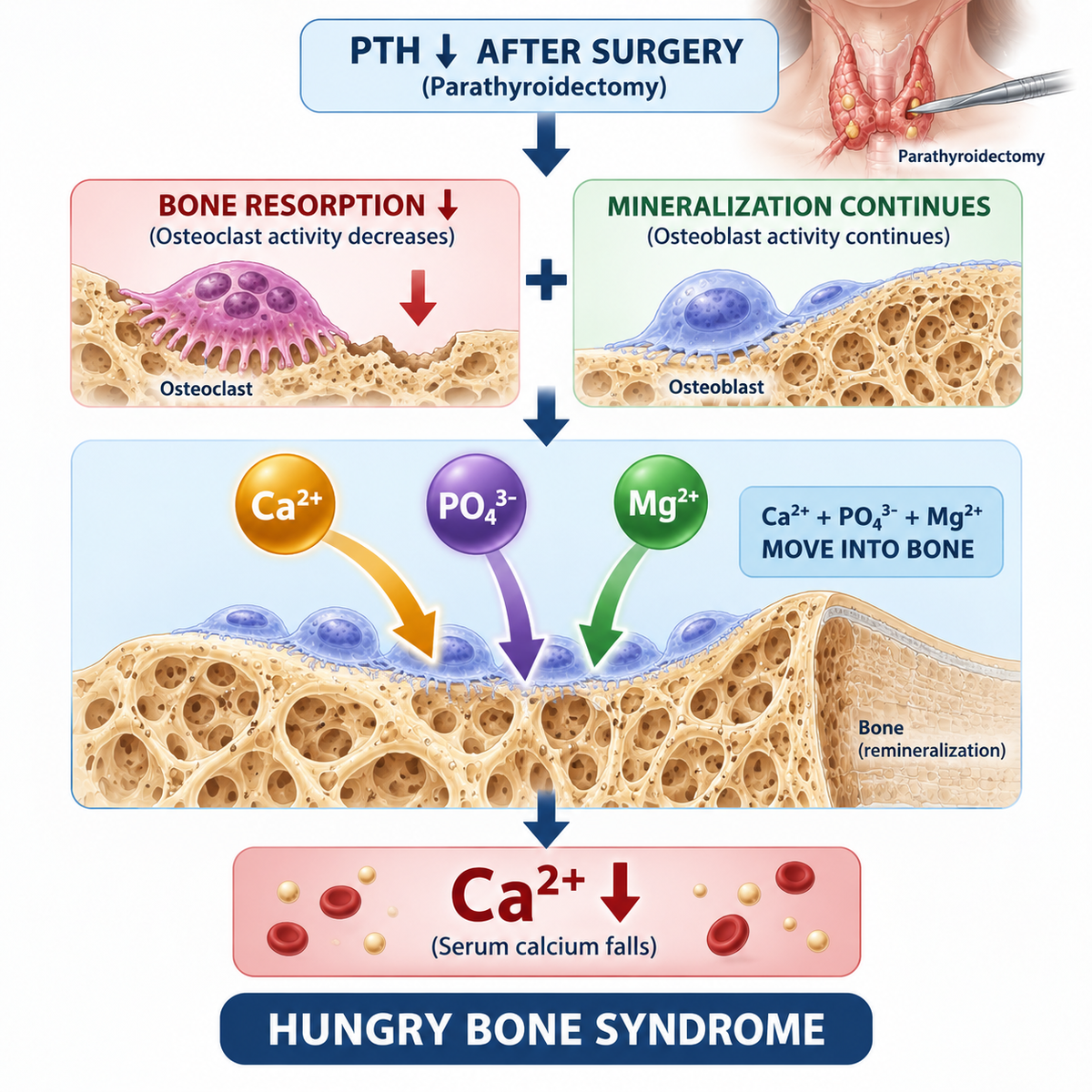
LONG-STANDING HIGH PTH HIGH BONE TURNOVER PARATHYROIDECTOMY PTH FALLS ABRUPTLY BONE RESORPTION FALLSwhile:
BONE FORMATION / MINERALIZATION CONTINUES Ca²⁺ + PO₄ + Mg MOVE INTO BONE PROLONGED POSTOPERATIVE HYPOCALCEMIA HUNGRY BONE SYNDROMEThis rapid skeletal mineral uptake following removal of the hyperparathyroid state is the central pathophysiological concept. It is particularly important after surgery for severe high-turnover hyperparathyroidism. (PubMed Central (PMC))
Central Memory Rule
Use a prominent memory box:
LOW Ca AFTER PARATHYROIDECTOMY IS NOT AUTOMATICALLY HYPOPARATHYROIDISMThen:
Hungry bone syndrome
Ca ↓
PO₄ often ↓
Mg may ↓
ALP often high from preceding high bone turnover
versus:
Postsurgical hypoparathyroidism
Ca ↓
PO₄ ↑
PTH ↓ / inappropriately normal
Final line:
THE PHOSPHATE + PTH PATTERN HELPS SEPARATE THE TWOThe distinction between HBS and postoperative hypoparathyroidism is clinically important, although real postoperative patterns can overlap and HBS definitions vary. (PubMed Central (PMC))
Opening Content
Use the following complete text:
Hungry bone syndrome (HBS) is a metabolic complication most strongly associated with parathyroidectomy in patients who have had substantial preoperative hyperparathyroidism and high bone turnover.
The name describes what happens physiologically.
Before surgery, prolonged excessive PTH can drive markedly increased bone remodeling. After successful parathyroidectomy, circulating PTH may fall abruptly. Osteoclastic bone resorption falls, but bone formation and mineralization can continue.
The skeleton then becomes a powerful sink for minerals.
Calcium moves rapidly from the extracellular fluid into bone. Phosphate and magnesium may also be incorporated into the remineralizing skeleton.
The result can be:
PROFOUND + PROLONGED HYPOCALCEMIAoften accompanied by:
HYPOPHOSPHATEMIAand sometimes:
HYPOMAGNESEMIAThis is hungry bone syndrome.
HBS is particularly important because hypocalcemia after neck surgery has another major explanation:
POSTSURGICAL HYPOPARATHYROIDISMThe two conditions are not identical and should not be diagnosed simply from the presence of a low postoperative calcium.
Is There A Universal Definition?
There is no completely uniform definition of hungry bone syndrome across studies.
A commonly used research/teaching definition describes significant hypocalcemia—often total calcium below approximately 8.4 mg/dL (2.1 mmol/L)—that persists beyond about 4 postoperative days, frequently with hypophosphatemia and/or hypomagnesemia.
However:
HBS SHOULD NOT BE REDUCED TO ONE NUMERICAL CUTOFFDiagnosis requires interpretation of:
- the postoperative calcium trajectory;
- duration of hypocalcemia;
- phosphate;
- magnesium;
- PTH;
- preoperative bone turnover;
- the underlying hyperparathyroid disorder;
- the operation performed.
Current reviews explicitly note the absence of a universally agreed definition. (NCBI)
Normal Postoperative Calcium Fall Versus Hbs
A transient decrease in serum calcium can occur after successful parathyroidectomy.
That alone does not establish HBS.
Think of hungry bone syndrome when the hypocalcemia is:
- more pronounced than expected;
- persistent rather than brief;
- associated with evidence of substantial skeletal mineral uptake;
- occurring in a patient with significant preoperative high-turnover bone disease.
The key concept is:
POSTOPERATIVE HYPOCALCEMIA ≠ AUTOMATICALLY HBSand:
POSTOPERATIVE HYPOCALCEMIA ≠ AUTOMATICALLY HYPOPARATHYROIDISMThe biochemical pattern and clinical context determine the mechanism.
Why Does Hungry Bone Syndrome Occur?
Normal Bone Remodeling
Bone is continuously remodeled through coordinated:
Osteoclastic resorption
Old bone mineral and matrix are removed.
and:
Osteoblastic formation
New osteoid is produced and subsequently mineralized.
Under normal circumstances these processes are coupled.
PTH is one of the major regulators influencing bone remodeling.
Calcium Homeostasis
What Prolonged High Pth Does To Bone
Persistent severe hyperparathyroidism can markedly increase bone turnover.
This means:
BONE RESORPTION ↑and:
BONE FORMATION ↑The skeleton may develop a large remodeling space and substantial mineral deficit.
Severe disease can produce manifestations such as:
- osteitis fibrosa cystica;
- brown tumors;
- skeletal pain;
- fractures;
- reduced skeletal mineralization.
High alkaline phosphatase can reflect increased osteoblastic activity and overall high bone turnover.
Radiological bone disease and markedly elevated ALP are recognized preoperative risk markers for HBS. (OUP Academic)
Internal links where appropriate:
Primary Hyperparathyroidism
Secondary Hyperparathyroidism
CKD-MBD
What Happens After Parathyroidectomy?
Successful removal of the source of excessive PTH produces a major physiological change.
Before surgery:
PTH HIGH HIGH BONE TURNOVERAfter surgery:
PTH FALLS OSTEOCLASTIC RESORPTION FALLSBut osteoblast-driven bone formation and mineralization can continue.
The previously mineral-depleted skeleton now takes up mineral rapidly.
Therefore:
SERUM → BONEwith movement of:
Ca²⁺ PO₄ MgThis is why the term:
HUNGRY BONEis physiologically descriptive.
Modern reviews of HBS after surgery for renal secondary hyperparathyroidism describe precisely this abrupt shift from PTH-driven resorption toward intensive skeletal mineral deposition. (PubMed Central (PMC))
Why Calcium Falls
The major mechanism is:
RAPID SKELETAL CALCIUM UPTAKEThe extracellular calcium pool is small compared with the potential mineral requirement of a severely depleted skeleton.
Therefore a highly active remineralizing skeleton can consume calcium faster than it can be supplied from:
- intestinal absorption;
- supplements;
- extracellular stores.
This can produce profound and prolonged hypocalcemia.
Why Phosphate Falls
Bone mineralization requires both:
CALCIUMand:
PHOSPHATEDuring HBS, phosphate can move from blood into bone.
Therefore:
SERUM PO₄ MAY FALLThis is one of the most useful biochemical clues when distinguishing HBS from hypoparathyroidism.
Why Magnesium May Fall
Magnesium can also move into the remineralizing skeleton.
Therefore:
Mg MAY ↓This matters for a second reason.
Severe hypomagnesemia can impair:
- PTH secretion;
- PTH action.
Therefore magnesium deficiency can further worsen or prolong hypocalcemia.
Use the memory line:
HBS + LOW Mg = HARDER-TO-CORRECT HYPOCALCEMIAHypomagnesemia
Alkaline Phosphatase
ALP is especially useful in understanding HBS risk.
Markedly elevated preoperative ALP can indicate:
HIGH BONE FORMATION / HIGH BONE TURNOVERA skeleton with a large mineralization deficit has greater capacity to take up calcium after surgery.
Therefore:
HIGH PREOPERATIVE ALP = IMPORTANT HBS RISK CLUEBut:
ALP ALONE DOES NOT DIAGNOSE HBSESE expert consensus lists significantly elevated ALP among potential risk factors for HBS. (OUP Academic)
Who Is at Risk?
Who Is At Risk?
Use the following risk-factor section.
Important features associated with increased HBS risk include:
- severe or prolonged hyperparathyroidism;
- high preoperative PTH;
- markedly elevated ALP;
- radiological evidence of hyperparathyroid bone disease;
- osteitis fibrosa cystica;
- brown tumors;
- fractures or severe skeletal disease;
- large parathyroid adenoma/tumor burden in PHPT;
- vitamin D deficiency in some populations;
- severe renal secondary hyperparathyroidism.
The exact strength of individual predictors varies among studies and patient populations.
ESE expert consensus identifies high PTH, large adenoma volume, high calcium, radiological bone disease, elevated ALP and low preoperative 25-OH vitamin D as potential HBS risk factors in PHPT. (OUP Academic)
High Pth As A Risk Marker
A markedly elevated preoperative PTH suggests greater exposure of the skeleton to the effects of hyperparathyroidism.
But:
PTH ALONE IS NOT A PERFECT PREDICTORInterpret it together with:
- ALP;
- skeletal manifestations;
- disease duration/severity;
- renal status;
- the underlying form of hyperparathyroidism.
Primary Hyperparathyroidism And Hbs
HBS can occur after parathyroidectomy for:
PRIMARY HYPERPARATHYROIDISMRisk is particularly relevant in patients with severe skeletal involvement.
Examples include:
- markedly elevated PTH;
- very high ALP;
- osteitis fibrosa cystica;
- brown tumors;
- fractures;
- substantial vitamin D deficiency.
Modern PHPT is often diagnosed earlier, so severe skeletal disease and HBS may be less common in populations where routine biochemical screening is widespread. However, severe presentations continue to occur. (OUP Academic)
Primary Hyperparathyroidism
Secondary Hyperparathyroidism And Ckd
HBS is particularly important following parathyroidectomy for severe:
RENAL SECONDARY HYPERPARATHYROIDISMLong-standing CKD-MBD can produce extremely high bone turnover.
After parathyroidectomy, the skeletal mineral demand may be substantial.
Therefore these patients may require:
- intensive calcium monitoring;
- substantial calcium replacement;
- active vitamin D;
- prolonged biochemical follow-up.
Reported HBS frequency after parathyroidectomy for renal secondary hyperparathyroidism varies greatly because definitions, patient populations and perioperative protocols differ. Do not quote one incidence as universally applicable. (PubMed Central (PMC))
Internal links:
Secondary Hyperparathyroidism
CKD-MBD
Tertiary Hyperparathyroidism
Patients with autonomous hyperparathyroidism arising after prolonged renal secondary hyperparathyroidism may also have substantial skeletal remodeling.
Following parathyroidectomy:
HBS CAN OCCURThe diagnostic principle remains the same:
LOOK AT THE PREOPERATIVE BONE-TURNOVER STATE + POSTOPERATIVE MINERAL TRAJECTORYTiming, Duration and Symptoms
Timing
HBS usually becomes apparent during the early postoperative period.
The calcium decline can continue over several days rather than simply occurring immediately after surgery.
Modern reviews of severe renal SHPT describe the calcium nadir commonly occurring around postoperative days 2–5, although the exact trajectory varies. (PubMed Central (PMC))
Therefore:
A NORMAL OR ACCEPTABLE Ca IMMEDIATELY AFTER SURGERY DOES NOT GUARANTEE THAT HBS WILL NOT DEVELOPSerial monitoring is important in high-risk patients.
How Long Can Hbs Last?
HBS is defined by its prolonged nature compared with the usual brief postoperative calcium fall.
Depending on:
- severity of previous bone disease;
- underlying hyperparathyroidism;
- renal function;
- mineral deficit;
- treatment;
calcium requirements can remain increased for:
WEEKSand sometimes:
MONTHSThe important teaching point is:
RECOVERY IS DYNAMICAs skeletal remineralization progresses, calcium requirements eventually decrease.
Symptoms
Symptoms are those of hypocalcemia and depend on severity and rate of fall.
Possible manifestations include:
- perioral tingling;
- distal paresthesia;
- muscle cramps;
- carpopedal spasm;
- tetany;
- weakness;
- seizures;
- QT prolongation;
- arrhythmia in severe cases.
Severe HBS can therefore become a medical emergency. (PubMed Central (PMC))
Hypocalcemia
Laboratory Findings and PTH Interpretation
Diagnostic Biochemical Pattern
Use a prominent box:
HUNGRY BONE SYNDROMETypical pattern:
Calcium
↓Phosphate
↓ oftenMagnesium
↓ may occurALP
↑ often before surgery / reflecting high turnoverPTH
VARIABLE — INTERPRET IN POSTOPERATIVE CONTEXTWhy Pth Can Be Complicated
PTH after surgery depends on:
- whether one abnormal gland was removed;
- whether multiple glands were removed;
- whether subtotal or total parathyroidectomy was performed;
- residual parathyroid tissue;
- autotransplantation;
- transient gland suppression;
- renal hyperparathyroidism physiology.
Therefore:
PTH IS IMPORTANT, BUT THE ENTIRE POSTOPERATIVE PATTERN MATTERSThis is why a rigid statement that HBS always has “normal PTH” would be misleading across all clinical settings.
Some PHPT research definitions specifically require normal/elevated postoperative PTH to distinguish HBS from postoperative HypoPT, but this should not be generalized to every surgical context. (PubMed Central (PMC))
Hungry Bone Syndrome vs Postsurgical Hypoparathyroidism
Most Important Differential: Postsurgical Hypoparathyroidism
Both conditions can produce:
Ca ↓after neck/parathyroid surgery.
But their physiology differs.
HBS
The problem is:
SKELETAL MINERAL UPTAKEPostsurgical hypoparathyroidism
The problem is:
INSUFFICIENT PTHThis distinction changes interpretation and expected biochemical patterns.
Hungry Bone Syndrome Vs Postsurgical Hypoparathyroidism
| Feature | Hungry bone syndrome | Postsurgical hypoparathyroidism |
|---|---|---|
| Calcium | ↓ | ↓ |
| Main mechanism | Rapid skeletal mineral uptake | PTH deficiency |
| Phosphate | Often ↓ | Usually ↑ |
| Magnesium | May ↓ | May be normal or ↓ |
| PTH | Variable/context-dependent | Low or inappropriately normal |
| Preoperative ALP | Often markedly ↑ in high-risk disease | Not required |
| Preoperative bone disease | Often present in severe cases | Not required |
| Typical context | High-turnover HPT followed by PTX | Parathyroid removal/injury/dysfunction |
| Duration | Can be prolonged | Transient or chronic depending gland recovery |
| Core clue | Bone avidly taking up mineral | Inadequate PTH response |
Below table:
PO₄ LOW → THINK SKELETAL UPTAKE PO₄ HIGH + PTH LOW → THINK HYPOPARATHYROIDISMBut add:
No single laboratory value should be used alone; postoperative patterns can overlap.
Why Phosphate Differs
This deserves its own section because it is highly educational.
HBS
Phosphate:
MOVES INTO BONEtherefore:
PO₄ ↓Hypoparathyroidism
Loss of PTH reduces renal phosphaturia.
Therefore:
RENAL PHOSPHATE RETENTION ↑ PO₄ ↑Thus:
THE SAME LOW CALCIUM CAN HAVE OPPOSITE PHOSPHATE PATTERNSThis is one of the best examples of using physiology rather than memorizing diagnoses.
Phosphate Homeostasis
Other Differential Diagnoses
Postoperative hypocalcemia may also be influenced by:
- vitamin D deficiency;
- hypomagnesemia;
- renal dysfunction;
- citrate exposure if major transfusion occurred;
- medications;
- acute critical illness.
Therefore HBS should not become a catch-all diagnosis for every low calcium after surgery.
Diagnostic Approach
Implement the following responsive algorithm.
HYPOCALCEMIA AFTER PARATHYROID / NECK SURGERY SEVERE OR SYMPTOMATIC?YES
→ urgent calcium management + ECG/clinical monitoring
and simultaneously:
CHECKCa / ionized Ca
PO₄
Mg
PTH
renal function
PTH LOW / INAPPROPRIATELY NORMAL + PO₄ HIGH→ POSTSURGICAL HYPOPARATHYROIDISM
PO₄ LOW + HIGH PREOPERATIVE BONE TURNOVERespecially:
ALP ↑ / severe HPT / skeletal disease
HUNGRY BONE SYNDROME MONITOR SERIAL Ca / PO₄ / Mg REPLACE MINERAL + ACTIVE VITAMIN D AS NEEDED REDUCE REPLACEMENT AS BONE HUNGER RESOLVESPreoperative Assessment
Preoperative Assessment
In a patient undergoing parathyroidectomy for severe hyperparathyroidism, assess HBS risk before surgery.
Important information includes:
- serum calcium;
- phosphate;
- magnesium;
- PTH;
- ALP;
- renal function;
- 25-OH vitamin D;
- evidence of skeletal disease;
- severity/duration of hyperparathyroidism.
The purpose is not necessarily to calculate a formal score.
The purpose is:
IDENTIFY THE PATIENT WHO MAY REQUIRE INTENSIVE POSTOPERATIVE MINERAL MONITORINGVitamin D Before Surgery
Vitamin D deficiency can coexist with hyperparathyroidism and may contribute to skeletal demineralization.
Low preoperative 25-OH vitamin D has been identified as a potential HBS risk factor in PHPT expert consensus. (OUP Academic)
However:
DO NOT INVENT A UNIVERSAL PREOPERATIVE VITAMIN D LOADING PROTOCOLManagement depends on the underlying disease, calcium status, renal function and surgical context.
Vitamin D Deficiency
Postoperative Monitoring
High-risk patients require serial monitoring.
Monitor as clinically appropriate:
- serum calcium;
- ionized calcium when needed;
- phosphate;
- magnesium;
- PTH;
- renal function.
The frequency depends on:
- severity;
- symptoms;
- rate of calcium decline;
- IV calcium requirement;
- renal function;
- surgical setting.
Treatment of Hungry Bone Syndrome
Treatment Goals
Treatment has several goals:
1. PREVENT/TREAT SYMPTOMATIC HYPOCALCEMIA 2. SUPPLY THE REMINERALIZING SKELETON 3. CORRECT Mg WHEN NEEDED 4. USE ACTIVE VITAMIN D TO SUPPORT Ca ABSORPTION 5. MONITOR PO₄ RATHER THAN IGNORING IT 6. REDUCE THERAPY AS BONE HUNGER RESOLVESTreatment requirements can be substantial and highly individualized. (NCBI)
Calcium Replacement
Calcium is the central replacement therapy.
Depending on severity, calcium may be given:
- orally;
- intravenously;
- or using both during transition.
Use:
MILD/STABLE → ORAL Ca MAY BE SUFFICIENT SEVERE/SYMPTOMATIC → IV Ca MAY BE REQUIREDSevere Symptomatic Hypocalcemia
If the patient develops:
- tetany;
- seizure;
- significant arrhythmia;
- severe symptomatic hypocalcemia;
urgent treatment is required.
Use:
IV CALCIUMtypically:
CALCIUM GLUCONATEwith:
- clinical monitoring;
- ECG monitoring when indicated;
- repeated biochemical assessment.
Oral Calcium
As the patient becomes stable, oral calcium becomes important for ongoing replacement.
Requirements may be considerably greater than ordinary nutritional calcium intake while the skeleton is rapidly remineralizing.
However:
CALCIUM REQUIREMENT IS DYNAMICAs HBS resolves:
REQUIREMENT FALLSTherefore therapy must be reassessed rather than left indefinitely at the maximum postoperative dose.
Active Vitamin D
Active vitamin D supports intestinal calcium absorption.
Commonly used active vitamin D therapy includes:
CALCITRIOLor an appropriate active vitamin D analogue according to local practice and renal context.
Active vitamin D is particularly important when rapid and reliable support of calcium absorption is needed.
Modern reviews identify calcium plus calcitriol as central HBS treatment. (PubMed Central (PMC))
Why Ordinary Vitamin D Alone May Not Be Enough Acutely
Nutritional vitamin D status should be corrected when deficient.
But severe HBS often requires active vitamin D because:
- calcium demand is immediate;
- calcitriol acts directly at the active-hormone level;
- CKD may impair renal activation of vitamin D.
Therefore distinguish:
Nutritional vitamin D
for vitamin D stores/deficiency
from:
Active vitamin D
for active hormonal support of calcium absorption in appropriate HBS management.
Vitamin D Metabolism
Magnesium Treatment
If:
Mg ↓correct it.
Reasons:
- magnesium itself is being depleted;
- severe magnesium deficiency can impair PTH secretion;
- magnesium deficiency can cause PTH resistance;
- hypocalcemia may therefore become more difficult to correct.
Use:
PERSISTENT HYPOCALCEMIA → CHECK MgWhat About Phosphate?
This requires careful wording.
HBS can produce hypophosphatemia because phosphate enters bone.
However:
DO NOT AUTOMATICALLY GIVE LARGE PHOSPHATE LOADSespecially in patients with:
- CKD;
- severe hypocalcemia.
Why?
Excess phosphate can:
- complex with calcium;
- further lower ionized calcium;
- increase calcium-phosphate precipitation risk;
- accumulate when renal excretion is impaired.
Therefore:
MONITOR PHOSPHATEand individualize management of clinically important hypophosphatemia according to renal function and severity.
Contemporary renal-HBS literature emphasizes cautious phosphate management, particularly because many affected patients cannot excrete phosphate normally. (PubMed Central (PMC))
Hungry Bone Syndrome in Dialysis Patients
Patients with advanced CKD require additional considerations.
Management may involve coordinated adjustment of:
- calcium replacement;
- active vitamin D;
- dialysis prescription;
- dialysate calcium;
- phosphate management.
This must be individualized with nephrology involvement.
Recovery and Tapering Treatment
Why Calcium Requirements Eventually Decrease
The skeleton cannot remain indefinitely “hungry.”
Over time:
MINERALIZATION DEFICIT IS REPAIRED SKELETAL Ca UPTAKE FALLS SERUM Ca STABILIZES SUPPLEMENT REQUIREMENT FALLSTherefore continued high replacement without reassessment can eventually cause:
HYPERCALCEMIAUse the memory line:
HBS TREATMENT MUST BE TITRATED DOWN DURING RECOVERYRecovery Phase
Signs of recovery include:
- stable calcium with progressively less supplementation;
- stabilization of phosphate;
- stabilization of magnesium;
- falling calcium requirement;
- evolution of bone-turnover markers.
The clinical trend matters.
Can Hbs Be Prevented?
Use cautious wording.
HBS cannot always be prevented.
However, preoperative recognition of high-risk patients allows:
- correction of important vitamin D deficiency when appropriate;
- planning for postoperative monitoring;
- early calcium/active vitamin D strategies according to local protocol;
- coordination among surgery, endocrinology and nephrology where relevant.
A 2025 systematic review in advanced CKD found that interventions intended to reduce post-parathyroidectomy hypocalcemia have been studied, but the evidence base remains heterogeneous; therefore do not claim one universal prevention protocol. (PubMed Central (PMC))
Does Hbs Mean The Surgery Failed?
NOHBS can occur precisely because the hyperparathyroid state has been successfully corrected.
The postoperative mineral shift reflects the skeleton responding to the abrupt change in PTH-driven bone turnover.
Therefore:
HBS ≠ FAILED PARATHYROIDECTOMYDoes Hbs Mean All Parathyroid Function Has Been Lost?
NOThat describes a different mechanism.
HBS is fundamentally:
SKELETAL MINERAL UPTAKEwhereas postoperative hypoparathyroidism is:
INADEQUATE PTH FUNCTIONThe two can occasionally coexist or be difficult to separate early, which is why serial biochemical interpretation matters.
Worked Clinical Cases
Use all 12.
Case 1 — Classic PHPT-associated HBS
Patient with severe PHPT has:
- markedly elevated preoperative PTH;
- very high ALP;
- skeletal pain;
- parathyroidectomy.
Several days later:
- Ca ↓;
- PO₄ ↓;
- Mg mildly ↓.
Interpretation
HUNGRY BONE SYNDROMEReason
High preoperative bone turnover followed by prolonged postoperative mineral uptake.
Case 2 — Ordinary early postoperative calcium fall
Patient after uncomplicated parathyroidectomy:
- mild Ca reduction on day 1;
- asymptomatic;
- calcium stabilizes rapidly.
Interpretation
DO NOT LABEL EVERY POSTOPERATIVE Ca FALL AS HBSHBS implies a more substantial/prolonged mineral shift.
Case 3 — Postsurgical hypoparathyroidism
Patient after neck surgery:
- Ca ↓;
- PO₄ ↑;
- PTH very low.
Interpretation
POSTSURGICAL HYPOPARATHYROIDISMnot classic HBS.
Key clue
PO₄ ↑ + PTH ↓Case 4 — Phosphate distinguishes the mechanism
Two patients both have:
Ca = 7.5 mg/dLPatient A:
PO₄ low
Patient B:
PO₄ high + PTH low
Interpretation
Patient A, with appropriate high-turnover postoperative context:
→ HBS more likely
Patient B:
→ Hypoparathyroidism more likely
Lesson
THE CALCIUM VALUE ALONE DOES NOT IDENTIFY THE CAUSECase 5 — Severe renal secondary HPT
Dialysis patient has:
- very high preoperative PTH;
- markedly high ALP;
- severe skeletal disease.
After parathyroidectomy:
- profound persistent Ca ↓;
- PO₄ falls;
- large calcium requirement.
Interpretation
SEVERE HBS AFTER PTX FOR RENAL SHPTThis is an important high-risk population.
Case 6 — Magnesium complicating recovery
Patient with HBS receives calcium but calcium remains difficult to stabilize.
Mg is markedly low.
Interpretation
HYPOCALCEMIA IS BEING COMPOUNDED BY HYPOMAGNESEMIAAction principle
CORRECT Mg AS WELL AS CaCase 7 — High ALP before surgery
PHPT patient:
- ALP markedly elevated;
- PTH high;
- radiological bone disease.
Question
Is HBS guaranteed?
Answer
NOBut the patient has important risk features and warrants appropriate postoperative monitoring.
Case 8 — Normal immediate postoperative calcium
High-risk patient has normal calcium several hours after surgery.
Wrong conclusion
“HBS excluded.”
Correct conclusion
HBS MAY EVOLVE OVER THE NEXT SEVERAL DAYSSerial calcium monitoring remains important.
Case 9 — Symptomatic severe HBS
Patient develops:
- carpopedal spasm;
- profound hypocalcemia;
- QT prolongation.
Principle
URGENT IV CALCIUM + MONITORINGwhile correcting associated abnormalities and continuing cause-specific management.
Case 10 — Hypophosphatemia in CKD
Dialysis patient with HBS develops low phosphate.
Wrong action
Automatically administer a large phosphate load.
Correct principle
ASSESS SEVERITY + RENAL FUNCTION + Ca × PO₄ CONSEQUENCESand individualize phosphate management.
Case 11 — Recovery and overtreatment
Several weeks after severe HBS:
- skeletal mineral demand has decreased;
- patient remains on the same very high calcium/active vitamin D regimen;
- serum calcium rises.
Interpretation
HBS IS RESOLVING BUT TREATMENT HAS NOT BEEN REDUCEDLesson
REPLACEMENT MUST FOLLOW THE CHANGING PHYSIOLOGYCase 12 — HBS does not mean failed surgery
Patient develops profound HBS after successful removal of a large parathyroid adenoma.
PTH excess has resolved.
Question
Did the operation fail?
Answer
NOThe postoperative hypocalcemia reflects skeletal remineralization after correction of the previous hyperparathyroid state.
Common Mistakes
Include all 20.
Mistake 1
Every low calcium after parathyroidectomy is HBS.
Wrong.
Mistake 2
Every low calcium after neck surgery is hypoparathyroidism.
Wrong.
Mistake 3
HBS has one universally accepted numerical definition.
Wrong.
Mistake 4
HBS is simply failure of the parathyroid glands.
Wrong.
Mistake 5
HBS occurs because bone resorption suddenly increases.
Wrong. The major shift is toward skeletal mineral deposition after the previous high-PTH state is corrected.
Mistake 6
Phosphate is irrelevant.
Wrong.
Mistake 7
Phosphate should always be high when calcium is low.
Wrong.
Mistake 8
HBS and HypoPT have identical phosphate patterns.
Wrong.
Mistake 9
PTH alone always distinguishes HBS.
Wrong.
Mistake 10
ALP diagnoses HBS.
Wrong.
Mistake 11
Very high ALP before surgery guarantees HBS.
Wrong.
Mistake 12
A normal calcium immediately after surgery excludes HBS.
Wrong.
Mistake 13
Magnesium can be ignored.
Wrong.
Mistake 14
Every low phosphate should automatically receive aggressive phosphate replacement.
Wrong.
Mistake 15
Nutritional vitamin D and calcitriol are interchangeable concepts.
Wrong.
Mistake 16
Calcium requirements remain constant throughout HBS.
Wrong.
Mistake 17
A patient who needed very high calcium initially should remain indefinitely on the same amount.
Wrong.
Mistake 18
HBS means parathyroid surgery failed.
Wrong.
Mistake 19
HBS occurs only after PHPT surgery.
Wrong. It is particularly important after surgery for severe renal SHPT as well.
Mistake 20
Treatment is more important than identifying the biochemical mechanism.
Wrong. Severe hypocalcemia requires immediate treatment, but mechanism determines ongoing management.
Hungry Bone Syndrome in One Minute
One-Minute Revision
HUNGRY BONE SYNDROME IN ONE MINUTE
SEVERE HYPERPARATHYROIDISM HIGH BONE TURNOVER PARATHYROIDECTOMY PTH ↓ RAPIDLY BONE RESORPTION ↓but:
BONE FORMATION / MINERALIZATION CONTINUES BONE TAKES UPCa²⁺ + PO₄ + Mg
Ca ↓↓↓ PO₄ ↓ often Mg ↓ sometimes HUNGRY BONE SYNDROMERisk clues:
PTH ↑↑ + ALP ↑↑ + SKELETAL DISEASETreatment principles:
Ca + ACTIVE VITAMIN D ± Mgwith:
SERIAL MONITORINGand:
TAPER AS BONE HUNGER RESOLVESGolden Comparison
AFTER PARATHYROID SURGERYCa ↓ + PO₄ ↓ + high-turnover context
THINK HUNGRY BONECa ↓ + PO₄ ↑ + PTH ↓
THINK HYPOPARATHYROIDISMThen:
PHYSIOLOGY > MEMORIZATIONFrequently Asked Questions
What is hungry bone syndrome?
Hungry bone syndrome is prolonged postoperative hypocalcemia caused mainly by rapid skeletal mineral uptake after correction of a high-turnover hyperparathyroid state.
Why is it called hungry bone syndrome?
After parathyroidectomy, previously mineral-depleted high-turnover bone can rapidly take up calcium and other minerals, making the skeleton behave as if it is “hungry” for mineral.
When does HBS occur?
It most characteristically occurs after parathyroidectomy for significant hyperparathyroidism, particularly when preoperative bone turnover is high.
Is every low calcium after parathyroidectomy HBS?
No. A transient postoperative calcium fall is common, and postsurgical hypoparathyroidism is another important cause.
What happens to phosphate in HBS?
Phosphate commonly falls because phosphate is incorporated into remineralizing bone.
What happens to magnesium?
Magnesium may also fall, and significant hypomagnesemia can further impair PTH secretion and action.
What happens to PTH in HBS?
PTH depends on the operation and residual parathyroid function. It should be interpreted in the complete postoperative context rather than using one universal HBS PTH pattern.
How is HBS different from postsurgical hypoparathyroidism?
HBS is caused by skeletal mineral uptake and often has low phosphate, whereas postsurgical hypoparathyroidism is caused by insufficient PTH and typically has high phosphate with low or inappropriately normal PTH.
What predicts HBS?
High preoperative bone turnover is important. Markedly elevated ALP, severe hyperparathyroidism, high PTH and significant skeletal disease are useful risk clues.
Can HBS occur in dialysis patients?
Yes. It is particularly important after parathyroidectomy for severe renal secondary hyperparathyroidism.
How is HBS treated?
Treatment centers on calcium replacement, active vitamin D, correction of magnesium when needed and close biochemical monitoring. Requirements are individualized and may be substantial.
Does every patient need IV calcium?
No. IV calcium is used when hypocalcemia is severe or symptomatic; stable patients may be managed with oral replacement according to clinical requirements.
Should low phosphate always be aggressively replaced?
No. Phosphate management must consider severity, calcium and renal function, particularly in CKD, because excessive phosphate can worsen calcium-phosphate balance.
How long does HBS last?
Duration varies. Severe disease can require increased calcium and active vitamin D for weeks or sometimes months while skeletal remineralization proceeds.
Does HBS mean the parathyroid operation failed?
No. HBS can occur after successful correction of hyperparathyroidism because the skeleton rapidly begins replenishing its mineral deficit.
Key Take-Home Messages
Hungry bone syndrome is best understood as a dramatic change in bone physiology after correction of hyperparathyroidism.
Before surgery:
PTH ↑drives:
HIGH BONE TURNOVERand can leave the skeleton with a substantial mineral deficit.
After successful parathyroidectomy:
PTH FALLSand bone resorption falls rapidly.
However, bone formation and mineralization continue.
The skeleton therefore begins to take up:
CALCIUM PHOSPHATEand:
MAGNESIUMfrom the extracellular fluid.
The result can be:
PROFOUND + PROLONGED HYPOCALCEMIAThe most important clinical mistake is to assume that every postoperative low calcium represents hypoparathyroidism.
Instead ask:
WHAT IS THE PHOSPHATE? WHAT IS THE PTH? WHAT WAS THE PREOPERATIVE BONE-TURNOVER STATE? WHAT IS THE CALCIUM TRAJECTORY?A patient with severe preoperative hyperparathyroidism, markedly elevated ALP and skeletal disease who develops prolonged hypocalcemia with falling phosphate has a very different physiological problem from a patient with low calcium, high phosphate and an inappropriately low postoperative PTH.
The first patient has a skeleton avidly taking up mineral.
The second has inadequate PTH activity.
Therefore:
LOW Ca AFTER SURGERY → DO NOT STOP AT THE CALCIUMInstead:
Ca → PO₄ → Mg → PTH → ALP / PREOPERATIVE BONE TURNOVER → CLINICAL CONTEXTTreatment follows the physiology:
CALCIUM + ACTIVE VITAMIN D + Mg WHEN NEEDEDwith repeated biochemical monitoring and progressive reduction of replacement as skeletal mineral demand resolves.
Final memory statement:
HUNGRY BONE = THE SKELETON BECOMES THE MINERAL SINK