Autonomy after prolonged compensation
Tertiary hyperparathyroidism is a state of excessive PTH secretion that develops after prolonged secondary hyperparathyroidism, most characteristically in patients with advanced chronic kidney disease.
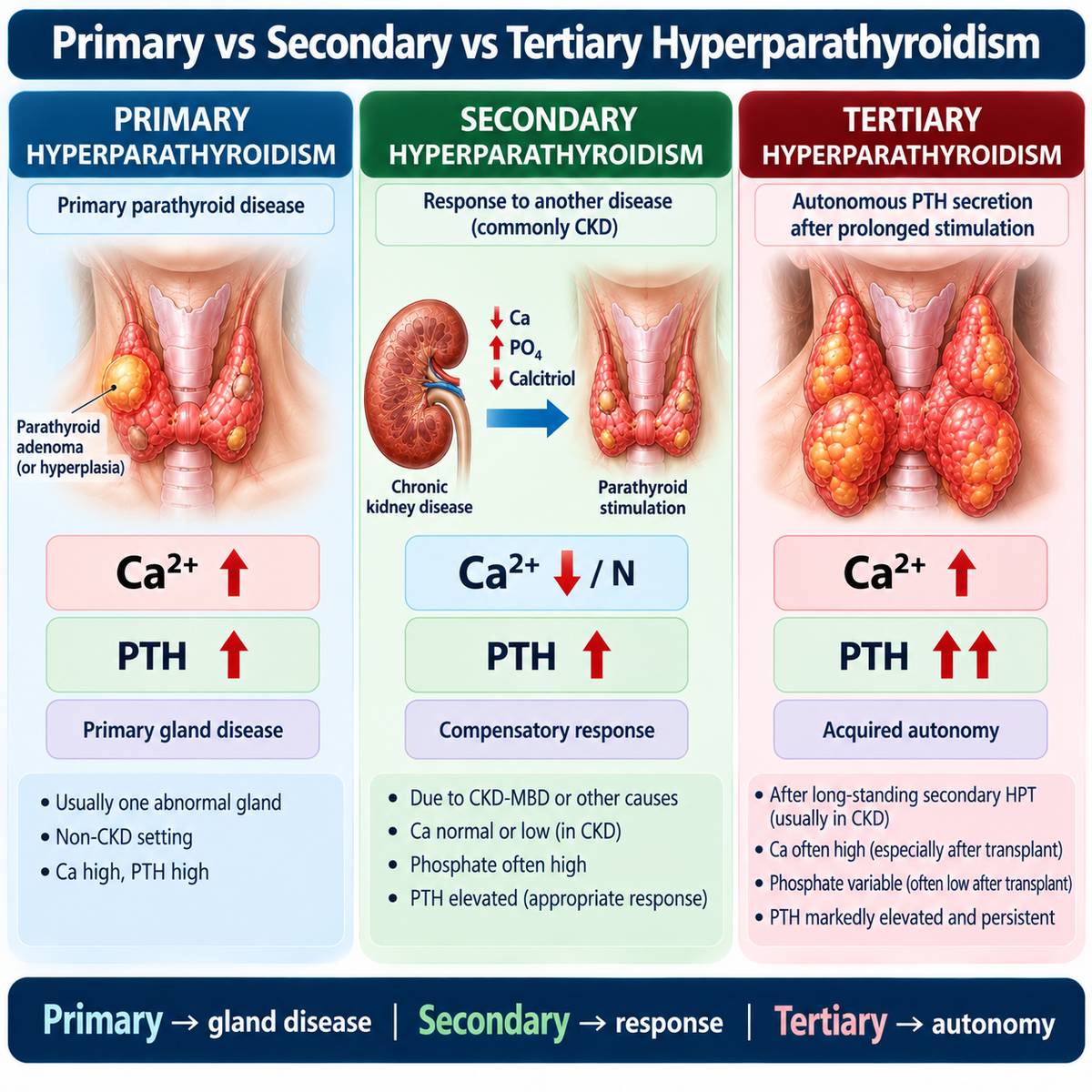
SECONDARY = COMPENSATION · TERTIARY = AUTONOMY AFTER PROLONGED COMPENSATION · PRIMARY = PRIMARY PARATHYROID DISEASE
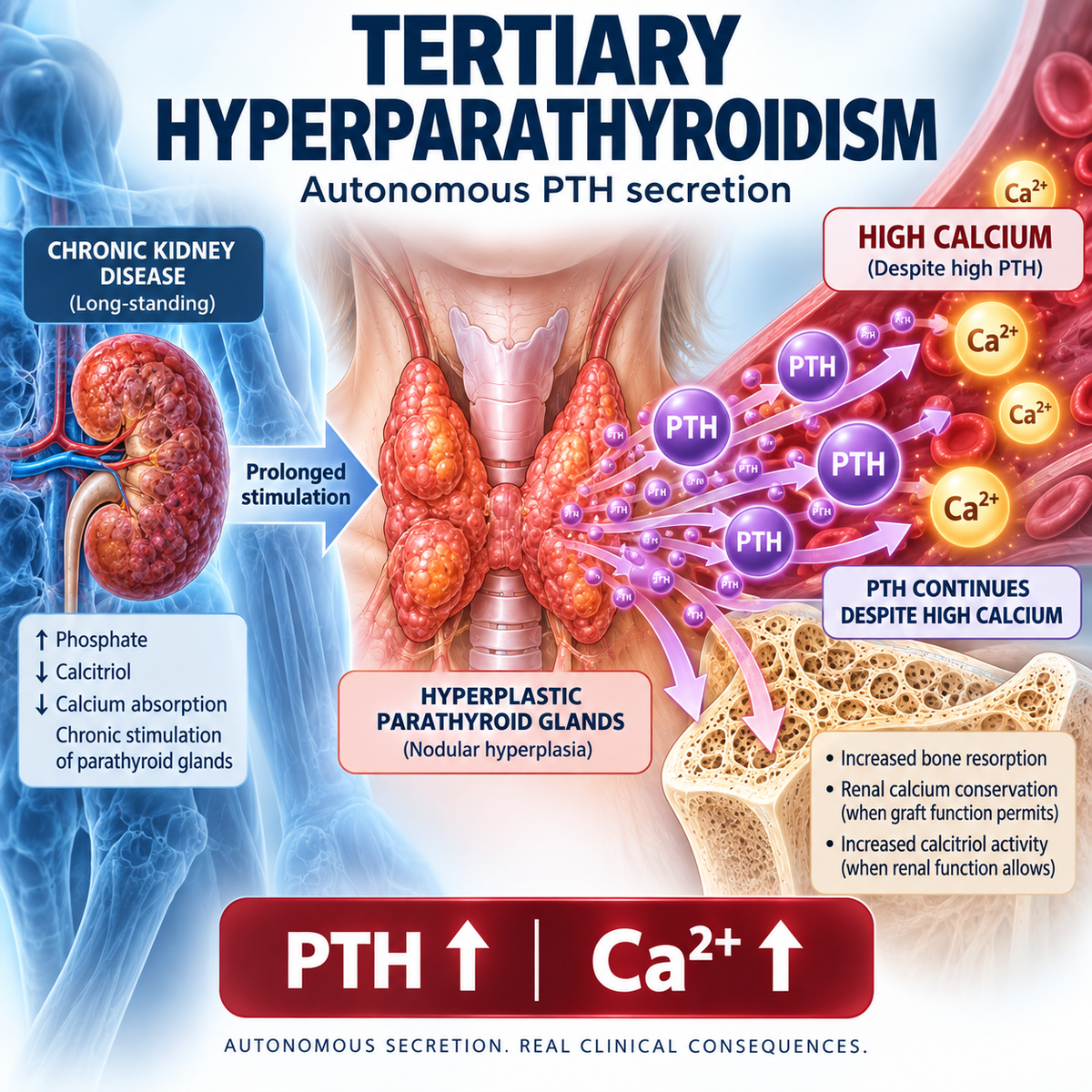
What Is Tertiary Hyperparathyroidism?
Central Concept
CKDPhosphate retention + calcitriol ↓ + disturbed Ca balance
SECONDARY HYPERPARATHYROIDISMPersistent parathyroid stimulation
PARATHYROID HYPERPLASIAProgressive loss of normal feedback sensitivity
AUTONOMOUS / SEMI-AUTONOMOUS PTH SECRETION TERTIARY HYPERPARATHYROIDISMoften:
PTH ↑↑ + Ca ↑The defining concept is:
THE ORIGINAL STIMULUS NO LONGER FULLY CONTROLS PTH SECRETIONProlonged CKD-associated SHPT can produce increasingly autonomous parathyroid hyperplasia; this may persist after kidney transplantation despite major correction of the original CKD-related biochemical stimulus. (MDPI)
Central Memory Rule
Use a prominent callout:
Secondary hyperparathyroidism
PTH HIGH BECAUSE THE BODY IS RESPONDINGTertiary hyperparathyroidism
PTH REMAINS EXCESSIVE AFTER THE RESPONSE BECOMES AUTONOMOUSPrimary hyperparathyroidism
THE PARATHYROID GLAND ITSELF WAS THE PRIMARY PROBLEM FROM THE BEGINNINGFinal line:
SECONDARY = COMPENSATION TERTIARY = AUTONOMY AFTER PROLONGED COMPENSATION PRIMARY = PRIMARY PARATHYROID DISEASEOpening Article Content
Use the following complete content.
Tertiary hyperparathyroidism is a state of excessive PTH secretion that develops after prolonged secondary hyperparathyroidism, most characteristically in patients with advanced chronic kidney disease.
Initially, increased PTH in CKD is an adaptive response.
The kidneys become progressively less able to maintain normal phosphate and vitamin D physiology. Reduced calcitriol activity, phosphate abnormalities and disturbances in calcium balance stimulate the parathyroid glands.
The result is:
SECONDARY HYPERPARATHYROIDISMAt this stage, the increased PTH is fundamentally a response to another disease.
However, persistent stimulation over years can produce progressive parathyroid enlargement and hyperplasia.
Eventually, some enlarged parathyroid tissue becomes much less responsive to the normal regulatory signals that should suppress PTH secretion.
The result is:
PERSISTENT EXCESSIVE PTH SECRETIONthat can continue even when the original stimulus has been substantially corrected.
This state is traditionally called:
TERTIARY HYPERPARATHYROIDISMThe classic clinical example is a patient with long-standing CKD-associated secondary hyperparathyroidism who receives a functioning kidney transplant but continues to have:
PTH ↑and develops or maintains:
HYPERCALCEMIAbecause enlarged parathyroid glands continue secreting excessive PTH despite improved renal physiology. (MDPI)
Important Terminology Warning
Include this section early.
The terminology is not completely uniform.
Terms used in the literature include:
- tertiary hyperparathyroidism;
- persistent hyperparathyroidism after kidney transplantation;
- persistent post-transplant hyperparathyroidism;
- hypercalcemic post-transplant hyperparathyroidism.
These terms overlap but are not necessarily identical.
Persistent PTH elevation after transplantation does not automatically prove complete parathyroid autonomy.
Some secondary hyperparathyroidism gradually regresses after successful transplantation.
Therefore:
DO NOT DIAGNOSE TERTIARY HPT FROM ONE HIGH PTH RESULT AFTER TRANSPLANTATIONInterpret:
- calcium;
- phosphate;
- renal graft function;
- PTH trajectory;
- time since transplantation;
- previous severity of SHPT;
- medication exposure.
Recent literature continues to emphasize heterogeneous definitions of persistent and tertiary post-transplant HPT. (PubMed Central (PMC))
How CKD Causes Secondary Hyperparathyroidism
Start With Normal Pth Physiology
PTH is secreted by the parathyroid glands in response to changes in extracellular ionized calcium.
When calcium falls:
PTH ↑PTH acts to defend extracellular calcium by:
- increasing renal calcium reabsorption;
- decreasing renal phosphate reabsorption;
- increasing phosphaturia;
- stimulating renal calcitriol production when renal function permits;
- influencing bone remodeling.
When calcium rises:
PTH SHOULD FALLThis feedback relationship is essential for understanding tertiary HPT.
Calcium Homeostasis
What Happens In Ckd?
As kidney function declines, several abnormalities contribute to secondary HPT.
These include:
- altered phosphate handling;
- reduced renal calcitriol production;
- impaired intestinal calcium absorption through reduced active vitamin D activity;
- changes in FGF23 physiology;
- disturbances in calcium balance;
- progressive parathyroid stimulation.
The result is:
PTH ↑Initially this is:
A COMPENSATORY RESPONSEnot autonomous parathyroid disease.
Internal links:
CKD-MBD
Secondary Hyperparathyroidism
Vitamin D Metabolism
Phosphate Homeostasis
Secondary Hyperparathyroidism
Secondary hyperparathyroidism occurs when an external physiological disturbance chronically stimulates otherwise appropriately responding parathyroid tissue.
In CKD:
CKD-MBD PARATHYROID STIMULATION PTH ↑The gland is responding to the metabolic environment.
Therefore:
HIGH PTH ≠ AUTOMATICALLY PRIMARY OR TERTIARY HPTKDIGO recommends interpreting PTH together with calcium, phosphate and the broader CKD-MBD pattern rather than reacting to one isolated PTH measurement. (KDIGO)
How Secondary HPT Becomes Autonomous
Why The Parathyroid Glands Enlarge
Persistent stimulation causes:
PARATHYROID CELL PROLIFERATION GLANDULAR HYPERPLASIAInitially this can be relatively diffuse.
With prolonged severe disease, enlarged glands may develop:
NODULAR HYPERPLASIAand increasingly abnormal regulation.
The important concept is:
THE GLANDS ADAPT STRUCTURALLY TO YEARS OF STIMULATIONThis is not simply a temporary increase in hormone release.
Progressive Resistance To Normal Feedback
As severe SHPT progresses, parathyroid tissue can become less responsive to regulatory signals.
Important mechanisms include reduced responsiveness involving:
CaSR — CALCIUM-SENSING RECEPTORand:
VDR — VITAMIN D RECEPTORThe result is progressively more difficult suppression of PTH.
This helps explain why advanced disease may become resistant to conventional medical treatment and eventually behave autonomously.
From Secondary To Tertiary Hpt
Stage 1
CKD-MBDstimulates PTH.
Stage 2
SECONDARY HPTPTH is elevated as compensation.
Stage 3
Persistent stimulation causes:
PARATHYROID HYPERPLASIAStage 4
Advanced hyperplastic tissue becomes:
LESS RESPONSIVE TO Ca / VITAMIN-D FEEDBACKStage 5
PTH secretion becomes increasingly:
AUTONOMOUSStage 6
Even after major correction of the original stimulus:
PTH REMAINS EXCESSIVEoften causing:
HYPERCALCEMIAThis is the conceptual transition to:
TERTIARY HYPERPARATHYROIDISM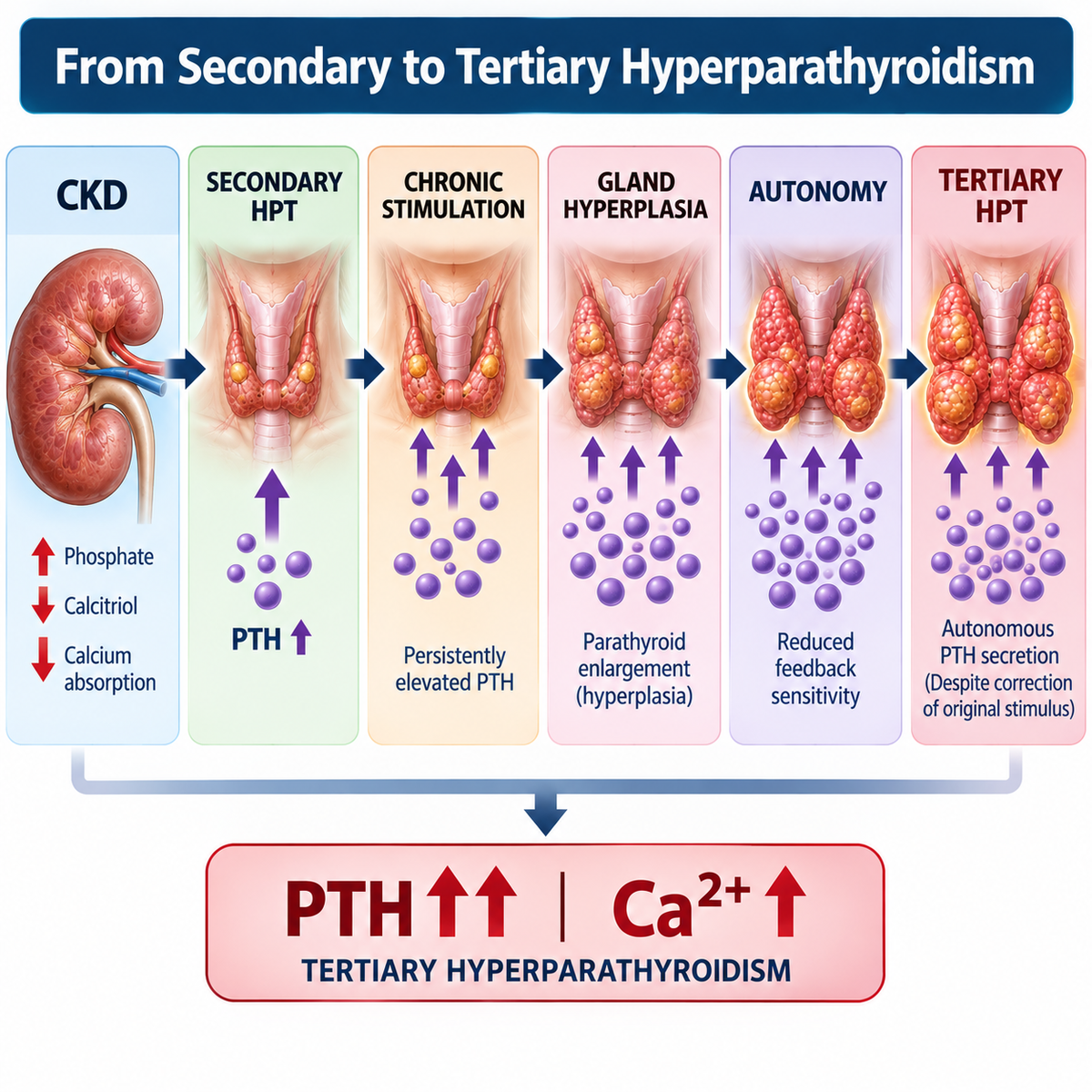
Why Kidney Transplantation Reveals Tertiary HPT
Why Kidney Transplantation Reveals Tertiary Hpt
This is one of the most important sections.
Before transplantation, a patient may have:
CKD G5D PHOSPHATE / CALCITRIOL / Ca DISTURBANCE PTH ↑↑After successful kidney transplantation:
RENAL FUNCTION IMPROVESphosphate handling improves
calcitriol physiology improves
uremic abnormalities improve.
Therefore:
PTH SHOULD TEND TO FALLIn many patients, parathyroid hyperplasia gradually regresses.
But in some patients:
ENLARGED / NODULAR PARATHYROID TISSUE PERSISTS PTH REMAINS EXCESSIVE Ca RISESThis is the classic post-transplant tertiary HPT phenotype. (PubMed Central (PMC))
Why Hypercalcemia Develops
In ordinary CKD-associated secondary HPT, calcium may be normal or low because the elevated PTH is responding to disturbed mineral physiology.
In tertiary HPT:
PTH SECRETION BECOMES EXCESSIVE RELATIVE TO CaTherefore PTH can drive:
- renal calcium conservation when graft function permits;
- increased calcitriol-mediated intestinal calcium availability;
- increased skeletal calcium mobilization.
The result may be:
HYPERCALCEMIAThus:
HIGH Ca + HIGH PTHafter prolonged renal secondary HPT strongly raises concern for autonomous parathyroid secretion.
Why Phosphate May Become Low After Transplantation
This is an important teaching point.
Before transplantation:
CKD may produce:
PO₄ ↑because renal phosphate excretion is impaired.
After successful transplantation:
renal phosphate excretion improves.
If PTH remains markedly elevated:
PTH → PHOSPHATURIA ↑Therefore:
PO₄ ↓can occur.
So the same patient may transition from:
Before transplant
PTH ↑ + PO₄ ↑
to:
After functioning transplant with persistent PTH excess
PTH ↑ + PO₄ ↓
This is not contradictory.
It reflects restoration of the kidney's ability to respond to the phosphaturic action of PTH. Persistent tertiary HPT after transplantation has classically been associated with hypercalcemia and hypophosphatemia. (PubMed Central (PMC))
Typical Biochemical Pattern
TERTIARY HYPERPARATHYROIDISMTypical pattern in a functioning kidney transplant recipient:
PTH
↑↑Calcium
↑ oftenPhosphate
↓ oftenKidney function
Improved relative to pre-transplant CKDBut immediately add:
The biochemical phenotype depends on renal function and clinical context. Tertiary HPT should not be defined solely by one universal calcium, phosphate or PTH threshold.
Tertiary Hpt Before Transplantation?
Tertiary HPT is often taught through the post-transplant example because correction of renal failure makes autonomy easier to recognize.
However, advanced long-standing renal SHPT can become highly autonomous even before transplantation.
Therefore:
TERTIARY PHYSIOLOGY CAN EVOLVE DURING PROLONGED CKDKidney transplantation is not the cause of tertiary HPT.
Rather:
TRANSPLANTATION MAY REVEAL THAT AUTONOMY ALREADY EXISTSPrimary, Secondary and Tertiary Hyperparathyroidism
Secondary Vs Tertiary Hyperparathyroidism
| Feature | Secondary HPT | Tertiary HPT |
|---|---|---|
| Initial cause | External stimulus, commonly CKD | Prolonged preceding secondary HPT |
| PTH | ↑ | Usually markedly ↑ |
| Calcium | Normal/↓ commonly in CKD | Often ↑ |
| Phosphate | Often ↑ in advanced CKD | Variable; often ↓ after functioning transplant |
| Parathyroid tissue | Hyperplastic but still substantially feedback-responsive | Increasingly autonomous hyperplastic/nodular tissue |
| Response to correcting cause | PTH should improve | PTH remains excessive |
| Kidney transplant | Often improves stimulus | Persistent HPT may remain |
| Core concept | Compensation | Autonomy |
Bottom:
SECONDARY = RESPONSE TERTIARY = RESPONSE THAT BECAME AUTONOMOUSPrimary Vs Tertiary Hpt
This distinction is equally important.
Both may produce:
Ca ↑ + PTH ↑Therefore biochemical values alone may not always tell the entire story.
Primary HPT
The parathyroid abnormality begins as:
PRIMARY PARATHYROID DISEASEusually involving one or more abnormal glands.
Tertiary HPT
The parathyroid abnormality develops after:
LONG-STANDING SECONDARY STIMULATIONusually in CKD.
Therefore the major discriminator is:
HISTORY + RENAL CONTEXT + GLANDULAR PATTERN + BIOCHEMICAL EVOLUTIONPrimary Hyperparathyroidism
Secondary Vs Tertiary Vs Primary Hpt Master Table
Use prominently.
| Feature | Primary HPT | Secondary HPT in CKD | Tertiary HPT |
|---|---|---|---|
| Original problem | Parathyroid disease | CKD-MBD stimulus | Long-standing secondary HPT |
| PTH | ↑ / inappropriate normal | ↑ | ↑↑ often |
| Calcium | ↑ | Normal/↓ commonly | ↑ often |
| Phosphate | Often ↓ | ↑ often in advanced CKD | Variable; often ↓ after transplant |
| Renal function | May be normal | Impaired | CKD history; may have functioning transplant |
| Parathyroid autonomy | Primary | No/limited | Acquired |
| Multiple gland hyperplasia | Possible but not defining | Common | Common/advanced |
| Main concept | Primary gland disease | Compensation | Acquired autonomy |
Add:
These are characteristic patterns, not absolute rules.
Persistent Hyperparathyroidism After Kidney Transplant
Persistent Hpt After Kidney Transplantation
Persistent PTH elevation after transplantation is common enough that it should not immediately be equated with tertiary HPT.
After transplantation:
PTH MAY DECLINE GRADUALLYbecause enlarged glands do not necessarily regress immediately.
Therefore evaluate:
- time since transplantation;
- calcium trajectory;
- phosphate;
- graft function;
- pre-transplant PTH severity;
- previous dialysis duration;
- gland size if known;
- calcimimetic exposure.
Recent evidence shows substantial heterogeneity in definitions and timing of post-transplant persistent HPT. (PubMed Central (PMC))
How Common Is Persistent Hpt?
Studies report widely varying rates because they use different:
- PTH thresholds;
- calcium requirements;
- follow-up times;
- populations;
- definitions of tertiary versus persistent HPT.
A recent literature review reports persistent HPT after kidney transplantation in approximately 15–50% of recipients depending on definition and timing, while other cohorts have reported different values. (PubMed Central (PMC))
Use the teaching statement:
PERSISTENT HPT IS COMMON; TRUE AUTONOMOUS HYPERCALCEMIC DISEASE IS A MORE SPECIFIC PHENOTYPERisk Factors For Persistent/Tertiary Disease
Important risk clues include:
- severe pre-transplant SHPT;
- very high pre-transplant PTH;
- long dialysis exposure;
- large/enlarged parathyroid glands;
- nodular hyperplasia;
- previous requirement for calcimimetic therapy;
- persistent hypercalcemia;
- prolonged severe CKD-MBD.
Clinical Manifestations
Patients may be asymptomatic and identified biochemically.
Potential consequences of persistent excessive PTH and hypercalcemia include:
- bone disease;
- bone pain;
- fracture risk;
- hypercalciuria;
- nephrolithiasis;
- nephrocalcinosis;
- soft-tissue calcification;
- vascular calcification;
- possible adverse graft effects.
Persistent post-transplant HPT is associated observationally with adverse patient and graft outcomes, although definitions and causality remain heterogeneous. A 2026 systematic review/meta-analysis found persistent post-transplant HPT associated with higher mortality and graft-failure risks, with stronger graft-risk signals in hypercalcemic phenotypes. (PubMed Central (PMC))
Why The Transplanted Kidney Matters
Persistent hypercalcemia can affect a kidney graft through:
- hypercalciuria;
- nephrolithiasis;
- nephrocalcinosis;
- tubular injury.
Therefore tertiary HPT is not merely an abnormal PTH laboratory result.
The combination:
PTH ↑ + Ca ↑ + FUNCTIONING KIDNEY GRAFTcan have clinically important consequences.
Diagnostic Approach
Diagnostic Approach
Implement this as a major responsive algorithm.
PTH ↑ AFTER KIDNEY TRANSPLANT CHECK CaCa normal
Consider:
- persistent residual secondary HPT;
- CKD-MBD depending graft function;
- vitamin D deficiency;
- gradual parathyroid regression.
Ca high
PTH SUPPRESSED?YES
→ PTH-independent hypercalcemia.
Use general hypercalcemia diagnostic pathway.
NO — PTH HIGH / INAPPROPRIATELY HIGH
PTH-DEPENDENT HYPERCALCEMIAAsk:
LONG HISTORY OF CKD + SEVERE SHPT?YES
→ consider:
TERTIARY HYPERPARATHYROIDISMNO / UNCERTAIN
→ consider:
PRIMARY HYPERPARATHYROIDISMor another PTH-dependent disorder.
Evaluate:
PO₄ + renal function + history + previous PTH + glandular context
Do Not Diagnose By Imaging
Use a strong teaching box:
TERTIARY HPT IS A BIOCHEMICAL + CLINICAL DIAGNOSISParathyroid imaging can help:
LOCALIZE ABNORMAL GLANDS FOR SURGERYbut should not replace biochemical diagnosis.
This follows the same fundamental principle already taught in the Primary Hyperparathyroidism article.
Ultrasound And Nuclear Imaging
When surgery is being planned, localization may use techniques such as:
- neck ultrasound;
- sestamibi-based imaging;
- other advanced imaging according to local surgical practice.
But renal hyperparathyroidism often involves:
MULTIGLAND DISEASETherefore imaging should not be interpreted as though every patient has one isolated adenoma.
Laboratory Assessment
Important investigations include:
Ca PO₄ PTH CREATININE / eGFR ALP 25-OH VITAMIN DDepending on context also consider:
- ionized calcium;
- urinary calcium;
- bone assessment;
- graft evaluation;
- parathyroid imaging if surgery is being considered.
Pth Should Not Be Interpreted Alone
Display:
PTH = CONTEXT-DEPENDENT HORMONEThe same PTH concentration means different things in:
- CKD G5D;
- a functioning kidney transplant;
- hypercalcemia;
- hypocalcemia;
- vitamin D deficiency.
Therefore:
PTH + Ca + PO₄ + eGFR + CLINICAL CONTEXTmust be interpreted together.
KDIGO explicitly recommends basing CKD-MBD therapeutic decisions on serial assessments of phosphate, calcium and PTH considered together. (KDIGO)
Important Dialysis Pth Nuance
For CKD G5D, KDIGO suggests maintaining intact PTH approximately:
2–9 × THE ASSAY UPPER NORMAL LIMITand responding to marked changes within this range rather than trying to normalize PTH completely. (KDIGO)
This recommendation applies to:
DIALYSIS CKD-MBDIt should not be copied as a diagnostic definition of tertiary HPT after kidney transplantation.
This distinction must be explicit.
Treatment Principles
Treatment Principle
Treatment depends on whether the patient is:
- still in advanced CKD/dialysis;
- awaiting transplantation;
- post-transplant;
- hypercalcemic;
- symptomatic;
- medically controlled;
- medically refractory.
The broad treatment options are:
CORRECT MODIFIABLE CKD-MBD FACTORS MEDICAL PTH CONTROL CALCIMIMETIC / APPROPRIATE VITAMIN-D STRATEGYif persistent clinically significant autonomous disease:
PARATHYROIDECTOMYCorrect Modifiable Factors First
In CKD-associated secondary HPT, evaluate:
- hyperphosphatemia;
- hypocalcemia;
- high phosphate intake;
- vitamin D deficiency.
KDIGO recommends evaluating these modifiable factors when PTH is progressively rising or persistently above the assay upper limit in CKD G3a–G5 not on dialysis. (PubMed Central (PMC))
This matters because:
CORRECTABLE SECONDARY HPT SHOULD NOT BE MISLABELED TERTIARY HPTPhosphate Management
In advanced CKD, phosphate management can involve:
- dietary phosphate strategies;
- phosphate-lowering therapy;
- dialysis phosphate removal where appropriate.
Hyperphosphatemia
or Phosphate Homeostasis if the former does not exist.
Vitamin D And Active Vitamin D
Vitamin D management depends strongly on CKD stage and clinical context.
KDIGO does not recommend routine calcitriol/vitamin-D analogue use for every adult with CKD G3a–G5 not on dialysis; these agents may be reserved for selected patients with severe/progressive hyperparathyroidism in advanced CKD. (KDIGO)
Therefore:
DO NOT WRITE “HIGH PTH = GIVE CALCITRIOL”Treatment must follow CKD stage, calcium, phosphate and the broader mineral pattern.
Calcimimetics
Calcimimetics increase sensitivity of the calcium-sensing receptor to extracellular calcium.
This suppresses PTH secretion.
In CKD G5D requiring PTH-lowering therapy, KDIGO includes calcimimetics among recommended therapeutic options. (KDIGO)
In post-transplant persistent hypercalcemic HPT:
CINACALCETis frequently used clinically to reduce:
- calcium;
- PTH;
and may improve hypophosphatemia.
However, post-transplant use has historically often been off-label depending on jurisdiction, and it does not remove autonomous parathyroid tissue. (PubMed Central (PMC))
Calcimimetic Principle
Use:
CALCIMIMETIC → CaSR SIGNAL ↑ → PTH ↓This can improve biochemical control.
But:
BIOCHEMICAL CONTROL ≠ REMOVAL OF THE AUTONOMOUS GLANDULAR PROCESSTherefore some patients require long-term therapy or eventually surgery.
Parathyroidectomy
Parathyroidectomy becomes important in:
SEVERE / PERSISTENT / MEDICALLY REFRACTORY HYPERPARATHYROIDISMKDIGO suggests parathyroidectomy in CKD G3a–G5D patients with severe hyperparathyroidism that fails to respond to medical or pharmacological therapy. (KDIGO)
In post-transplant tertiary HPT, surgery may be considered when clinically significant hypercalcemic HPT persists or causes complications despite appropriate medical management.
Surgery Versus Calcimimetic
This should be balanced.
Calcimimetic
Advantages:
- avoids surgery;
- can lower calcium;
- can lower PTH;
- useful for selected patients.
Limitations:
- ongoing treatment may be required;
- disease can recur biochemically after withdrawal;
- autonomous glandular tissue remains.
Parathyroidectomy
Advantages:
- most definitive control of autonomous parathyroid tissue;
- can normalize calcium/PTH more completely in selected patients.
Limitations:
- operative risk;
- postoperative hypocalcemia;
- hungry bone syndrome;
- possible transient changes in graft function;
- possibility of persistent/recurrent disease depending surgical context.
Current evidence suggests surgery provides stronger biochemical control than calcimimetic treatment in established tertiary HPT, but optimal timing and patient selection remain debated. (PubMed)
Timing Of Surgery After Kidney Transplantation
Why?
Because parathyroid tissue may regress after restoration of kidney function.
Therefore immediate surgery for every elevated PTH after transplantation would overtreat some patients.
But prolonged:
HYPERCALCEMIA + EXCESSIVE PTHwith complications or failure of medical control increases the rationale for definitive treatment.
Recent literature suggests potential advantages to earlier intervention in selected severe disease but emphasizes that optimal timing remains uncertain and heterogeneous. (PubMed Central (PMC))
Use:
TIMING = INDIVIDUALIZEDbased on:
severity + duration + Ca + PTH + complications + graft function + medical response
Surgical Approaches
Keep conceptual.
Operations may include:
- subtotal parathyroidectomy;
- total parathyroidectomy with autotransplantation;
- other tailored approaches depending surgical anatomy and institutional practice.
Multigland disease is common.
Hungry Bone Syndrome After Surgery
Major Postoperative Complication: Hungry Bone Syndrome
This provides the important cluster link.
A patient with prolonged severe hyperparathyroidism may have:
HIGH BONE TURNOVERAfter parathyroidectomy:
PTH FALLS RAPIDLY BONE TAKES UP Ca + PO₄ + Mg PROLONGED HYPOCALCEMIAThis is:
HUNGRY BONE SYNDROMEInternal link prominently:
Hungry Bone Syndrome Explained
Why Hbs Risk May Be Substantial
Patients requiring parathyroidectomy for severe renal HPT may have:
- very high PTH;
- markedly elevated ALP;
- prolonged high-turnover bone disease.
Therefore their skeleton may have a large mineral deficit.
After surgery:
THE SKELETON BECOMES A MINERAL SINKThis explains why postoperative calcium requirements can be substantial.
Persistent Disease After Surgery
Persistent or recurrent HPT may occur because of:
- residual hyperfunctioning tissue;
- supernumerary glands;
- incomplete resection;
- autotransplanted tissue;
- recurrent hyperplasia.
Evaluation depends on:
- postoperative PTH trajectory;
- calcium;
- phosphate;
- operative history;
- imaging when appropriate.
Hypercalcemia Differential and Complications
Hypercalcemia Diagnostic Differential
A kidney transplant recipient with:
Ca ↑ + PTH ↑does not automatically have tertiary HPT.
Consider:
- tertiary HPT;
- primary HPT;
- medication/context effects;
- familial hypocalciuric hypercalcemia where clinically appropriate.
If:
Ca ↑ + PTH SUPPRESSEDthen tertiary HPT is not the appropriate mechanism.
Instead investigate:
PTH-INDEPENDENT HYPERCALCEMIAInternal links:
Hypercalcemia Diagnostic Approach
Familial Hypocalciuric Hypercalcemia
Fhh
FHH should not dominate this article.
But if a patient has:
- hypercalcemia;
- nonsuppressed PTH;
- unexpectedly low urinary calcium;
- family history/lifelong hypercalcemia;
consider FHH according to the established diagnostic pathway.
Familial Hypocalciuric Hypercalcemia
Bone Effects
Long-standing excessive PTH can produce:
HIGH-TURNOVER BONE DISEASEPossible consequences include:
- bone loss;
- skeletal pain;
- fracture;
- osteitis fibrosa in severe disease.
Following transplantation, bone disease can also reflect:
- previous renal osteodystrophy;
- glucocorticoid exposure;
- persistent HPT;
- osteoporosis;
- other transplant-related factors.
Therefore:
POST-TRANSPLANT BONE DISEASE ≠ AUTOMATICALLY TERTIARY HPTVascular And Soft-Tissue Calcification
CKD-MBD can promote:
- vascular calcification;
- soft-tissue calcification.
Persistent mineral abnormalities after transplantation may continue to contribute to these risks.
Monitoring After Kidney Transplantation
In the immediate post-transplant period, KDIGO recommends measuring:
Ca + PO₄ AT LEAST WEEKLY UNTIL STABLEAfter the immediate period, monitoring frequency should depend on:
- CKD stage of the transplant;
- magnitude of abnormalities;
- progression;
- treatment.
PTH and ALP monitoring is individualized according to transplant CKD stage and abnormalities. (PubMed Central (PMC))
Complete Diagnostic Pathway
Implement this large algorithm.
PTH ↑ WHAT IS THE CLINICAL CONTEXT?CKD present / dialysis
Ca + PO₄ + CKD-MBD FACTORSCorrect:
PO₄ / Ca / vitamin D / treatment factors
PTH improves
→ SECONDARY HPT
PTH remains severe/refractory
→ ADVANCED SHPT / POSSIBLE AUTONOMOUS DISEASE
Consider medical intensification / surgery according to severity.
Kidney transplant functioning
PTH ↑ Ca?Ca normal
→ persistent HPT may still be regressing.
Assess:
time + eGFR + PO₄ + vitamin D + trend
Ca ↑
PTH SUPPRESSED?Yes
→ PTH-independent hypercalcemia
No
PTH-DEPENDENT HYPERCALCEMIALong severe CKD/SHPT history?
Yes
TERTIARY HPT LIKELYNo / uncertain
PRIMARY HPT / OTHER PTH-DEPENDENT CAUSEMedical control where appropriate
Persistent clinically important autonomous disease?
CONSIDER PARATHYROIDECTOMYMonitor for:
HUNGRY BONE SYNDROMEWorked Clinical Cases
Case 1 — Ordinary secondary HPT
Patient with CKD G4:
- Ca low-normal;
- phosphate elevated;
- PTH elevated;
- vitamin D deficient.
Interpretation
SECONDARY HYPERPARATHYROIDISMThe PTH rise is responding to CKD-MBD.
Lesson
HIGH PTH DOES NOT MEAN TERTIARY HPTCase 2 — Severe dialysis SHPT
Dialysis patient:
- PTH markedly elevated;
- phosphate high;
- calcium normal;
- ALP elevated.
Question
Is this automatically tertiary HPT?
Answer
NOSevere SHPT can produce extremely high PTH.
The defining issue is not simply PTH magnitude.
Case 3 — Post-transplant PTH still elevated at an early stage
Patient recently received a functioning kidney transplant.
PTH remains elevated but:
- calcium normal;
- renal function improved.
Interpretation
DO NOT IMMEDIATELY LABEL TERTIARY HPTParathyroid regression can take time.
Follow the biochemical trajectory.
Case 4 — Classic tertiary HPT
Patient had years of dialysis and severe SHPT.
After successful kidney transplant:
- graft function good;
- Ca persistently ↑;
- PTH markedly ↑;
- phosphate ↓.
Interpretation
TERTIARY HYPERPARATHYROIDISMReason
Persistent excessive PTH despite major correction of the original renal stimulus.
Case 5 — Why phosphate changes after transplantation
Before transplant:
PTH ↑ + PO₄ ↑
After transplant:
PTH remains ↑ + PO₄ ↓
Question
Why?
Answer
The functioning graft can now excrete phosphate in response to excessive PTH.
Lesson
RENAL FUNCTION CHANGES THE BIOCHEMICAL EXPRESSION OF PTHCase 6 — Primary versus tertiary HPT
Kidney transplant recipient has:
- hypercalcemia;
- elevated PTH.
But CKD history was short and previous SHPT was mild.
Interpretation
PRIMARY HPT MUST ALSO BE CONSIDEREDLesson
HISTORY MATTERSCase 7 — Suppressed PTH
Transplant recipient:
- Ca markedly high;
- PTH suppressed.
Interpretation
NOT PTH-MEDIATED TERTIARY HPTInvestigate PTH-independent hypercalcemia.
Internal link to hypercalcemia diagnostic article.
Case 8 — Calcimimetic control
Post-transplant patient with persistent hypercalcemic HPT receives appropriate calcimimetic therapy.
Ca falls and PTH improves.
Interpretation
BIOCHEMICAL CONTROL ACHIEVEDBut:
AUTONOMOUS GLANDULAR TISSUE HAS NOT NECESSARILY DISAPPEAREDCase 9 — Medically refractory disease
Patient has persistent:
- hypercalcemia;
- markedly elevated PTH;
- complications;
despite appropriate medical management.
Principle
CONSIDER PARATHYROIDECTOMYCase 10 — Hungry bone syndrome after surgery
Patient with severe long-standing renal HPT undergoes parathyroidectomy.
Postoperatively:
- Ca falls profoundly;
- phosphate falls;
- calcium requirement becomes high.
Interpretation
HUNGRY BONE SYNDROMEInternal link to dedicated article.
Case 11 — Persistent PTH after parathyroidectomy
PTH remains excessive after surgery.
Consider
- residual gland;
- supernumerary gland;
- incomplete resection;
- recurrent hyperplasia;
- autotransplanted tissue depending operation.
Lesson
SURGERY DOES NOT ELIMINATE THE NEED FOR BIOCHEMICAL FOLLOW-UPCase 12 — Falling PTH after transplantation
Patient had severe SHPT before transplantation.
Over the following months:
- PTH progressively falls;
- calcium remains normal;
- phosphate normalizes.
Interpretation
REGRESSING SECONDARY HPTrather than established persistent autonomous tertiary disease.
Lesson
TREND > SINGLE VALUECommon Mistakes
Include all 20.
Mistake 1
Tertiary HPT means simply very high PTH.
Wrong.
Mistake 2
Every dialysis patient with severe PTH elevation has tertiary HPT.
Wrong.
Mistake 3
Every high PTH after kidney transplantation is tertiary HPT.
Wrong.
Mistake 4
Secondary and tertiary HPT are distinguished by one universal PTH cutoff.
Wrong.
Mistake 5
Kidney transplantation causes tertiary HPT.
Wrong. Prolonged secondary stimulation produces the abnormal glands; transplantation may reveal persistence/autonomy.
Mistake 6
Secondary HPT is always pathological autonomous secretion.
Wrong. It begins as physiological compensation.
Mistake 7
Tertiary HPT must always have low phosphate.
Wrong. Phosphate depends strongly on renal function.
Mistake 8
Tertiary HPT must always have hypercalcemia in every clinical context.
Wrong. Hypercalcemia is highly characteristic, especially after successful transplant, but definitions and phenotypes vary.
Mistake 9
Primary and tertiary HPT can always be distinguished from one calcium/PTH pair.
Wrong.
Mistake 10
History of CKD automatically proves tertiary HPT.
Wrong.
Mistake 11
Parathyroid imaging makes the diagnosis.
Wrong.
Mistake 12
One enlarged gland proves primary HPT.
Wrong. Renal HPT can involve asymmetric multigland disease.
Mistake 13
PTH should be normalized in every dialysis patient.
Wrong.
Mistake 14
Every elevated PTH in CKD requires calcitriol.
Wrong.
Mistake 15
Calcimimetics surgically cure autonomous parathyroid tissue.
Wrong.
Mistake 16
Every patient with persistent HPT after transplantation needs immediate surgery.
Wrong.
Mistake 17
There is one universally accepted timing for post-transplant parathyroidectomy.
Wrong.
Mistake 18
Parathyroidectomy has no important postoperative metabolic complications.
Wrong.
Mistake 19
Postoperative profound hypocalcemia always means accidental removal of all parathyroid tissue.
Wrong. Hungry bone syndrome is an important alternative.
Mistake 20
One PTH result is enough to understand CKD-related parathyroid disease.
Wrong.
Tertiary Hyperparathyroidism in One Minute
One-Minute Revision
TERTIARY HYPERPARATHYROIDISM IN ONE MINUTE
CKD SECONDARY HPT CHRONIC PTH STIMULATION PARATHYROID HYPERPLASIA FEEDBACK RESPONSIVENESS ↓ AUTONOMOUS PTH SECRETION TERTIARY HPTClassic post-transplant pattern:
PTH ↑↑ Ca ↑ PO₄ ↓ oftenwith:
FUNCTIONING KIDNEY GRAFTManagement:
ASSESS SEVERITY + Ca + PO₄ + GRAFT + COMPLICATIONS MEDICAL CONTROLor when refractory/appropriate:
PARATHYROIDECTOMYwatch for:
HUNGRY BONE SYNDROMEGolden Comparison Box
PRIMARY HPT
PARATHYROID PROBLEM FIRSTSECONDARY HPT
OTHER DISEASE STIMULATES PTHTERTIARY HPT
LONG-STANDING SECONDARY HPT BECOMES AUTONOMOUSBottom:
PRIMARY = PRIMARY DISEASE SECONDARY = COMPENSATION TERTIARY = ACQUIRED AUTONOMYFrequently Asked Questions
What is tertiary hyperparathyroidism?
Tertiary hyperparathyroidism is persistent excessive PTH secretion that develops after prolonged secondary hyperparathyroidism when hyperplastic parathyroid tissue becomes increasingly autonomous.
What is the commonest clinical setting?
The classic setting is long-standing CKD-associated secondary hyperparathyroidism that persists despite successful kidney transplantation.
Does kidney transplantation cause tertiary HPT?
No. Prolonged secondary hyperparathyroidism produces the parathyroid hyperplasia; transplantation may reveal that the glands no longer suppress normally after renal physiology improves.
Why does calcium become high?
Autonomous PTH secretion becomes excessive relative to the serum calcium concentration and continues promoting calcium conservation and mobilization despite hypercalcemia.
What happens to phosphate?
It depends on renal function. Phosphate may be high in advanced CKD but become low after successful transplantation because the functioning graft can respond to excessive PTH by excreting phosphate.
What is the difference between secondary and tertiary HPT?
Secondary HPT is fundamentally a compensatory response to another disorder, whereas tertiary HPT represents acquired autonomous or poorly suppressible PTH secretion after prolonged secondary stimulation.
How does tertiary HPT differ from primary HPT?
Primary HPT begins as primary parathyroid disease. Tertiary HPT develops after prolonged secondary HPT, most commonly in CKD.
Does every high PTH after kidney transplantation mean tertiary HPT?
No. PTH can remain elevated for some time while parathyroid hyperplasia regresses, and persistent HPT has heterogeneous definitions. Calcium, phosphate, graft function, time and biochemical trends must be considered.
Is there a diagnostic PTH cutoff for tertiary HPT?
There is no single universally accepted PTH cutoff that by itself establishes tertiary hyperparathyroidism.
How is tertiary HPT diagnosed?
Diagnosis is based on the clinical history of prolonged secondary HPT together with persistent inappropriate PTH secretion, calcium/phosphate physiology, renal function and biochemical evolution.
Is imaging required for diagnosis?
No. Imaging is mainly used to localize abnormal parathyroid tissue when intervention is being planned rather than to establish the biochemical diagnosis.
Can tertiary HPT be treated medically?
Yes. Calcimimetics can provide biochemical control in selected patients, and management of CKD-MBD factors remains important according to renal context.
When is parathyroidectomy considered?
Surgery is considered for severe, persistent or medically refractory hyperparathyroidism and clinically important hypercalcemic disease or complications. No single universal PTH threshold determines surgery.
What is an important complication after parathyroidectomy?
Hungry bone syndrome can cause profound and prolonged hypocalcemia as high-turnover bone rapidly takes up calcium, phosphate and magnesium after PTH falls.
Can tertiary HPT affect the kidney transplant?
Persistent hypercalcemic hyperparathyroidism can promote hypercalciuria, nephrocalcinosis and other complications, and persistent post-transplant HPT has been associated observationally with adverse graft and patient outcomes.
Key Take-Home Messages
Tertiary hyperparathyroidism is best understood as the final stage of a physiological progression.
The process begins with:
CKD-MBDThe abnormal renal mineral environment stimulates:
PTH SECRETIONThis produces:
SECONDARY HYPERPARATHYROIDISMAt first, the parathyroid response is adaptive.
But if stimulation continues for years:
PARATHYROID HYPERPLASIA PROGRESSESand enlarged glands can become increasingly insensitive to the normal signals that should suppress PTH.
Eventually:
PTH SECRETION BECOMES INCREASINGLY AUTONOMOUSThen even when the original stimulus is substantially corrected—classically after successful kidney transplantation—
PTH REMAINS EXCESSIVEand:
CALCIUM MAY BECOME HIGHThis is the central concept of:
TERTIARY HYPERPARATHYROIDISMHowever, not every persistent PTH elevation after transplantation represents established autonomous disease.
Parathyroid hyperplasia may regress gradually.
Therefore:
TREND MATTERSand diagnosis requires:
PTH + Ca + PO₄ + eGFR + TIME + HISTORYA useful comparison is:
PRIMARY HPT = PARATHYROID DISEASE STARTED THE PROBLEM SECONDARY HPT = ANOTHER DISEASE IS DRIVING PTH TERTIARY HPT = PROLONGED SECONDARY HPT BECAME AUTONOMOUSTreatment depends on the clinical setting.
Correct modifiable CKD-MBD abnormalities when relevant.
Use appropriate PTH-lowering medical therapy when indicated.
But when clinically significant autonomous disease persists despite appropriate medical treatment:
PARATHYROIDECTOMY MAY BE REQUIREDAnd after surgery, always remember:
HUNGRY BONE SYNDROMEbecause the same skeleton that experienced years of high PTH can rapidly become a powerful mineral sink once PTH falls.
Final memory statement:
TERTIARY HPT = SECONDARY HPT THAT LEARNED TO FUNCTION INDEPENDENTLY